Principle of Mathematical Induction (original) (raw)
Last Updated : 1 Jun, 2026
Mathematical Induction is a method used to prove that a mathematical statement is true for all natural numbers. It works by first proving the statement for the initial value and then showing that if it is true for one number, it is also true for the next number.
It is widely used in proving various statements such as a sum of first n natural numbers is given by the formula n(n + 1)/2.
This can be easily proved using the Principle of Mathematical Induction.
We can compare mathematical induction to falling dominoes. When a domino falls, it knocks down the next domino in succession. The first domino knocks down the second one, the second one knocks down the third, and so on. In the end, all of the dominoes will be bowled over. But there are some conditions to be fulfilled:
- The base step is that the starting domino must fall to set the knocking process in action.
- The distance between dominoes must be equal for any two adjacent dominoes. Otherwise, a certain domino may fall without bowling over the next. Then the sequence of reactions will stop.
- Maintaining the equal inter-domino distance ensures that P(k) ⇒ P(k + 1) for each integer k ≥ a. This is the inductive step.
Statement
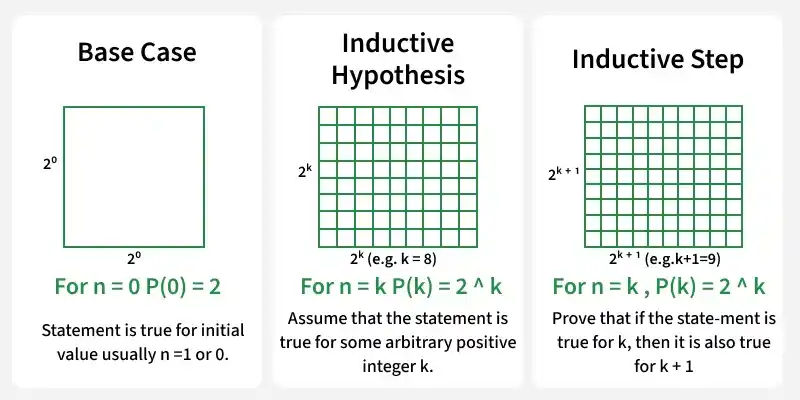
Any statement P(n), which is for "n" a natural number, can be proved using the Principle of Mathematical Induction by following the steps below:
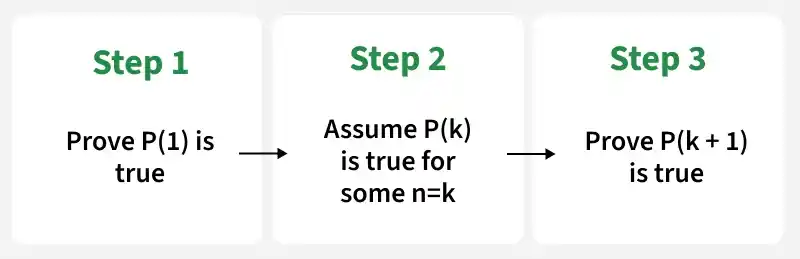
**Step 1: Verify if the statement is true for trivial cases (**n = 1) i.e. check if P(1) is true.
**Step 2: Assume that the statement is true for n = k for some k ≥ 1 i.e. P(k) is true.
**Step 3: If the truth of P(k) implies the truth of P(k + 1), then the statement P(n) is true for all n ≥ 1.
The image added below contains all the steps of Mathematical Induction
**Example: For any positive integer n, prove that n3 + 2n is always divisible by 3
**Solution:
Let P(n): n3 + 2n is divisible by 3 be the given statement.
**Step 1: Basic Step
Firstly we prove that P(1) is true. Let n = 1 in n3 + 2n
= 13 + 2(1)
= 3As 3 is divisible by 3. Hence, P(1) is true.
**Step 2: Assumption Step
Let us assume that P(k) is true for some positive integer k.
Then, k³ + 2k is divisible by 3.
Thus, we can write:
k³ + 2k = 3m, where m is any positive integer .....(i)
**Step 3: Inductive Step
We need to prove that P(k+1) is true, i.e., (k+1)³ + 2(k+1) is divisible by 3.
(k + 1)³ + 2(k + 1)
= k³ + 3k² + 3k + 1 + 2k + 2
= k³ + 3k² + 3k + 2k + 3
= (k³ + 2k) + (3k² + 3k + 3)
Using equation (i):
= 3m + 3(k² + k + 1)
= 3(m + k² + k + 1)
Since it is a multiple of 3, it is divisible by 3.
Thus, P(k+1) is true.
Hence, by the Principle of Mathematical Induction, P(n): n³ + 2n is divisible by 3 is true for all positive integers n.
PMI in Computer Science
The Principle of Mathematical Induction (PMI) is widely used in Computer Science because many concepts are based on repeated steps or recursion.
- **Correctness of Algorithms: PMI is used to prove that algorithms work correctly for all inputs and that recursive algorithms terminate properly.
- **Data Structures: It helps in proving properties of trees, linked lists, and graphs.For example, A binary tree with n nodes has n−1 edges.
- **Complexity Analysis: PMI is used to prove formulas for time and space complexity in recursive algorithms such as Merge Sort.
- **Combinatorics in CS: It helps in solving counting problems and proving combinatorial formulas used in algorithms.
- **Formal Languages and Automata: PMI is used to prove properties related to strings, grammars, and formal languages.
Solved Examples
**Example 1: For all n ≥ 1, prove that, 12 + 22 + 32+....+n2 = {n(n + 1) (2n + 1)} / 6
**Solution:
Let the given statement be P(n),
For n = 1, the left side :
1 2 = 1The right-hand side:
P(n):1^2+ 2^2 + 3^2+ \ldots+ n^2 = \frac{n(n + 1) (2n + 1)}{6} \\~\\ \text{For n=1} \\ P(1):\frac{1(1+1)(2×1+1)}{6} = 1Now, let's take a positive integer, k, and assume P(k) to be true i.e.,
1^2 + 2^2 + 3^2 +....+k^2 = \frac{k(k+1)(2k+1)}{6}
We shall now prove that P(k + 1) is also true, so now we have,
P(k + 1) = P(k) + (k + 1)2
= \frac{k(k+1)(2k+1)}{6} + (k+1)^2
= (k+1) \frac{( 2k^2 + k) + 6(k+1)}{6}
=\frac{(k+1)(2k^2 +7k+6)}{6}
=\frac{(k+1) (k+2) (2k+3)}{6}
=\frac{(k+1) ((k+1)+1) (2(k+1) +1)}{6}Thus P(k + 1) is true, whenever P(k) is true for all natural numbers. Hence, by the process of mathematical induction, the given result is true for all natural numbers.
**Example 2: For all n ≥ 1, prove that, 1.2.3 + 2.3.4 + 3.4.5+...+n(n + 1) (n + 2) = {n (n + 1) (n + 2) ( n + 3)} / 4
Solution:
Let the given statement be S(n),
S(n):1.2.3+ 2.3.4 + 3.4.5+\ldots+ n.(n+1)(n+2) = \frac{n(n + 1)(n + 2)(n+3)}{4}\\ \ \\ \text{For n=1,} \\ S(1):\frac{1(1+1)(1+2)(1+3)}{4} = 6\\ \text{which is true.}
Now, let's take a positive integer, k, and assume S(k) to be true i.e.
S(k):1.2.3+ 2.3.4 + 3.4.5+\ldots+ k.(k+1)(k+2) = \frac{k(k+ 1)(k + 2)(k+3)}{4}We shall now prove that S(k + 1) is also true, so now we have,
S(k+1):S(k) + (k+1)(k+2)(k+3)\\ \ \\ \Rightarrow S(k+1): \frac{k(k+ 1)(k + 2)(k+3)}{4} + (k+1)(k+2)(k+3)\\ \ \\ \Rightarrow S(k+1): \frac{k(k+ 1)(k + 2)(k+3)+ \ 4(k+1)(k+2)(k+3)}{4} \\ \ \\ \Rightarrow S(k+1): \frac{(k+1)(k+2)(k+3)(k+4)}{4}\\ \ \\ \Rightarrow S(k+1): \frac{ (k+1)\{(k+1)+1\}\{(k+1)+2\}\{(k+1)+3\} }{4} \\Thus S(k + 1) is true, whenever S(k) is true for all natural numbers. And we initially showed that S(1) is true thus S(n) is true for all natural numbers.
**Example 3: For all n ≥ 1, prove that, 1 + 3 + 5 +... + 2n - 1 = n2
**Solution:
Let the given statement be S(n),
and S(n) = 1 + 3 + 5 +... + 2n - 1 = n2
For n = 1,
L.H.S = 2 (1) × 1 - 1 = 1
R.H.S = 12 = 1Thus S(1) is true .
Now, let's take a positive integer, k, and assume S(k) to be true i.e.,
S(k) = 1+ 3 + 5+...+(2k - 1) = k2We shall now prove that S(k + 1) is also true, so now we have,
1 + 3 + 5+...+ (2(k + 1) - 1) = (k + 1)2L.H.S = 1 + 3 + 5 + .... (2k - 1 ) + 2k + 2 - 1
⇒ L.H.S = S(k) + 2k + 1
⇒ L.H.S = k2 + 2k + 1
⇒ L.H.S = (k + 1)2
⇒ L.H.S = R.H.SThus S(k + 1) is true, whenever S(k) is true for all natural numbers. And we initially showed that S(1) is true thus S(n) is true for all natural numbers.
**Example 4: For all n ≥ 1, prove that, 1.2 + 2.3 + 3.4 +...+ n(n + 1) = {n(n + 1)(n + 2)} / 3
Solution:
Let the given statement be S(n),
\ S(n):1.2+ 2.3 + 3.4+ ……+ n.(n+1) = \frac{n(n + 1)(n + 2)}{3}\\ \ \\ \text{for n=1,} \\ \ S(1) : \frac{1(1+1)(1+2)}{3} = 2\\ \text{which is true.}Now, let's take a positive integer, k, and assume S(k) to be true i.e.,
S(k):1.2+ 2.3 + 3.4+ ……+ k.(k+1) = \frac{k(k+ 1)(k + 2)}{3} \ \\We shall now prove that S(k + 1) is also true, so now we have,
S(k+1) : S(k) + (k+1)(k+2)\\ \ \\ \Rightarrow S(k+1) : \frac{k(k+ 1)(k + 2)}{3} + (k+1)(k+2)\\ \ \\ \Rightarrow S(k+1) :\frac{k(k+ 1)(k + 2)+ 3(k+1)(k+2)}{3} \\ \ \\ \Rightarrow S(k+1) :\frac{(k+1)(k+2)(k+3)}{3}\\ \ \\ \Rightarrow S(k+1) :\frac{ (k+1)\{(k+1)+1\}\{(k+1)+2\} }{3}Thus S(k + 1) is true, whenever S(k) is true for all natural numbers. And we initially showed that S(1) is true thus S(n) is true for all natural numbers.
**Example 5: Prove that an = a1 + (n - 1) d is the general term of any arithmetic sequence.
Solution:
For n = 1,
an = a1 + (1 - 1) d = a1
so the formula holds true for n = 1Let us assume that the formula ak = a1 + (k - 1) is true for all natural numbers.
We shall now prove that the formula is also true for k+1, so now we have,
ak + 1 = a1 + [(k + 1) - 1] d = a1 + k · d.We assumed that ak = a1 + (k - 1) d, and by the definition of an arithmetic sequence ak+ 1 - ak = d,
Then, ak + 1 - ak
= (a1 + k · d) - (a1 + (k - 1)d)
= a1 - a1 + kd - kd + d
= dThus the formula is true for k + 1, whenever it is true for k. And we initially showed that the formula is true for n = 1. Thus the formula is true for all natural numbers.
Practice Questions
**Question 1: Prove that for all natural numbers n, the following holds: 1 + 2 + 3 + . . . + n = [n(n + 1)]/2.
**Question 2: Show that for all integers n ≥ 1 : 13 + 23 + 33 + . . . + n3 = [{n(n + 1)}/2]2.
**Question 3: Verify that for all natural numbers n: 2n > n2.
**Question 4: Prove that for all integers n ≥ 1: 1×2 + 2×3 + 3×4 + ⋯ + n(n+1) = [n(n+1)(n+2)]/3.
**Question 5: Show that for all integers n ≥ 1: 7n − 4n is divisible by 3.