Profit Formula (original) (raw)
Last Updated : 23 Jul, 2025
Profit is the money you make after covering all your costs and expenses. In simple terms, if you sell something for more than it costs you to make or buy, the difference is your profit—it reflects performance, supports growth, and drives long-term success.
**For example, you run a lemonade stand. If you spend 50onlemonsandsugar(yourcosts)andsellallyourlemonadefor50 on lemons and sugar (your costs) and sell all your lemonade for 50onlemonsandsugar(yourcosts)andsellallyourlemonadefor100 (your revenue), your profit is 100−100 - 100−50 = $50.
That $50 is your reward for your effort and risk!
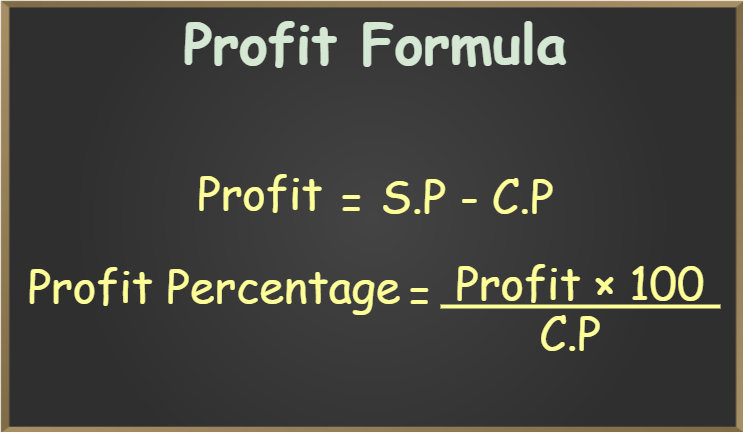
The profit formula is given as:
Profit Formula
Where:
- **Cost Price (CP) is the original purchase or production cost of the product.
- **Selling Price (SP) is the amount at which the product is sold.
**Example: If you are selling a product for 120,anditcostsyou120, and it costs you 120,anditcostsyou80 to purchase or produce it.
**Solution:
**Given that :
- (SP) = $120
- (CP) = $80
Profit = Selling Price − Cost Price
= 120 − 80 = 40
So, the **Profit is ****$40**.
How to Calculate Cost Price (CP) and Selling Price (SP)
To Calculate Cost Price (CP)
**Cost Price (CP) refers to the original amount paid for a product or the cost incurred to produce or acquire it. It’s essentially the amount you spend to obtain the product before you sell it.
**When Selling Price (SP) and Profit are Known:
**Cost Price = S.P − Profit
**Example: If you sold an item for Rs 150 and made a profit of Rs 50. The Cost Price (CP) would be:
**Explanation:
Cost Price = S.P − Profit
Cost Price = 150 - 50
Cost Price = 100
When Selling Price (SP) and Profit Percentage (Profit %) are Known:
**Cost Price = 100 × Selling Price/100 + Profit %
**Example: If you know that you made a 20% profit on an item, and the Selling Price is Rs200, you can calculate the Cost Price using the formula:
**Explanation:
Cost Price = 100 × Selling Price/100 + Profit %
Cost Price = 100 × 200/100 + 20
Cost Price = 20000/120
Cost Price = 166.67
To Calculate Selling Price (SP)
The **Selling Price (SP) is the price at which a product is sold to customers. It includes the **Cost Price (CP) and any additional profit you want to earn. The Selling Price is often set to ensure that you cover all costs and make a profit.
When Cost Price (CP) and Profit are Known:
**Selling Price = Cost Price + Profit
**Example: Ifyou bought a product for Rs80 (Cost Price) and want to make a profit of Rs20. The Selling Price (SP) would be:
**Explanation:
Selling Price = Cost Price + Profit
Selling Price = 80 + 20
Selling Price = 100
When Cost Price (CP) and Profit Percentage (Profit %) are Known:
**Selling Price = (100 + Profit %) × Cost Price /100
**Example: If you bought an item for $150 and want to make a 25% profit on it, the Selling Price would be calculated as:
**Explanation:
Selling Price = (100 + Profit %) × Cost Price /100
Selling Price = 125 × 150/100
Selling Price = 18750/100
Selling Price = 187.5
Formulas to Calculate Profit
The various formulas to calculate Profit are:
- The formula for Profit Percentage is dependent on Profit and C.P.
**Profit Percent Formula = (Profit × 100)/ C.P.
- Gross Profit Formula is the profit on the total sales of goods
**Gross Profit = Total Revenue – Total Cost of Goods Sold
- Net Profit is the profit that is incurred after excluding all expenses and other costs.
**Net Profit = Gross profit - Expenses
**Profit Percentage
Profit percentage (%) is the amount of profit represented as a percentage of the total. Because this profit is dependent on the cost price.
**Profit percentage = (Profit / Cost price ) × 100
Different Profit Formulas
Some important formulas related to profit are given below:
| Type of Profit | **Formulas |
|---|---|
| Profit | Revenue - Costs |
| Profit Percentage Formula | (Profit/Cost Price) × 100 |
| Gross Profit Formula | Total revenue - Costs of goods sold |
| Net Profit Formula | Total revenue - Total costs - Indirect costs |
| Operating Profit Formula | Gross profit - Operating expenses |
| Profit Margin Formula | (Profit / Total revenue) × 100% |
| Gross Profit Margin Formula | (Gross profit / Total revenue) × 100% |
| Net Profit Margin Formula | (Net profit / Total revenue) × 100% |
| Operating Profit Margin Formula | (Operating profit / Total revenue) × 100% |
| Average Profit Formula | Total profits / Number of years of profit |
Solved Questions on Profit Formula
**Question 1: A shopkeeper buys pens in bulk for Rs. 20 each. He sells each of them for Rs. 45. What will be the profit and the profit percentage?
**Solution:
Given: Selling price of the Pen (S.P) = Rs. 45
Cost price of the Pen (C.P) = Rs. 20
Now, As per the profit formula,
Profit = Selling Price – Cost Price
So, profit = 45 – 20
Profit = Rs. 25Now, Using the formula for profit percentage,
Profit % = (Profit / Cost Price ) × 100
So, the profit percentage = (25 / 20) × 100
= 1.25 × 100Profit percentage = 125%.
**Question 2: If a shopkeeper sells fruits at Rs 250 per kg, whose cost price is Rs 150/- per kg. What will be the profit gained by the shopkeeper?
**Solution:
Given, Cost Price = Rs.150/-
Selling Price = Rs.250/-
From the formula of profit, we know,
Profit = Selling Price – Cost Price
Profit = 250 – 150
Profit = 100Therefore, the shopkeeper earn profit Rs. 100/- .
**Question 3: Find the gain percentage if the profit is Rs 100 and the cost price is Rs 150.
**Solution:
As we know,
The profit percentage formula is
Profit percentage % = (Profit / Cost Price ) × 100
Since, Profit = Rs 100 and Cost Price = Rs 150
Therefore, Profit % = (100/150) × 100
Profit % = 10000/150
= 66.66Hence, the gain percentage is 66.66%.
**Question 4: Sanju sold a digital watch for Rs. 6,000, on which he gains 25%. What is the cost price of the digital watch?
**Solution:
For the digital watch Gain = 25%.
Let cost price of watch (C.P.) = Rs.100.
Therefore, selling price (S.P.) of digital watch = (100 + 25) = 125
When selling price (S.P.) is Rs.125, cost price (C.P.) is Rs.100.Therefore, when selling price (S.P.) is Rs.6000,
Cost price (C.P.) = {100 / (100 + gain )} × 6000
= 100/125 × 6000
= (100 × 6000)/125
= 600000/125
= 4800Therefore, cost price (C.P.) of the digital watch = Rs. 4800.
**Question 5: A cost price for the bag is Rs. 350, and the selling price is Rs. 400. Find the profit percentage he earned.
**Solution:
Cost price = Rs 350
Selling price = Rs 400
Profit = SP – CP
= 400 – 350
= 50.Gain% = (Profit / Cost price ) x 100
= (50/350) × 100
= 14.28 %
**Question 6: What will be the selling price if the profit is Rs 100 and the cost price is Rs 350?
**Solution:
Let selling price = x
Given cost price = Rs 350
And profit = Rs 100
Profit = Selling Price (S.P) – Cost Price (C.P)
100 = x - 350
or x = 100 + 350
x = 450So the selling price is Rs 450.
**Related Articles:
Practical Questions
**Question 1: If a company sells a product for 150andthetotalcostofproducingitis150 and the total cost of producing it is 150andthetotalcostofproducingitis90, what is the profit?
**Question 2: A store buys an item for 45andsellsitfor45 and sells it for 45andsellsitfor75. What is the profit margin?
**Question 3: Calculate the profit if the total revenue is 12,000andthetotalcostis12,000 and the total cost is 12,000andthetotalcostis8,500.
**Question 4: If a business has a total revenue of 50,000andexpensesof50,000 and expenses of 50,000andexpensesof32,000, what is the profit?
**Question 5: Determine the profit if a manufacturer’s revenue is 20,000andthecostofgoodssoldis20,000 and the cost of goods sold is 20,000andthecostofgoodssoldis14,000.
**Question 6: A company’s profit is 3,000,anditstotalrevenueis3,000, and its total revenue is 3,000,anditstotalrevenueis15,000. What is the profit percentage?
**Question 7: What is the profit if a product is sold for 250andtheproductioncostis250 and the production cost is 250andtheproductioncostis180?
**Question 8: A business earns 60,000inrevenueandincurs60,000 in revenue and incurs 60,000inrevenueandincurs45,000 in costs. What is the net profit?
**Question 9: Find the profit if the selling price of an item is 400andthecostpriceis400 and the cost price is 400andthecostpriceis320.
**Question 10: Calculate the profit percentage if the total revenue from sales is 22,000andthetotalcostis22,000 and the total cost is 22,000andthetotalcostis18,000.
Conclusion
The profit formula is a fundamental tool in business and finance used to determine the financial gain from the operations. By calculating the difference between the total revenue and total costs, businesses can assess their profitability and make informed decisions. The formula helps in evaluating the success of business strategies, pricing, and cost management. Understanding and applying the profit formula enables better financial planning and optimization, contributing to a business's long-term success.