Proper Fractions (original) (raw)
Last Updated : 23 Jul, 2025
A proper fraction is a type of fraction where the numerator is less than the denominator. This means the value of a proper fraction is always less than 1.
**Examples of Proper Fractions are:
• 1/2 (one-half)
• 3/4 (three-quarters)
• 2/5 (two-fifths)
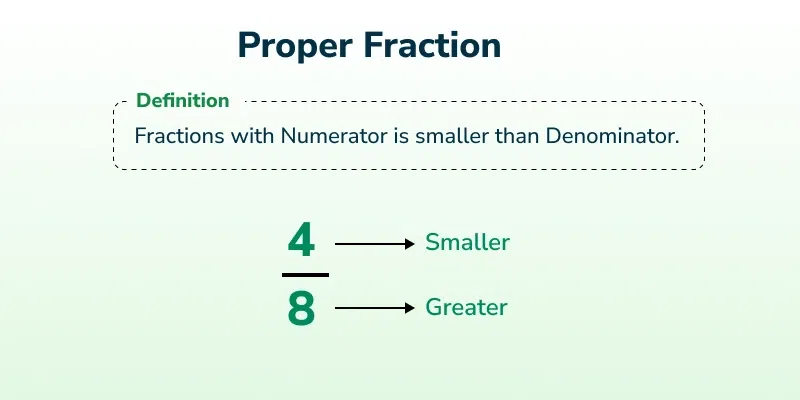
Proper Fractions
Fractions which have values either equal or greater than 1 will always be Improper Fraction.
**For Example:
- 4/3 (four-thirds, which is an improper fraction)
- 5/5 (five-fifths, which is equal to one)
Steps to Determine Proper Fractions
To identify whether any fraction is proper or not, first identify its **numerator and **denominator. Then, if
- If the numerator is smaller than the denominator (e.g., 3/5, 2/7), it is a proper fraction.
- If the numerator is equal to or greater than the denominator (e.g., 5/4, 7/4, 2/2), it is not a proper fraction.
Let's consider an example for better understanding.
- **Fraction 22/25:
- **Numerator: 22
- **Denominator: 25
- **Comparison: Since 22 (numerator) is smaller than 25 (denominator), it is a **proper fraction.
- **Fraction 13/11:
- **Numerator: 13
- **Denominator: 11
- **Comparison: Since 13 (numerator) is greater than 11 (denominator), it is **not a proper fraction.
Operations on Proper Fractions
Proper fraction can be added, subtracted, multiplied or divided with each other similar to any other fractions. For any two fractions a/b and c/d, formulas of each operations are:
| Operation | Formula | Example |
|---|---|---|
| **Addition | \frac{a}{b} + \frac{c}{d} = \frac{ad + bc}{bd} | \frac{1}{3} + \frac{1}{6} = \frac{2 + 1}{6} = \frac{3}{6} = \frac{1}{2} |
| **Subtraction | \frac{a}{b} - \frac{c}{d} = \frac{ad - bc}{bd} | \frac{3}{4} - \frac{1}{4} = \frac{3 - 1}{4} = \frac{2}{4} = \frac{1}{2} |
| **Multiplication | \frac{a}{b} \times \frac{c}{d} = \frac{ac}{bd} | \frac{2}{3} \times \frac{3}{4} = \frac{6}{12} = \frac{1}{2} |
| **Division | \frac{a}{b} \div \frac{c}{d} = \frac{a}{b} \times \frac{d}{c} = \frac{ad}{bc} | \frac{2}{5} \div \frac{1}{2} = \frac{2}{5} \times \frac{2}{1} = \frac{4}{5} |
Difference Between Proper and Improper Fraction
Some of the key **difference between proper and improper fractions are:
| Feature | Proper Fraction | Improper Fraction |
|---|---|---|
| **Definition | Numerator is less than the denominator. | Numerator is greater than or equal to the denominator. |
| **Value | Always less than 1. | Equal to or greater than 1. |
| **Representation | Can be a part of a whole. | Can represent a whole number or more. |
Proper Fractions on Number line
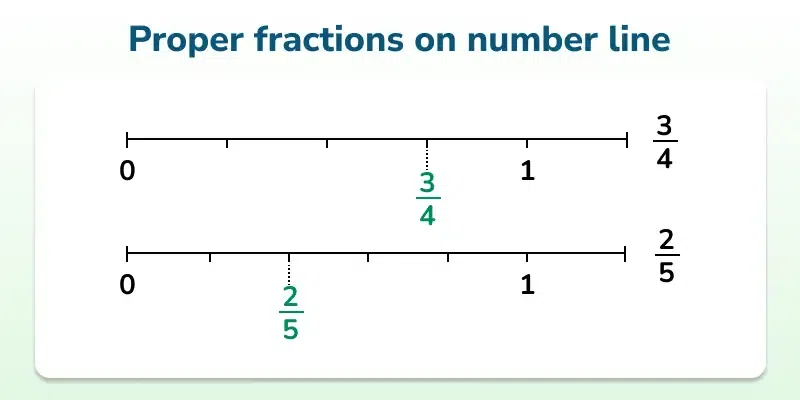
Since the value of a proper fraction is less than 1, it is always placed between 0 and 1 on a number line. The whole part between 0 and 1 is divided into equal parts based on the denominator, and the numerator shows the fraction’s position. For example, to represent 3/4, divide the space between 0 and 1 into 4 parts, and the third part marks 3/4, in 2/5 the space between 0 and 1 is divided into 5 parts and the second part represents 2/5.
**Read More: