Properties of Probability (original) (raw)
Last Updated : 2 Jun, 2026
Probability is a branch of mathematics that studies the likelihood of events occurring. It helps in measuring uncertainty and predicting possible outcomes using available information.
**Some important properties of probability are given below:
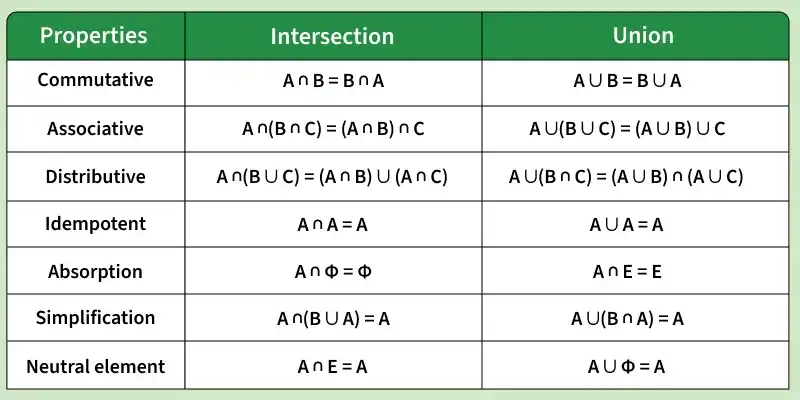
- **Non-Negativity: The probability of any event is always non-negative. For any event A,
P(A) ≥ 0.
- **Normalization: The probability of the sure event (sample space) is 1. If S is the sample space, then
P(S) = 1.
- **Additivity (Sum Rule): For any two mutually exclusive (disjoint) events A and B, the probability of their union is the sum of their individual probabilities:
P(A∪B) = P(A) + P(B)
- **Complementary Rule: The probability of the complement of an event A (i.e., the event not occurring) is
P(A∣B)= P(A∩B) / P(B)
provided P(B)>0.
- **Multiplication Rule: For any two events A and B, the probability of both occurring (i.e., the intersection) is:
P(A∩B) = P(A∣B) ⋅ P(B)
Sample Problems
**Example 1: A fair die is rolled. What is the probability of rolling a number greater than 6?
Solution: Since there are no numbers greater than 6 on a standard die, P(rolling > 6) = 0
**Example 2: A coin is tossed. Verify that the sum of probabilities of all outcomes is 1.
Solution: P(Heads) = 1/2, P(Tails) = 1/2
1/2 + 1/2 = 1, so the property holds.
**Example 3 : In a deck of 52 cards, what is the probability of drawing either a king or a queen?
Solution: P(King) = 4/52 = 1/13, P(Queen) = 4/52 = 1/13
P(King or Queen) = 1/13 + 1/13 = 2/13
**Example 4: The probability of rain tomorrow is 0.3. What is the probability it won't rain?
Solution: P(no rain) = 1 - P(rain) = 1 - 0.3 = 0.7
**Example 5: In a standard deck, compare P(drawing a king) and P(drawing a face card).
Solution: P(King) = 4/52 = 1/13
P(Face card) = 12/52 = 3/13
Since all kings are face cards, P(King) ≤ P(Face card)
**Example 6: In a class, 60% of students play soccer, 30% play basketball, and 20% play both. What percentage plays either soccer or basketball?
Solution: P(Soccer or Basketball) = P(Soccer) + P(Basketball) - P(Soccer and Basketball)
= 0.60 + 0.30 - 0.20 = 0.70 or 70%
**Example 7: A fair coin is tossed twice. What's the probability of getting heads both times?
Solution: P(H on first toss) = 1/2, P(H on second toss) = 1/2
P(H and H) = 1/2 × 1/2 = 1/4
**Example 8: In a deck of 52 cards, what's the probability of drawing a king, given that it's a face card?
Solution: P(King | Face card) = P(King and Face card) / P(Face card)
= (4/52) / (12/52) = 1/3
**Example 9: 30% of students are in Science. 80% of Science students and 60% of non-Science students wear glasses. What percentage of all students wear glasses?
Solution: P(Glasses) = P(Glasses|Science) × P(Science) + P(Glasses|not Science) × P(not Science)
= 0.80 × 0.30 + 0.60 × 0.70 = 0.24 + 0.42 = 0.66 or 66%
**Example 10: 1% of people have a certain disease. The test for this disease is 95% accurate (both for positive and negative results). If a person tests positive, what's the probability they have the disease?
Solution: Let D = disease, T = positive test
P(D|T) = [P(T|D) × P(D)] / [P(T|D) × P(D) + P(T|not D) × P(not D)]
= (0.95 × 0.01) / (0.95 × 0.01 + 0.05 × 0.99)
≈ 0.1611 or about 16.11%
Practice Problems
**1) A bag contains 5 red marbles, 3 blue marbles, and 2 green marbles. If a marble is drawn at random, what is the probability of drawing either a red or a green marble?
**2) In a class of 30 students, 18 play football, 15 play basketball, and 10 play both. What is the probability that a randomly selected student plays neither sport?
**3) The probability of a student passing a math test is 0.7, and the probability of passing a science test is 0.8. If the events are independent, what is the probability of passing both tests?
**4) A fair six-sided die is rolled. What is the probability of rolling an even number or a number greater than 4?
**5) In a deck of 52 cards, what is the probability of drawing a heart, given that the card drawn is red?