Rate of Change Formula (original) (raw)
Last Updated : 23 Mar, 2026
The rate of change describes how one quantity varies in relation to another. In simple terms, it is the ratio of the change in one variable to the corresponding change in another.
The rate of change has specific formulas for coordinates and linear functions, allowing us to quantify variation systematically.
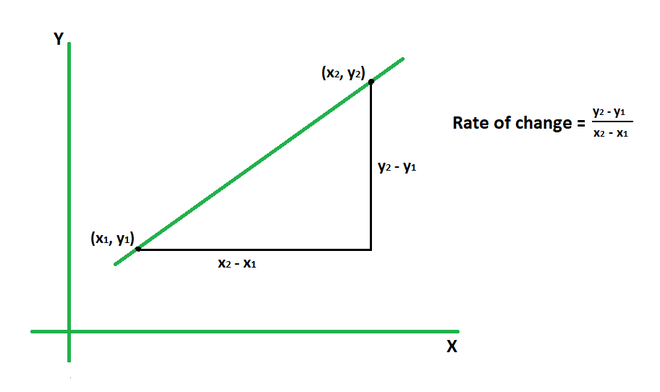
The rate of change of coordinates (x1, y1) with respect to the other coordinates (x2, y2) is given by the ratio of the difference between the y-coordinates to that of the x-coordinates. In other words, the rate of change is equal to the slope of the line joining these points. It can also be denoted by the symbol m.
\text{Rate of Change} = \frac{\text{Change in Output(y)}}{\text{Change in Input(x)}}
or
R = \frac{\Delta y}{\Delta x} = \frac{y_2 - y_1}{x_2 - x_1}
Where,
R is the rate of change of variable y with respect to variable x,
(x1, y1) and (x2, y2) are the coordinates.
For a linear function y = f(x), the rate of change is calculated for the interval (a, b) where b > a. Its formula is given by the ratio of the difference between the function values for each interval to the difference between interval values.
R = \frac{f(b) - f(a)}{b - a}
Here, R is the rate of change of variable y with respect to variable x for the interval (a, b).
Solved Examples
**Problem 1: Calculate the rate of change for the coordinates (4, 11) and (2, 5).
**Solution:
We have,
(x1, y1) = (4, 11)
(x2, y2) = (2, 5)Using the formula, we have
R = (y2 - y1)/(x2 - x1)
= (5 - 11)/(2 - 4)
= -6/(-2)
= 3
**Problem 2: The rate of change for two points (x, 3) and (1, 6) is 7. Find the value of x.
**Solution:
(x1, y1) = (x, 3)
(x2, y2) = (1, 6)
R = 7Using the formula, we have
R = (y2 - y1)/(x2 - x1)
=> 7 = (6 - 3)/(1 - x)
=> 7 = 3/(1 - x)
=> 7 - 7x = 3
=> 7x = 4
=> x = 4/7
**Problem 3: The rate of change for two points (5, 4) and (3, y) is 4. Find the value of y.
**Solution:
(x1, y1) = (5, 4)
(x2, y2) = (3, y)
R = 4Using the formula, we have
R = (y2 - y1)/(x2 - x1)
=> 4 = (y - 4)/(3 - 5)
=> 4 = (y - 4)/(-2)
=> -8 = y - 4
=> y = -4
**Problem 4: Calculate the rate of change for the function f(x) = x2 if the interval is (3, 5).
**Solution:
We have, f(x) = x2
Calculate the value of f(3) and f(5).
f(3) = 32 = 9
f(5) = 52 = 25Using the formula, we have
R = (f(b) - f(a))/(b - a)
= (f(5) - f(3))/ (5 - 3)
= (25 - 9)/2
= 16/2
= 8
**Problem 5: Calculate the rate of change for the function f(x) = 4 - 3x3 if the interval is (1, 2).
**Solution:
We have, f(x) = 4 - 3x3
Calculate the value of f(1) and f(2).
f(1) = 4 - 3(1)3 = 4 - 3 = 1
f(2) = 4 - 3(2)3 = 4 - 24 = -20Using the formula,
R = (f(b) - f(a))/(b - a)
= (f(2) - f(1))/ (2 - 1)
= -20 - 1
= -21
**Problem 6: The rate of change for two points (x, 7) and (9, 2) is 5. Find the value of x.
**Solution:
(x1, y1) = (x, 7)
(x2, y2) = (9, 2)
R = 5Using the formula,
R = (y2 - y1)/(x2 - x1)
=> 5 = (2 - 7)/(9 - x)
=> 5 = -5/(9 - x)
=> 45 - 5x = -5
=> 5x = 50
=> x = 10
**Problem 7: The rate of change for two points (1, 5) and (8, y) is 9. Find the value of y.
**Solution:
(x1, y1) = (1, 5)
(x2, y2) = (8, y)
R = 9Using the formula,
R = (y2 - y1)/(x2 - x1)
=> 9 = (y - 5)/(8 - 1)
=> 9 = (y - 5)/7
=> y - 5 = 63
=> y = 68
**Problem 8: A car travels 240 miles in 4 hours. What is its rate of change in position (speed)?
**Solution:
Rate of change = Change in distance / Change in time
= 240 miles / 4 hours
= 60 miles per hour
**Problem 9: The temperature drops from 25°C to 13°C over 6 hours. What is the rate of temperature change?
**Solution:
Rate of change = Change in temperature / Change in time
= (13°C - 25°C) / 6 hours
= -2°C per hour
**Problem 10: An investment grows from 1000to1000 to 1000to1331 in 3 years. Assuming compound interest, what is the annual rate?
**Solution:
Using the compound interest formula: A = P(1 + r)t
1331 = 1000(1 + r)3
(1331/1000)(1/3) = 1 + rr = (1331/1000)(1/3) - 1 ≈ 0.10 or 10% per year
Practice Problems
**Question 1: The volume of a cube is increasing at a rate of 24 cm³/s. How fast is its surface area increasing when the side length is 10 cm?
**Question 2: A bacteria culture doubles every 3 hours. What is its growth rate in percentage per hour?
**Question 3: A car accelerates from 0 to 100 km/h in 8 seconds. What is its acceleration in m/s ²?
**Question 4: The price of a stock decreases from 80to80 to 80to60 over 6 months. What is the monthly rate of depreciation?
**Question 5: Given y = ln(x), find the rate of change when x = e.
**Question 6: A spherical balloon is inflated so that its volume increases at a constant rate of 100 cm³/s. How fast is its radius increasing when the radius is 5 cm?
**Question 7: The distance s in meters of a particle from a fixed point at time t seconds is given by s = 2t³ - 3t² + 4. Find its acceleration at t = 1 second.
**Question 8: A rectangle's length is increasing at 3 cm/s while its width is decreasing at 2 cm/s. At what rate is its area changing when the length is 10 cm and the width is 6 cm?
**Question 9: The cost C (in dollars) of producing x items is given by C(x) = 200 + 5x - 0.01x². Find the rate of change of cost when 100 items are produced.
**Question 10: A cone's radius is increasing at 2 cm/s, and its height is increasing at 3 cm/s. At what rate is its volume changing when the radius is 4 cm and the height is 9 cm?