Remainder Theorem (original) (raw)
Last Updated : 22 Apr, 2026
The Remainder Theorem is an algebraic concept that allows us to quickly determine the remainder when a polynomial is divided by a linear expression of the form (x − a), without performing a long division.
**Statement:
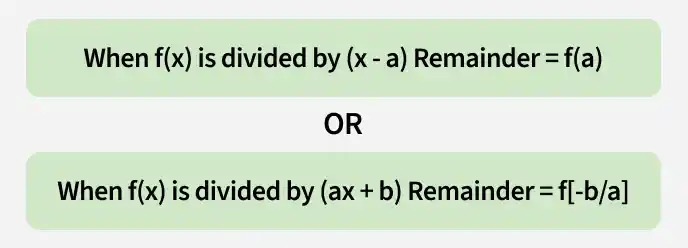
Instead of actually dividing the polynomial, we can just substitute x = ai nto the polynomial to get the remainder.
**Example: Divide 2x3 + 3x2 + 4x + 5 by x + 2
Given,
- Dividend = p(x) = 2x3 + 3x2 + 4x + 5
- Divisor = s(x) = (x + 2)
**Using long division:
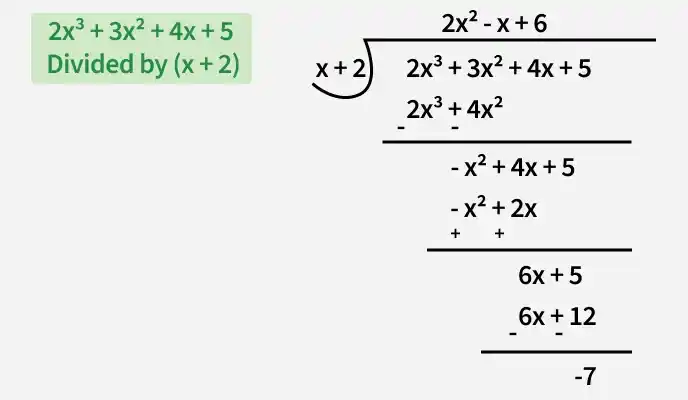
- Quotient = q(x) =2x2 - x + 6
- Remainder = r(x) = -7
Now, let’s simplify factorization using the Remainder Theorem.
First, find the zero of the divisor:
- x + 2 = 0
- x = -2
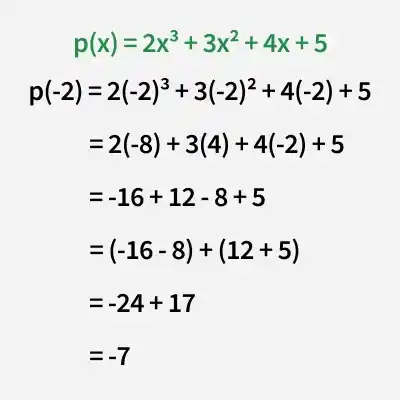
According to Remainder Theorem, substituting x = -2 in p(x),
Now, Remainder for p(-2) = -7
Thus, Remainder Theorem is verified.
Alternate Method
We know that any polynomial p(x) can be written as :
p(x) = (x−a)*q(x)+r, where q(x) is the quotient and r is the remainder.
If we substitute x = a in the above equation, we get
p(a) = r
Thus, the remainder is equal to the value of the polynomial at x=a
Similarly, for the divisor (x+2),
p(x) = (x+2)*q(x)+r
Putting x = −2 , we get
p(−2) = r
Hence, the remainder is p(−2)
Hence, proved.
**Applications
- **Simplifying polynomial division: The theorem eliminates the need for long division in certain cases.
- **Factoring polynomials: Using the theorem with the Factor Theorem allows for easier factoring.
- **Solving polynomial equations: It helps in checking whether a given number is a root of the polynomial.
- **Signal processing: In engineering, polynomials are used to model signals, and the Remainder Theorem aids in simplifying these models.
**Related Articles
Solved Examples
**Example 1: Find the remainder when p(x) = x4 - x3 + x2 - 2x + 1 is divided by g(x) = x - 2.
Given,
p(x) = x4 - x3 + x2 - 2x + 1
g(x) = x-2
Using Remainder theorem,
p(2) = (2)4 - (2)3 + (2)2 - 2(2) + 1 = 9
Thus, the remainder when p(x) is divided by g(x) then we get remainder as, 9
**Example 2: Find the root of the polynomial x2 - 5x + 4
We know that if for any p(x) we get p(a) = 0, then x-a is the factor of p(x) or a is the root of equation.
Given,
f(x) = x2 - 5x + 4
By hit and try method.
f(4) = 42 - 5(4) + 4
f(4) = 20 - 20 = 0
Since f(4) = 0, x = 4 is a root of the equation, and (x − 4) is a factor of x2 − 5x + 4.
**Example 3: Find the remainder when t3 - 2t + 4t + 5 is divided by t - 1.
Given,
p(t) = t3 - 2t2 + 4t + 5
g(t) = t - 1
Using Remainder theorem,
g(1) = (1)3 - 2(1)2 + 4 + 5 = 8
By the Remainder Theorem, 8 is the remainder when t3 - 2t2 + 4t + 5 is divided by t - 1
**Example 4: Find the remainder when x² - x + 2 is divided by x - 2.
Given,
p(x) = x² − x + 2Divisor: x − 2
So, x = 2Using Remainder Theorem,
Remainder = p(2)p(2) = (2)² − (2) + 2
= 4 − 2 + 2
= 4
**Example 5: Find the root of the polynomial 3x2 - 7x + 2
We know that if for any p(x) we get p(a) = 0, then x-a is the factor of p(x) or a is the root of equation.
Given,
f(x) = 3x2 - 7x + 2
By hit and try method.
f(2) = 3(2)2 - 7(2) + 2
f(2) = 12 -14 + 2= 0
Since f(2) = 0, x = 2 is a root of the equation, and (x − 2) is a factor 3x2 - 7x + 2.