Right Angled Triangle (original) (raw)
Last Updated : 26 Feb, 2026
A right-angle triangle is a type of triangle that has one angle measuring exactly 90 degrees (90°). It is also known as the right triangle.
In a right triangle, the two shorter sides are called the perpendicular and the base and meet at the right angle (90°), while the longest side, opposite the right angle, is called the hypotenuse.
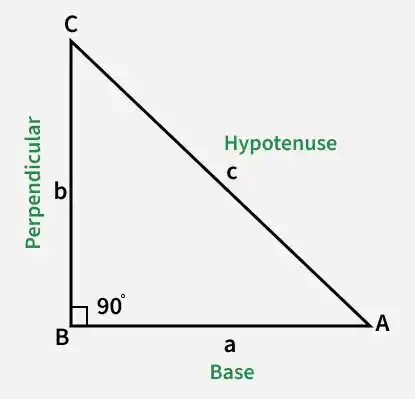
The sum of all the interior angles of the triangle is 180°, which is called the Angle Sum Property of a Triangle. So if any one angle is 90°, the sum of the other two angles is also 90°. They are used in many areas, from construction to navigation, and play a key role in trigonometry.
Properties of Right-Angled Triangle
- One of the angles in a right-angled triangle is exactly 90 degrees.
- The side opposite the right angle is the longest side of the triangle and is called the hypotenuse.
- For triangles with the same angles, the sides are in a consistent ratio. For example, in a 45-45-90 right triangle, the sides are in the ratio 1:1:√2, and in a 30-60-90 triangle, the sides are in the ratio 1:√3:2.
- An altitude drawn to the hypotenuse of a right triangle creates two smaller right-angled triangles, each of which is similar to the original right-angled triangle.
- Every right-angled triangle has a circumcircle (circle passing through all three vertices) with the hypotenuse as its diameter. It also has an incircle (circle tangent to all three sides), with the center at the intersection of the angle bisectors.
Basic Formulas
**Right Triangle Formula: According to the Pythagorean theorem, in a right-angled triangle, the square of the hypotenuse is equal to the sum of the squares of the other two sides.
(Hypotenuse)2 = (Perpendicular)2 + (Base)2
**Perimeter of Right-Angled Triangle: The perimeter of the right triangle is equal to the sum of the sides.
AB + BC + AC = (a + b + c) units.
**Area of Right-Angled Triangle: The area of a right triangle is the space occupied by the boundaries of the triangle.
Area of a Right Triangle = (1/2 × base × height) square units.
Derivation of Right-Angled Triangle Area Formula
For any right-angle triangle, PQR right-angled at Q with hypotenuse PR.
Now if we flip the triangle over its hypotenuse, a rectangle is formed, which is named PQRS.
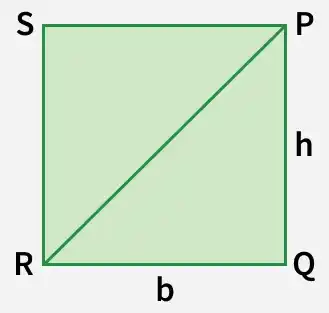
As we know, the area of a rectangle is given as the product of its length and width, i.e., area = length × breadth
Thus, the area of Rectangle PORS = b x h
Now, the area of the right-angle triangle is twice the area of the rectangle, then.
Thus,
Area of ∆PQR = 1/2 × Area of Rectangle PQRS
A = 1/2 × b × h
Hypotenuse of a Right-Angled Triangle
For a right triangle, the hypotenuse is calculated using the Pythagorean theorem. Theorem,
H = \sqrt{(P^2 + B^2)}
where,
- H is the hypotenuse of a right triangle.
- P is the perpendicular of the right triangle.
**Also Check
Solved Examples Questions
**Example 1: Find the area of a triangle if the height and hypotenuse of a right-angled triangle are 10 cm and 11 cm, respectively.
Given:
- Height = 10 cm
- Hypotenuse = 11 cm
Using Pythagoras' theorem,
(Hypotenuse)2 = (Base)2 + (Perpendicular)2
(11)2 = (Base)2 + (10)2
(Base)2 = (11)2 - (10)2 = 121 - 100
Base = √21 = 4.6 cm
Area of the Triangle = (1/2) × b × h
Area = (1/2) × 4.6 × 10
Area = 23 cm2
**Example 2: Find out the area of a right-angled triangle whose perimeter is 30 units, height is 8 units, and hypotenuse is 12 units.
- Perimeter = 30 units
- Hypotenuse = 12 units
- Height = 8 units
Perimeter = base + hypotenuse + height
30 units = 12 + 8 + base
Base = 30 - 20 = 10 units
Area of Triangle = 1/2×b×h = 1/2 ×10 × 8 = 40 sq units
**Example 3: If two sides of a triangle are given, find out the third side, i.e., if the base = 3 cm and the perpendicular = 4 cm, find out the hypotenuse.
Given:
- Base (b) = 3 cm
- Perpendicular (p) = 4 cm
- Hypotenuse (h) = ?
Using Pythagoras theorem,
(Hypotenuse)2 = (Perpendicular)2 + (Base)2
= 42 + 32 = 16 + 9 = 25 cm2
Hypotenuse = √(25)
Hypotenuse = 5 cm