Row Matrix (original) (raw)
Last Updated : 13 Aug, 2025
A row matrix, also known as a row vector, is a matrix with a single row and can have any number of columns.
- A matrix "A = [aij]" is said to be a row matrix if the order of the matrix is "1 × n" (where n is the number of columns).
- It's a way to represent data in a horizontal format, where each element of the row represents a different variable or value.
- The order of the row matrix is always 1 × n.
Below is the visual representation of the row matrix:
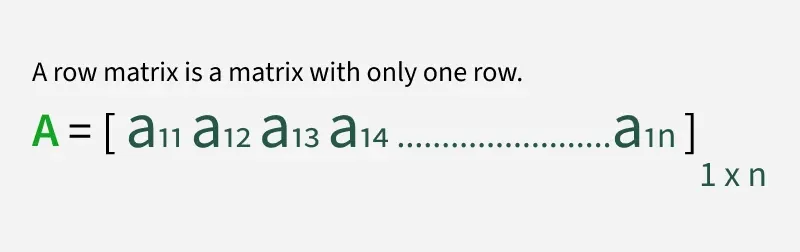
Visual Representation of Row Matrix
If the matrix is in the form of 1 x n, where 'n' represents the number of columns, it qualifies as a row matrix. In a row matrix, all the entries are arranged in a single row
Row Matrix Examples
- The matrix given below is a row matrix of order "1 × 3."
A_{1\times3} = \left[\begin{array}{cccc} p & q & r\end{array}\right]
- The matrix given below is a row matrix of order "1 × 4."
B_{1\times4} = \left[\begin{array}{cccc} a & b & c & d\end{array}\right]
- The matrix given below is a row matrix of order "1 × 5."
C_{1\times5} = \left[\begin{array}{ccccc} 0 & 5 & 8 & -7 & 11\end{array}\right]
Properties of a Row Matrix
The following are some important properties of a row matrix:
- Any row matrix will have only one row.
- A row matrix can have numerous columns.
- The number of entries in a row matrix is equal to the number of columns.
- A row matrix is also a rectangular matrix and a horizontal matrix.
- The transpose of a row matrix is a column matrix and vice versa.
- Any two-row matrices can be added or subtracted if the order of both matrices is the same.
- The multiplication of a row matrix is possible only with a column matrix if and only if the number of rows in the column matrix is equal to the number of columns in the given row matrix.
- A singleton matrix is obtained when a row matrix and a column matrix are multiplied.
Operations on a Row Matrix
We can operate on a row matrix using operations such as:
Addition of Row Matrices
Any two-row matrices can be added if the order of both matrices is the same. If the orders of both matrices are the same, then the corresponding entries are added.
For example, let M = \left[\begin{array}{ccc} -2 & 7 & 11\end{array}\right]_{1\times3} and N = \left[\begin{array}{ccc} 5 & 0 & -6\end{array}\right]_{1\times3}
M + N = \left[\begin{array}{ccc} -2 & 7 & 11\end{array}\right]_{1\times3} + \left[\begin{array}{ccc} 5 & 0 & -6\end{array}\right]_{1\times3}
M + N = \left[\begin{array}{ccc} (-2+5) & (7+0) & (11+(-6))\end{array}\right]_{1\times3}
M + N = \left[\begin{array}{ccc} 3 & 7 & 5\end{array}\right]_{1\times3}
Subtraction of Row Matrices
Any two-row matrices can be subtracted if the order of both matrices is the same. If the orders of both matrices are the same, then the corresponding entries are subtracted.
For example, let A = \left[\begin{array}{ccc} 22 & -13 & 19\end{array}\right]_{1\times3} and B = \left[\begin{array}{ccc} 12 & -8 & 7\end{array}\right]_{1\times3}
A - B = \left[\begin{array}{ccc} 22 & -13 & 19\end{array}\right]_{1\times3} + \left[\begin{array}{ccc} 12 & -8 & 7\end{array}\right]_{1\times3}
A - B = \left[\begin{array}{ccc} 10 & -5 & 12\end{array}\right]_{1\times3}
Multiplication
The multiplication of a row matrix is possible only with a column matrix if and only if the number of rows in the column matrix is equal to the number of columns in the given row matrix.
For example, let P = \left[\begin{array}{ccc} 1 & 2 & 3\end{array}\right]_{1\times3} and Q = \left[\begin{array}{c} 4\\ 0\\ 5 \end{array}\right]_{3\times1}
P × Q = \left[\begin{array}{ccc} 1 & 2 & 3\end{array}\right]_{1\times3}\times\left[\begin{array}{c} 4\\ 0\\ 5 \end{array}\right]_{3\times1}
P × Q = [19]1×1
**Related Articles
Solved Examples on Row Matrices
**Example 1: Find the transpose of the matrix given below.
**Solution:
The matrix given matrix is a row matrix of order "1 × 4." We know that the transpose of a matrix is obtained by interchanging the entries of rows and columns. So, the order of the transpose of the given matrix will be "4 × 1."
A = \left[\begin{array}{cccc} a & b & c & d\end{array}\right]_{1\times4} ⇒ A^{T} = \left[\begin{array}{c} a\\ b\\ c\\ d \end{array}\right]_{4\times1}
**Example 2: Find the value of A + 2B, if A = \left[\begin{array}{cccc} 3 & 7 & 0 & -2\end{array}\right]_{1\times4} and B = \left[\begin{array}{cccc} 1 & -3 & 5 & 1\end{array}\right]_{1\times4}
**Solution:
A + 2B = \left[\begin{array}{cccc} 3 & 7 & 0 & -2\end{array}\right]_{1\times4}+ 2 \times\left[\begin{array}{cccc} 1 & -3 & 5 & 1\end{array}\right]_{1\times4}
A + 2B = \left[\begin{array}{cccc} 3 & 7 & 0 & -2\end{array}\right]_{1\times4}+ \left[\begin{array}{cccc} 2 & -6 & 10 & 2\end{array}\right]_{1\times4}
A + 2B = \left[\begin{array}{cccc} (3+2) & (7-6) & (0+10) & (-2+2)\end{array}\right]_{1\times4}
A + 2B = \left[\begin{array}{cccc} 5 & 1 & 10 & 0\end{array}\right]_{1\times4}
**Example 3: Find the product of the matrices given below.
M = \left[\begin{array}{ccc} 11 & -5 & 8\end{array}\right]_{1\times3}and N = \left[\begin{array}{c} 2\\ 3\\ 4 \end{array}\right]_{3\times1}
**Solution:
M × N = \left[\begin{array}{ccc} 11 & -5 & 8\end{array}\right]_{1\times3}\times\left[\begin{array}{c} 2\\ 3\\ 4 \end{array}\right]_{3\times1}
M × N = \left[\begin{array}{c} (11\times2)+(-5\times3)+(8\times4)\end{array}\right]_{1\times1}
M × N = \left[\begin{array}{c} 39\end{array}\right]_{1\times1}
**Example 4: Find the value of P − Q, if P = \left[\begin{array}{cc} 25 & 14\end{array}\right]_{1\times2}and Q = \left[\begin{array}{cc} 13 & 10\end{array}\right]_{1\times2}
**Solution:
P - Q = \left[\begin{array}{cc} 25 & 14\end{array}\right]_{1\times2}- \left[\begin{array}{cc} 13 & 10\end{array}\right]_{1\times2}
P - Q = \left[\begin{array}{cc} (25-13) & (14-10)\end{array}\right]_{1\times2}
P - Q = \left[\begin{array}{cc} 12 & 4\end{array}\right]_{1\times2}