Sin Cos Tan Values (original) (raw)
Last Updated : 23 Jul, 2025
**Sine (sin), Cosine (cos), and Tangent (tan) are fundamental trigonometric functions that describe relationships between the angles and sides of a right-angled triangle. These are the basic ratios of Trigonometry that are used to study the relationship between the angles and respective sides of a triangle. These ratios are initially defined on a Right Angled Triangle using Pythagoras Theorem. **Sin, cos, and tan have extensive applications in fields like physics, engineering, and computer graphics. In this article, we will explore the values of these trigonometric functions, their significance, and how they are used in real-world scenarios.
Table of Content
- Sine (sin), cosine (cos), and tangent (tan) in Trigonometry
- Sin Cos Tan Formulas
- Trigonometric Functions
- Sin Cos Tan Values
- Sin, Cos, Tan Chart
- Solved Examples on Sine Cosine Tangent Formula
**Sine (sin), **cosine (cos), and **tangent (tan) in Trigonometry
Let's understand Sin, Cos, and Tan in trigonometry using formulas and examples.
A triangle that has one angle of 90° is called a right-angled triangle. It has sides called the base, perpendicular (height), and hypotenuse. The right-angled triangle follows the Pythagoras theorem.
| Term | Definition |
|---|---|
| Base | The side which contains the angle is called the base of the triangle. |
| Perpendicular | The side which forms 90° with the base is called perpendicular or the height of the triangle. |
| Hypotenuse | The longest side of the triangle is called the hypotenuse of the triangle. |
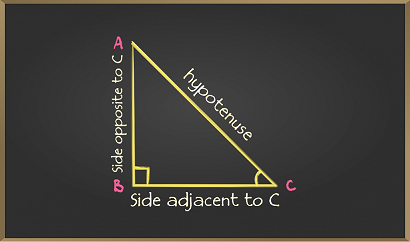
Sin, Cos, and Tan are the ratios of the sides of any right-angled triangle. In the right-angled triangle ABC given above for angle C the Sin, Cos, and Tan are,
- Sin C = Perpendicular / Hypotenuse = AB / CA
- Cos C = Base / Hypotenuse = BC / CA
- Tan C = Perpendicular / Base = AB / BC
Sin Cos Tan Formulas
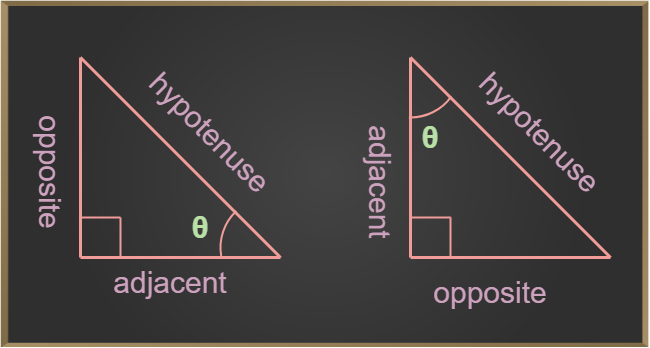
Sin, Cos, and Tan functions are defined as the ratios of the sides (opposite, adjacent, and hypotenuse) of a right-angled triangle. The formulas of any angle θ sin, cos, and tan are:
- sin θ = Opposite/Hypotenuse
- cos θ = Adjacent/Hypotenuse
- tan θ = Opposite/Adjacent
There are three more trigonometric functions that are reciprocal of sin, cos, and tan which are cosec, sec, and cot respectively, thus
- cosec θ = 1 / sin θ = Hypotenuse / Opposite
- sec θ = 1 / cos θ = Hypotenuse / Adjacent
- cot θ = 1 / tan θ = Adjacent / Opposite
Trigonometric Functions
The Trigonometric functions are also called trigonometric ratios. There are three basic and important trigonometric functions: Sine, Cosine, and Tangent.
- The sine trigonometric function is written as sin, cosine as **cos, and tangent as **tan in trigonometry.
- There are three more trigonometric functions: **cosec, **sec, and **cot, which are the **reciprocals of the **sin, cos, and **tan.
- These functions can be evaluated for the right-angled triangle.
Let a right-angled triangle with base b, perpendicular p, and hypotenuse h form θ angle with the base. Then, the trigonometric functions are given by:
| Trigonometric Functions | Formula of Trigonometric Functions |
|---|---|
| sin θ | sinθ = perpendicular/hypotenuse sinθ = p / h or θ = sin-1( p / h) |
| cos θ | cosθ = base/hypotenuse cosθ = b / h or θ = cos-1( b / h) |
| tan θ = sin θ/cos θ | tanθ = perpendicular/base tanθ = p / b or θ = tan-1( p / b) |
| cosecθ = 1/sin θ | cosecθ = hypotenuse/perpendicular cosecθ = h / p or θ = cosec-1(h / p) |
| secθ = 1/cos θ | secθ = hypotenuse/ base secθ = h / b or θ = sec-1(h / b) |
| cotθ = 1/tan θ | cotθ = base/perpendicularcotθ = b / p or θ = cot-1( b / p) |
**Trick to Remember Sin, Cos, Tan Ratio
| Statement to remember | Some people have curly black hair to produce beauty |
|---|---|
| Some people have | sinθ (some) = perpendicular(people)/hypotenuse(have) |
| curly black hair | cosθ (curly)= base(black)/hypotenuse(hair) |
| to produce beauty | tanθ (to)= perpendicular(produce)/base(beauty) |
Sin Cos Tan Values
Sin, Cos, and Tan values are the value of specific angles of a right-angled triangle. In trigonometry formulas, the values of Sin, Cos, and Tan are different for different values of angles in the triangle. For each specific angle, the value of sin, cos, and tan are the fixed ratio between the sides.
Sin Cos Tan Values Table
In trigonometry, we have basic angles of 0°, 30°, 45°, 60°, and 90°. The below Trigonometric table gives the value of trigonometric functions for basic angles:
| θ | 0° | 30° | 45° | 60° | 90° |
|---|---|---|---|---|---|
| sin | 0 | 1/2 | 1/√2 | √3/2 | 1 |
| cos | 1 | √3/2 | 1/√2 | 1/2 | 0 |
| tan | 0 | 1/√3 | 1 | √3 | ∞ |
| cosec | ∞ | 2 | √2 | 2/√3 | 1 |
| sec | 1 | 2/√3 | √2 | 2 | ∞ |
| cot | ∞ | √3 | 1 | 1/√3 | 0 |
Sin, Cos, Tan Chart
The positivity or negativity of trigonometric ratios depends on the quadrant in which the angle lies. The following chart defines the positivity and negativity for all trigonometric ratios in each quadrant breakdown:
- The sine and cosecant functions are positive in the first and second quadrants and negative in the third and fourth quadrants.
- The cosine and secant functions are positive in the first and fourth quadrants and negative in the second and third quadrants.
- The tangent and cotangent functions are positive in the first and third quadrants and negative in the second and fourth quadrants.
| Degrees | Quadrant | Sign of sin | Sign of cos | Sign of tan | Sign of cosec | Sign of sec | Sign of cot |
|---|---|---|---|---|---|---|---|
| 0° to 90° | 1stquadrant | +(positive) | +(positive) | +(positive) | +(positive) | +(positive) | +(positive) |
| 90° to 180° | 2ndquadrant | +(positive) | –(negative) | –(negative) | +(positive) | -(negative) | -(negative) |
| 180° to 270° | 3rd quadrant | –(negative) | -(negative) | +(positive) | -(negative) | -(negative) | +(positive) |
| 270° to 360° | 4th quadrant | –(negative) | +(positive) | -(negative) | -(negative) | +(positive) | -(negative) |
Reciprocal Identities
A cosecant function is the reciprocal function of the sine function and vice versa. Similarly, the secant function is the reciprocal function of the cosine function, and the cotangent function is the reciprocal function of the tangent function.
- sin θ = 1/cosec θ
- cos θ = 1/sec θ
- tan θ = 1/cot θ
- cosec θ = 1/sin θ
- sec θ = 1/cos θ
- cot θ = 1/tan θ
Pythagorean Identities
Pythagoras Identities of trigonometric functions are:
- sin2θ + cos2θ = 1
- sec2θ – tan2θ = 1
- cosec2θ – cot2θ = 1
Negative Angle Identity
The negative angle of a cosine function is always equal to the positive cosine of the angle, whereas the negative angle of the sine and tangent function is equal to the negative sine and tangent of the angle.
- sin (– θ) = – sin θ
- cos (– θ) = cos θ
- tan (– θ) = – tan θ
**Also, Check
Solved Examples on Sine Cosine Tangent Formula
Let's solve some example questions on the Sin Cos Tan Values.
**Example 1: The sides of the right-angled triangle are base = 3 cm, perpendicular = 4 cm, and hypotenuse = 5 cm. Find the value of sin θ, cos θ, and tan θ.
**Solution:
Given that,
Base (B) = 3 cm,
Perpendicular (P)= 4 cm
hypotenuse (H) = 5 cm
From the trigonometric functions formula:
sinθ = P/H = 4/5
cosθ = B/H = **3/5
tanθ = P/H = 4/3
**Example 2: The sides of the right-angled triangle are base = 3 cm, perpendicular = 4 cm, and hypotenuse = 5 cm. Find the value of cosecθ, secθ, and cotθ.
**Solution:
Given that, Base(b) = 3 cm, Perpendicular (p)= 4 cm and hypotenuse(h) = 5 cm
From the trigonometric functions formula:
cosecθ = 1/sinθ = H / P = 5/4
secθ = 1/cosθ = H / B= 5/3
cotθ = 1/tanθ = B / P = 3/4
**Example 3: Find θ if the base = √3 and perpendicular = 1 of a right-angled triangle.
**Solution:
Since, the perpendicular and base of the right-angled triangle is given so tan θ is used.
tan θ = perpendicular/ base
tan θ = 1/√3
θ = tan-1(1/√3) [from trigonometric table]
θ = 30°
**Example 4: Find θ if the base = √3 and hypotenuse = 2 of a right-angled triangle.
**Solution:
Since the base and hypotenuse of the right-angled triangle are given so cosθ is used.
cos θ = base / hypotenuse
cos θ = √3/2
θ = cos-1(√3/2) [from trigonometric table]
= **30°
**Example 5: **Find the value of x if sin(x) = 0.5 and 0° ≤ x ≤ 180°.
**Solution:
Given sin(x) = 0.5
We know that sin(30°) = 0.5.
In the first quadrant, x = 30°.
In the second quadrant, sin(180° - 30°) = sin(150°), so x = 150°.
Therefore, x = 30° or 150°.
**Example 6: If tan(θ) = 1 and 0° ≤ θ ≤ 360°, find all possible values of θ.
**Solution:
Given **tan(θ) = 1
We know that tan(45°) = 1 and tan(225°) = 1.
Therefore, θ = 45° or 225° (since tangent is positive in the 1st and 3rd quadrants).
Conclusion
**Sin, Cos, and Tan values is essential for mastering trigonometry and solving problems involving right-angled triangles. These trigonometric ratios form the foundation for various applications in fields like physics, engineering, and architecture. By knowing the key values and how to apply them in different contexts