Sine Rule (original) (raw)
Last Updated : 21 Feb, 2026
The Law of Sines states that in any triangle, the ratio of each side to the sine of its opposite angle is the same for all three sides. It is used to find a missing side or angle when enough information about the triangle is given.
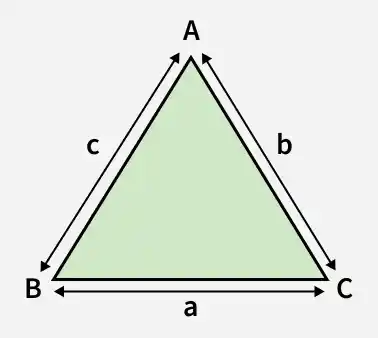
The expression for the Sine Rule is given as,
\frac{sin A}{a} = \frac{sin B}{b} = \frac{sin C}{c} = 2R
Where,
- a, b, c are the lengths of the sides of the triangle.
- A, B, C are the angles opposite to sides a, b, c respectively.
- R is the radius of the circumcircle of the triangle.
**Proof
**Given: In △ABC, AB = c, BC = a, and AC = b.
**Construction: Draw a perpendicular CD ⟂ AB.
Let CD = h be the height.
This divides △ABC into two right-angled triangles: △CDA and △CDB.
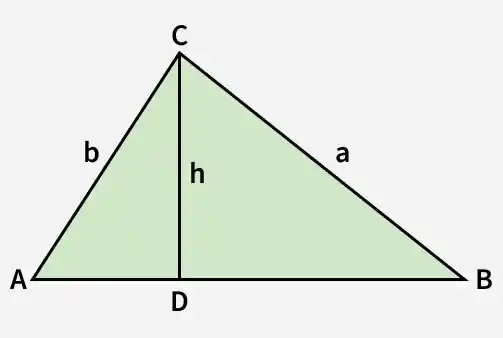
**To Show: a / b = sin A / sin B
**Proof:
In right triangle △CDA,
sin A = h / b
⇒ h = b sin AIn right triangle △CDB,
sin B = h / a
⇒ h = a sin BSince both expressions equal h, equate them:
b sin A = a sin BDivide both sides by (sin A sin B):
a / sin A = b / sin B⇒ a / b = sin A / sin B
Similarly,
sin B / sin C = b / cHence,
a / sin A = b / sin B = c / sin C.
Finding a Missing Side or Angle Using the Sine Rule
To find a missing side or angle of a triangle using the sine rule, follow these steps:
- Label the triangle clearly by naming the angles (A, B, C) and their opposite sides (a, b, c).
- Write the sine rule and substitute the known values into the formula.
- Solve the equation to find the required side or angle.
**Example: Calculate the length of AB in the given triangle. Write your answer to two decimal places.
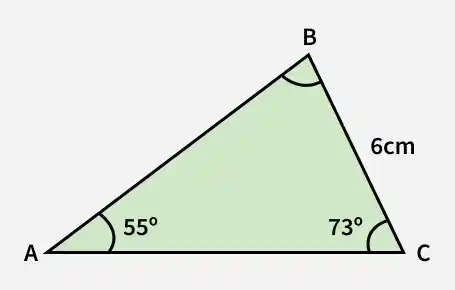
**Solution:
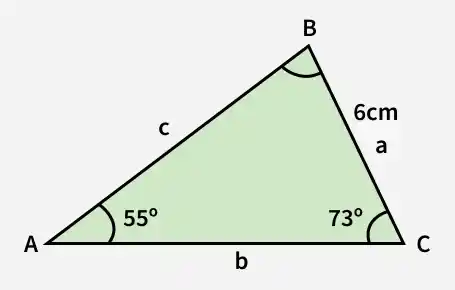
**Step 1. Label each angle (A, B, C) and each side (a, b, c) of the triangle.
**Step 2. State the sine rule and substitute
a / sin(A) = c / sin(C)
6 / sin(55°) = c / sin(73°)
**Step 3. Solve for c
c = 6 × sin(73°) / sin(55°)
c ≈ 7.00 (to 2 d.p.)
**Example: Calculate the size of the missing angle θ. Write your answer to one decimal place.
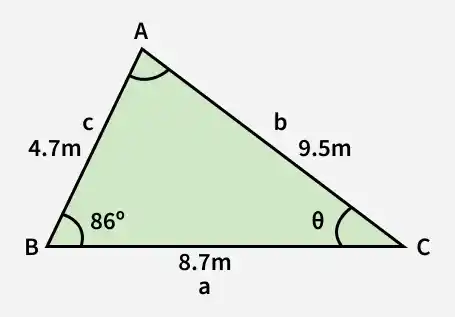
**Solution:
**Step 1: Label the triangle
B = 86°
C = θ
b = 9.5 (opposite B)
c = 4.7 (opposite C)**Step 2: Apply the sine rule
sin(B) / b = sin(C) / csin(86°) / 9.5 = sin(θ) / 4.7
sin(θ) = (sin(86°) / 9.5) × 4.7
θ = sin⁻¹(0.493531688)
θ ≈ 29.6° (1 d.p.)
Applications of the Sine Law
The sine law is a useful trigonometric rule used to find unknown sides or angles in any triangle (not only right triangles). Its main applications are:
- It is used to find the remaining side of a triangle when two angles and one side (AAS or ASA) are given.
- It is used to find an unknown angle or side when two sides and a non-included angle (SSA) are given.
Sample Problems
**Problem 1: Find the remaining lengths of the triangle XYZ when ∠X = 30° and ∠Y = 45° and x = 5 cm.
**Solution:
Given data, ∠X = 30°, ∠Y = 45° and x = 5 cm
We know that sum of the three angles of a triangle is 180°
So, ∠X + ∠Y + ∠Z = 1
30° + 45° + ∠Z = 180°
⇒ 75° + ∠Z = 180°
∠Z = 105°
Now from the law of Sines, x/ sin X = y/ sin Y = z/ sin Z
x/sin X = y/ sin Y ⇒ 5/ sin 30° = y/ sin 45°
⇒ x/(1/2) = y/(1/√2) ⇒ 10 =√2y ⇒ y = 7.07 cm
Similarly, x/ sin X = z/sin Z ⇒ 5/sin 30° = z/sin 105° [sin 105° = (√6 + √2)/4 = 0.965]
⇒ 5/(1/2) = z/(0.965) ⇒ z = 9.65 cm

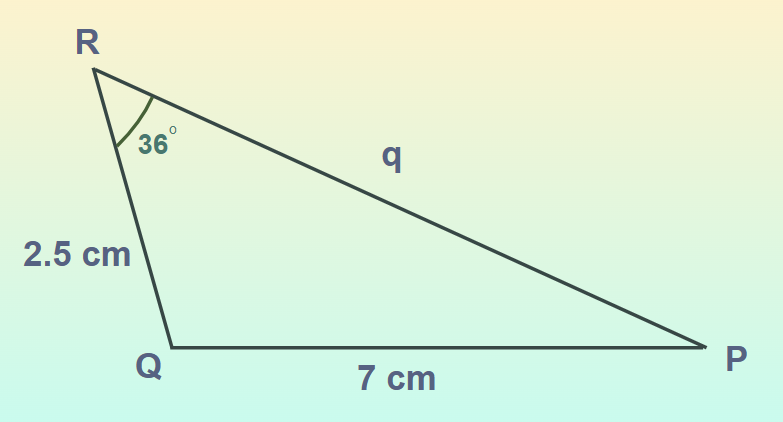
**Problem 2: Find ∠P and ∠Q and the length of the third side when ∠R = 36° and p = 2.5 cm and r = 7 cm.
**Solution:
Given, ∠R = 36° and p = 2.5 cm and r = 7 cm
From the Sine Rule Formula we have,
p/sin P = q/sin Q = r/sin R
⇒ 2.5/sin P = q/ sin Q = 7/sin 36°
⇒ 2.5/sin P = 7/sin 36° [sin 36° = 0.5878]
⇒ sin P = 0.20992 ⇒ P = sin-1 (0.20992)
**⇒ ∠P = 12.12°
⇒ We have, ∠P + ∠Q + ∠R = 180°
⇒12.12° + ∠Q + 36° = 180° ⇒ **∠Q = 131.88°
⇒ q/sin 131.88° = 7/sin 36°
⇒ q/0.7445 = 7/0.5878 ⇒ **q = 8.866 cm (approximately)
Hence ∠P = 12.12°, ∠Q = 131.88° and q = 8.866 cm
**Problem 3: Find the ratio of the sides of the triangle ABC when ∠A = 15°, ∠B = 45°, and ∠C = 120°.
**Solution:
Given: ∠A =15°, ∠B = 45° and ∠C = 120°
From the Sine Rule formula, **a/ sin A = b/ sin B = c/ sin C ⇒ a : b : c = sin A : sin B : sin C
⇒ a : b : c = sin 15°: sin 45° : sin 120°
sin 15° = (√3 - 1)/2√2 = 0.2588 (approximate value)
sin 45° = 1/√2 = 0.7071 (approximate value)
sin 120° = √3/2 = 0.866 (approximate value)
Hence the ratio of the three sides of the triangle ABC is **a : b : c = 0.2588 : 0.7071 : 0.866

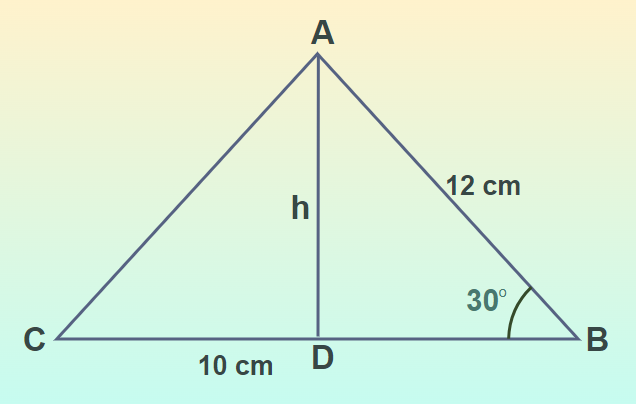
**Problem 4: Find the area of the triangle ABC when BC = 10 cm, AB = 12 cm, and ∠B= 30°.
**Solution:
Given, BC = a = 10 cm, AB = c = 12 cm and ∠B= 30°
We know that, **Area of the triangle = ½ (base) (height) = ½ (a) (h) ⇢ (1)
From the figure, sin B = height/ch = c sin B ⇢ (2)
Now substitute equation (2) in (1),
**Area of the triangle ABC = ½ (a)(c) sin B= ½ (10) (12) sin 30° [sin 30° = ½]
⇒ Area = ½ (120) ½ = 30 cm2
Hence the area of the triangle ABC is 30 cm 2 .
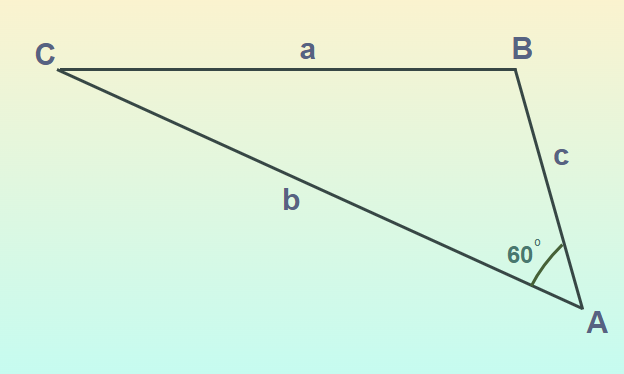
**Problem 5: Find ∠ACB if a = 3 cm, c = 1 cm, and ∠BAC = 60°.
**Solution:
Given, ∠BAC = 60°, a = 3 cm and c = 1 cm
From the Sine Rule Formula, we have **sin A/a = sin C/c
⇒ sin 60°/3 = sin C/1 [sin 60° = √3/2]
⇒ (√3/2)/3 = sin C/3 ⇒ sin C = 1/(2√3) ⇒ sin C = 0.2887 (approximately)
⇒ ∠C = sin-1(0.2887) ⇒ ∠C = 16.77°
Hence ∠ACB = 16.77°
**Problem 6: Find the length of the side YZ, if the area of the triangle XYZ is 24 cm2, ∠Y = 45°, and z = 4 cm.
**Solution:
Given, Area of the triangle XYZ = 24 cm2, ∠y = 45° and z = 4 cm
From the Sine rule law, we have Area of triangle XYZ = ½ (x)(z) sin Y
⇒ 24 = ½ (x)(4) sin 45° [sin 45° = 1/√2]
⇒ 24 = (x) × (2) × (1/√2)
⇒ 12√2 = x ⇒ **x = 16.968 cm
Hence the **length of the side YZ = x = 16.968 cm

**Problem 7: Find q when ∠P= 108°, ∠Q = 43°and p = 15 cm.
**Solution:
Given, ∠P = 108° , ∠Q = 43° and p = 15 cm
From the Sine Rule Formula we have, p/sin P = q/sin Q
⇒ 15/sin 108° = q/sin 43°
⇒ 15/(0.9510) = q/(0.6820) [sin 108° = 0.9510 & sin 43° = 0.6820]
⇒ q = 10.757 cm (approximately)
Hence **q =10.57 cm
