Solve Systems of Linear Equations by Graphing (original) (raw)
Last Updated : 27 Apr, 2026
A system of linear equations is a set of two or more linear equations that have the same variables. The main goal is to find the values of the variables that satisfy all the equations simultaneously.
The graphing method is a way of solving a system of linear equations by drawing their graphs on a coordinate plane.
- Each equation is represented by a straight line, and the solution of the system is the point where the lines intersect.
- This point gives the values of the variables (x, y) that satisfy all equations.
**Key Concepts
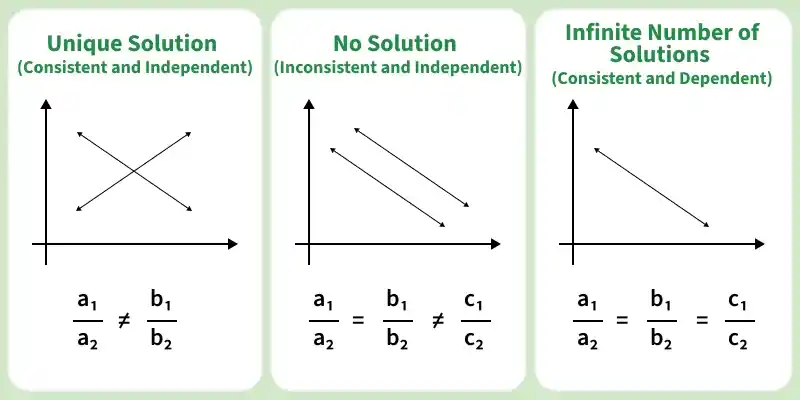
To solve a system using graphing, we find the coordinate point(s) where the lines intersect.
- If the lines intersect at one point → one solution
- If the lines are parallel → no solution
- If the lines overlap → infinitely many solutions
Steps to solve
The idea for solving the System of Linear Equations is to find the number of Coordinates (x, y) that satisfy all the equations of the system.
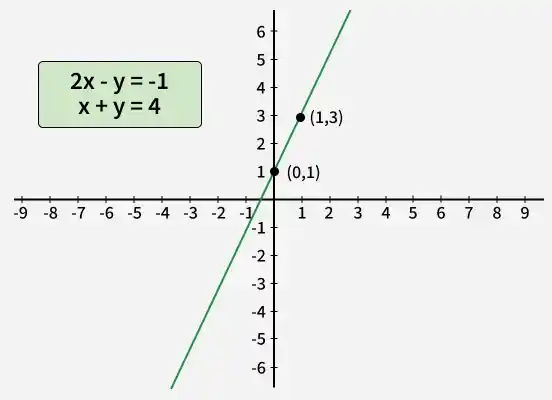
**Step 1: Plot the coordinates of equation 1 (i.e., coordinates A and coordinates B) on a graph paper. Then, use a ruler to plot a straight line intersecting both the coordinates.
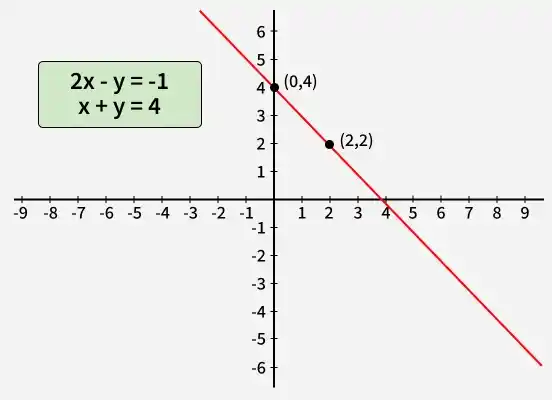
**Step 2: Plot the coordinates of equation 2 (i.e., coordinates C and coordinates D) on the same graph paper. Then, use a ruler to plot another straight line intersecting both the coordinates.
**Step 3: Identify the solutions of the system. Look at the lines on the graph and identify one of the 3 possible cases:
- **Case 1: Lines intersect each other at one point: Number of solutions = 1 (unique solution)
- **Case 2: Lines are parallel: Number of solutions = 0 (no solution)
- **Case 3: Lines are the same (overlap completely): Number of solutions = Infinite (infinitely many solutions)
Related Articles
Solved Examples
**Example 1: Solve System of Linear Equations using graphical method: 2x - y = -1, x + y = 4.
For equation 1 (i.e. y = 2x + 1)
For x = 0
y = 2(0) + 1 = 0 + 1 = 1
Thus coordinates (x, y) are (0, 1) .... (Coordinates A)
Similarly For x = 1, we get y = 2(1) + 1 = 3
Thus, coordinates (x, y) are (1,3) .... (Coordinates B)
In the same way,
**For equation 2 (i.e. y = -x + 4)
For x = 0, we get y = 4
Thus coordinates (x, y) are (0,4) .... (Coordinates C)
For x = 2, we get y = 2
Thus coordinates (x, y) are (2,2) .... (Coordinates D)
The coordinates were A (0, 1), B (1, 3) for equation 1 and C (0, 4), D (2, 2) for equation 2.
**Step 1: Plotting Coordinates of equation 1 [ i.e. A (0,1) and B (1,3)]
**Step 2: Plotting Coordinates of equation 2 [ i.e. C (0,4) and D (2,2)]
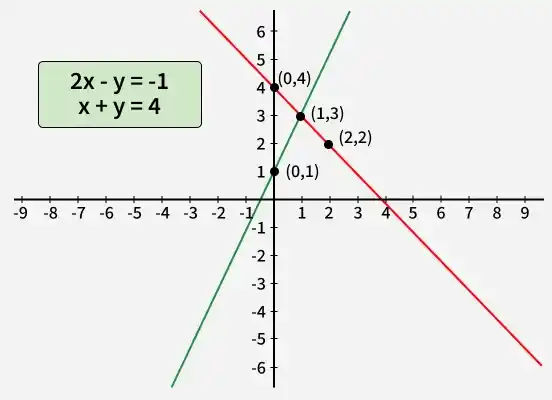
**Step 3: Thus, it is clearly shown in the graph that the two lines intersect each other at _point B (1, 3) on the graph.
Thus, we can say that the system has _a unique solution, and the solution is B (1, 3)
Solution is x = 1 and y = 3
**Example 2: Solve using graphical method: 2x + 3y = 6, 2x + 3y = 12
First, we start by converting the equations in Slope-Intercept form, we get
Equation 1:
2x + 3y = 6
3y = -2x + 6 ....Dividing both sides by 3
(3y/3) = (-2/3)x + (6/3)
y = (-2/3)x + 2 ....(Equation 1 in Slope-Intercept form)
Now if we put x = 0,
y = (-2/3) (0) + 2= 0 + 2 = 2
Thus Coordinates (x, y) are (0, 2) .... (Coordinates A)
Similarly for x = 3, we get y = (-2/3) (3) + 2 = 0
Thus Coordinates (x, y) are (3, 0) .... (Coordinates B)
Equation 2:
2x + 3y = 12
3y = -2x + 12 .... Dividing both sides by 3
(3y/3) = (-2/3) x + (12/3)
y = (-2/3) x + 4 .... (Equation 2 in Slope-Intercept form)
For x = 0,
y = 0 + 4 = 4
Thus Coordinates (x, y) are (0,4) .... (Coordinates C)
Similarly for x = 3, we get y = -2 + 4 = 2
Thus Coordinates (x, y) are (3, 2) .... (Coordinates D)
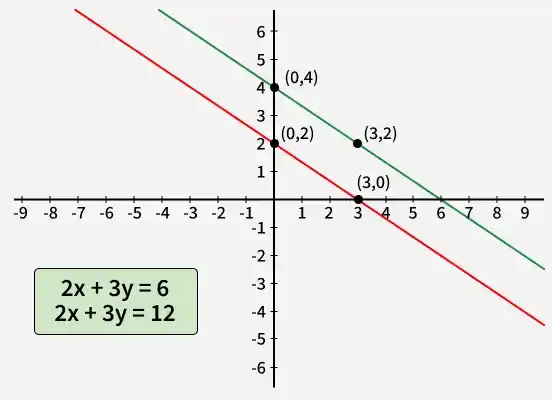
Now, Plotting the lines for both the equations on the graph using the above Coordinates, we get:
Thus, it is clearly shown in the graph that the two lines are parallel to each other, So we can conclude that the system has No Solution.
**Example 3: Solve: 2x + 3y = 13, 4x - 3y = -1
We need at least 2 Coordinates for each equation to form the lines on the graph:
Equation 1:
2x + 3y = 13
For x = -1, we get y = 5
Thus Coordinates (x, y) are (-1, 5) .... (Coordinates A)
For x = 2, we get y = 3
Thus Coordinates (x, y) are (2, 3) .... (Coordinates B)
Equation 2:
4x - 3y = -1
For x = -1, we get y = -1
Thus Coordinates (x, y) are (-1, -1) .... (Coordinates C)
For x = 5, we get y = 7
Thus Coordinates (x, y) are (5, 7) .... (Coordinates D)
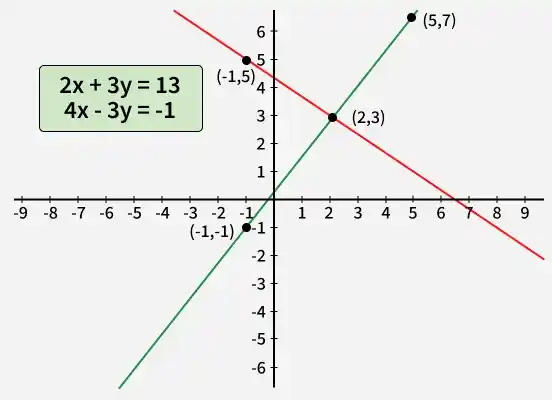
Now, Plotting the lines for both the equations on the graph using the above Coordinates, we get:
Thus, it is clearly shown in the graph that the two lines intersect each other at point B (2, 3), So we can conclude that the system has 1 solution and the solution to the system is x = 2 and y = 3.
**Example 4: Solve system of linear equations using graphical method: 3x + 3y = 18, 3x + 2y = 15
We need at least 2 Coordinates for each equation to form the lines on the graph:
Equation 1:
3x + 3y = 18
For x = 0, we get y = 6
Thus Coordinates (x, y) are (0, 6) .... (Coordinates A)
For x = 6, we get y = 0
Thus Coordinates (x, y) are (6, 0) .... (Coordinates B)
Equation 2:
3x + 2y = 15
For x = 1, we get y = 6
Thus Coordinates (x, y) are (1, 6) .... (Coordinates C)
For x = 5, we get y = 0
Thus Coordinates (x, y) are (5, 0) .... (Coordinates D)
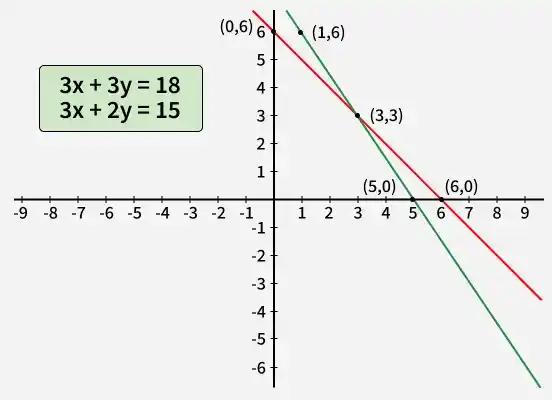
Now, Plotting the lines for both the equations on the graph using the above Coordinates, we get:
Thus, it is clearly shown in the graph that the two lines intersect each other at point E(3, 3) , So we can conclude that the system has 1 solution and the solution to the system is x = 3 and y = 3.
**Example 5: Solve system of linear equations using graphical method: 200x + 100y = 4000, x + 2y = 50
We need at least 2 Coordinates for each equation to form the lines on the graph:
Equation 1:
200x + 100y = 4000 .... can be simplified as
2x + y = 40
For x = 0, we get y = 40
Thus Coordinates (x, y) are (0, 40) .... (Coordinates A)
For x = 20, we get y = 0
Thus Coordinates (x, y) are (20, 0) .... (Coordinates B)
Equation 2: x + 2y = 50
For x = 0, we get y = 25
Thus Coordinates (x, y) are (0, 25) .... (Coordinates C)
For x = 50, we get y = 0
Thus Coordinates (x, y) are (50, 0) .... (Coordinates D)
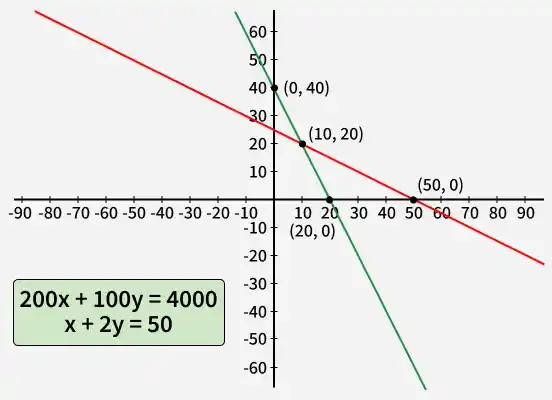
Now, Plotting the lines for both the equations on the graph using the above Coordinates, we get:
Thus, it is clearly shown in the graph that the two lines intersect each other at point E(10, 20) , So we can conclude that the system has 1 solution and the solution to the system is x = 10 and y = 20.
**Practical Questions
1. Find Intersection Point: Solve the system of equations by graphing:
\begin{cases}y = 2x + 3 \\y = -x + 1\end{cases}
2. Graph and Solve: Graph the following system and find the intersection:
\begin{cases}3x - y = 2 \\x + y = 4\end{cases}
3. Determine Solution: Graph the system of the equations and determine if it has one solution, no solution or infinitely many solutions:
\begin{cases}y = \frac{1}{2}x + 2 \\y = \frac{1}{2}x - 1\end{cases}
4. Intersection Coordinates: Find the coordinates of the intersection for:
\begin{cases}y = -2x + 5 \\y = x - 2\end{cases}
5. Graphing Challenge: Graph the system of the equations and determine the solution:
\begin{cases}2x + 3y = 6 \\x - 2y = -3\end{cases}