What is a Square Prism? (original) (raw)
Last Updated : 23 Jul, 2025
A square prism is a three-dimensional shape cuboid figure whose bases are squares and the other four faces are rectangular. It also called a rectangular prism or cuboid, is a three-dimensional geometric shape characterized by having two congruent square bases and four rectangular faces perpendicular to the bases.
We have different types of prisms based on the shape of the polygonal base, namely, triangular prisms, square prisms, rectangle prisms, Pentagonal prisms, hexagonal prisms, octagonal prisms, etc.
In this article, we will learn about, Square Prism Definition, Square Prism Formulae, Examples and others in detail.
Table of Content
- Square Prism Definition
- Square Prism Formulae
- Surface Area of a Square Prism
- Volume of a Square Prism
- Properties of a Square Prism
- Examples on Square Prism formula
Square Prism Definition
A square prism is a prism that has a square base. It is a special case of a cuboid having square bases. It has a total of six faces, which include four rectangular faces and two parallel square bases, twelve edges, and eight vertices. The opposite faces of a square prism are parallel and congruent to each other.
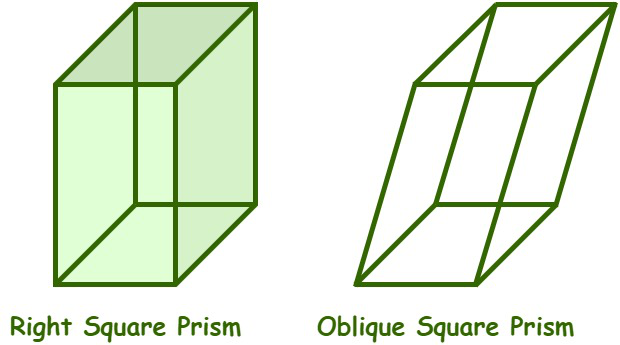
Rectangular faces of a square prism are called the lateral faces. There are two types of prisms based on the alignment of the square bases, i.e., a right square prism and an oblique square prism. A right square prism is a square prism whose lateral faces are perpendicular to its square bases, whereas an oblique square prism is a square prism whose lateral faces are not perpendicular to the square bases.
Square Prism Formulae
The formulas of a square prism include its formulae to determine its volume and surface areas:
- Surface Area of a Square Prism
- Volume of a Square Prism
Surface Area of a Square Prism
Surface area is the total area occupied by all the three-dimensional surfaces of a three-dimensional shape or object. To determine a prism's surface area, we must calculate the areas of each of its faces, then add the resulting areas. A square prism has two types of surface areas: a lateral surface area and a total surface area.
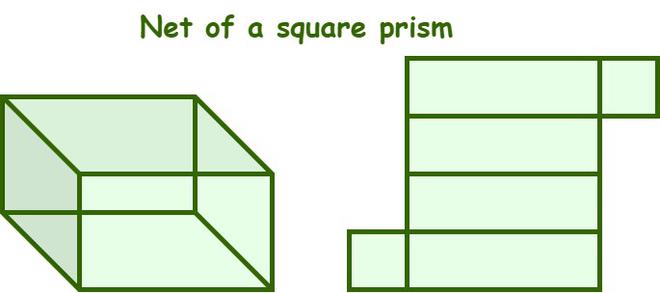
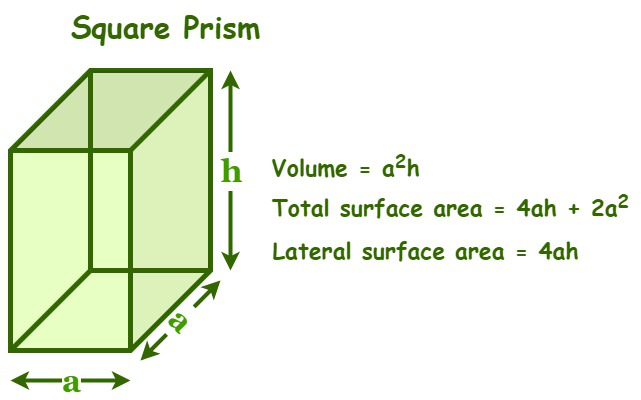
**Lateral Surface Area of a square prism: Thelateral surface area of a square prism is the area occupied by its lateral faces or side faces. The formula for calculating the lateral surface area of a square prism is given,
**Lateral Surface Area of a Prism = 4ah square units
Where,
- ****"a"** is the Side of Square Base
- ****"h"** is the Height of Square Prism
**Total surface area of a square prism: The total surface area of a square prism is defined as the total area occupied by all its surfaces (four lateral faces and two square bases). The formula for calculating the total surface area of a square prism is given as,
**Total Surface Area of Square Prism = (4ah + 2a 2 ) square units
Where,
- ****"a"** is the Side of Square Base
- ****"h"** is the Height of Square Prism
Volume of a Square Prism
Volume of a square prism is defined as the amount of space enclosed by its two congruent square bases and four rectangular faces. It is measured in terms of cubic units and is equal to the product of its height and the base area.
Volume = Area of Base × Height of Prism
As the bases are squares, the base area = (edge)2 = a2
By substituting the values in the above formula, we get
**Volume of a Square Prism = a 2 × h cubic units
Where,
- ****"a"** is the Side of Square Base
- ****"h"** is the Height of Square Prism
Properties of a Square Prism
A square prism, also known as a rectangular prism when generalized, is a three-dimensional shape with specific geometric characteristics. Its various properties are:
- A square prism has six faces.
- Two of these faces are congruent squares, which are the bases.
- The other four faces are rectangles, each connecting the corresponding sides of the two square bases.
- There are 12 edges in a square prism.
- A square prism has 8 vertices.
- All internal angles between adjacent edges are right angles (90 degrees).
- The angles between the faces are also right angles.
- A square prism has several planes of symmetry. Each plane of symmetry passes through the centers of the opposite faces.
- It has rotational symmetry around the axis perpendicular to the square bases.
**Article Related to Square Prism:
Examples on Square Prism formula
**Example 1: Find the volume of a square prism whose side is 8 cm and whose height is 13 cm.
**Solution:
Given data,
- Length of side of a square prism (a) = 8 cm
- Height of a square prism (h) = 13 cm
We know that,
Volume of a square prism = a2h cubic units
= (8)2 × 13
= 64 × 13
= 832 cu. cm
Thus, the volume of the given prism is 832 cu. cm.
**Example 2: Calculate the surface area of a square prism whose side is 10 units and whose height is 15 units.
**Solution:
Given data,
- Length of the side of a square prism (a) = 10 units
- Height of a square prism (h) = 15 units
We know that,
From the square prism formula, we have
Surface Area of a Square Prism = 2a2 + 4ah square units
= 2(10)2 + (4 × 10 × 15)
= 2(100) + 600
= 200 + 600 = 800 square units
Thus, the surface area of the given prism is 800 square units.
**Example 3: Find the volume of a container whose shape is a square prism with a side of 20 inches and a height of 25 inches.
**Solution:
Given data,
- Length of side of a square prism (a) = 20 inches
- Height of a square prism (h) = 25 inches
We know that,
Volume of a Square Prism = a2h cubic units
= (20)2 × 22
= 400 × 25
= 1000 cu. in
Thus, volume of the given prism is 1000 cu. in.
**Example 4: Calculate the lateral surface area of a square prism whose side is 12 cm and whose height is 16 cm.
**Solution:
Given data,
- Length of the side of a square prism (a) = 12 cm
- Height of a square prism (h) = 16 cm
From the square prism formula, we have
Lateral surface area of a square prism = 4ah square units
= 4 × 12 × 16 = 768 sq. cm
Thus, the lateral surface area of the given prism is 768 sq. cm.
**Example 5: Determine the height of a square prism if its volume is 891 cubic units and its side length is 9 units.
**Solution:
Given data,
- Length of the side of a square prism (a) = 9 units
- Volume (V) = 891 cubic units
Height (h) =?
From the square prism formula, we have
Volume of a square prism = a2h cubic units
⇒ (9)2 × h = 891
⇒ 81h = 891
⇒ h = 891/81 = 11 units
Hence, the height of a square prism is 11 units.
**Example 6: Determine the side length of a square prism if its lateral surface area is 660 sq. cm and its height is 15 cm.
**Solution:
Given data,
- Height of a square prism (h) = 15 cm
- Lateral surface area = 660 sq. cm
Length of the side of a square prism (a) =?
From the square prism formula, we have
Lateral surface area of a square prism = 4ah square units
⇒ 4 × a × 15 = 660
⇒ 60a = 660
⇒ a = 660/60 = 11 cm.
Hence, the side length of the given prism is 660 sq. cm.