Sum and Difference Formulas (original) (raw)
Last Updated : 14 Apr, 2026
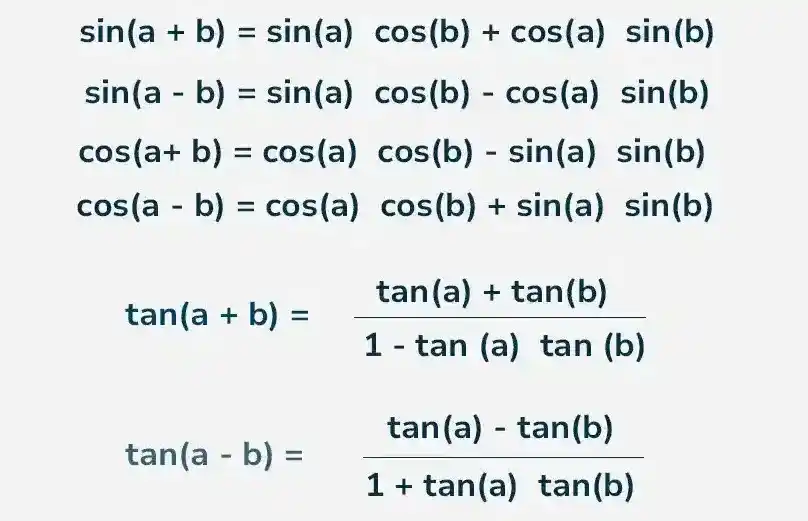
Sum and difference formulas are trigonometric identities used to find the values of angles by expressing them as the sum or difference of known standard angles like 30°, 45°, and 60° and are useful for solving problems, simplifying expressions, and proving identities.
The six main trigonometric formulas for sum and difference are
**Proof of Sum and Difference Identities
To demonstrate, the trigonometric sum and difference formulas let us consider a unit circle with coordinates given as (cos θ, sin θ).
- Consider points A and B, which form angles of α and β with the positive X-axis, respectively.
- The coordinates of A and B are (cos α, sin α) and (cos β, sin β), respectively.
The angle AOB is equal to (α - β). Now, consider another two points, P and Q, on the unit circle such that Q is a point on the X-axis with coordinates (1, 0) and angle POQ is equal to (α - β), and thus the coordinates of the point P are (cos (α - β), sin (α - β)).
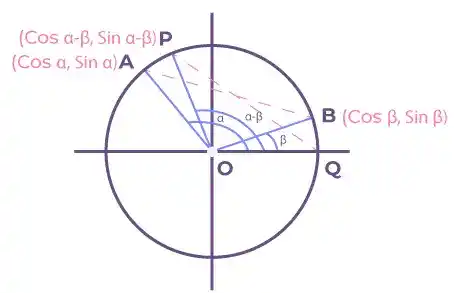
Now, OA = OP, and OB = OQ as they are the radii of the same unit circle, and also the measure of one of the included angles of both triangles is (α - β).
Hence, by the side-angle-side congruence, AOB and POQ are congruent triangles.
We know that the corresponding parts of congruent triangles are congruent, hence AB = PQ.
So, AB = PQ.
Using the distance formula between two points, we get,
dAB =\sqrt{(\cos\alpha - \cos\beta)^2 + (\sin\alpha - \sin\beta)^2}
= \sqrt{\cos^2\alpha - 2\cos\alpha\cos\beta + \cos^2\beta + \sin^2\alpha - 2\sin\alpha\sin\beta + \sin^2\beta}\quad {Since (a - b)2 = a2 - 2ab + b}
=\sqrt{(\cos^2\alpha + \sin^2\alpha) + (\cos^2\beta + \sin^2\beta) - 2(\cos\alpha \cos\beta + \sin\alpha \sin\beta)}
= \sqrt{1 + 1 - 2(\cos\alpha \cos\beta + \sin\alpha \sin\beta)} {Since, sin2 x + cos2 x = 1}
= \sqrt{2 - 2(\cos\alpha \cos\beta + \sin\alpha \sin\beta)}.......(1)
dPQ = \sqrt{(\cos(\alpha - \beta) - 1)^2 + (\sin(\alpha - \beta) - 0)^2}
= \sqrt{\cos^2(\alpha - \beta) - 2\cos(\alpha - \beta) + 1 + \sin^2(\alpha - \beta)} {(a - b)2 = a2 - 2ab + b}
= \sqrt{(\cos^2(\alpha - \beta) + \sin^2(\alpha - \beta)) + 1 - 2\cos(\alpha - \beta)}
= \sqrt{1 + 1 - 2\cos(\alpha - \beta)} {Since, sin2 x + cos2 x = 1}
= \sqrt{2 - 2\cos(\alpha - \beta)}......(2)
Since AB = PQ, equate both equations (1) and (2).
√[2 - 2(cos α cos β+ sin α sin β)] = \sqrt{2 - 2\cos(\alpha - \beta)}
By squaring on both sides, we get,
2 - 2(cos α cos β+ sin α sin β) = 2 - 2 cos (α - β)......(3)
Sum and Difference Formulas for Cosine
Cos (α - β) formula
from eq (3)
2 (1 - cos α cos β - sin α sin β) = 2 (1 - cos (α - β))
1 - cos α cos β - sin α sin β = 1 - cos (α - β)cos (α - β) = cos α cos β + sin α sin β
Cos (α + β) formula
To derive the sum formula of the cosine function substitute (-β) in the place of β in the difference of the cosine function.
Hence, cos (α + β) = cos (α - (β))
= cos α cos (-β) + sin α sin (-β) {Since, cos (α - β) = cos α cos β + sin α sin β}
= cos α cos β - sin α sin β {Since, cos (-θ) = cos θ, sin (-θ) = - sin θ}cos (α + β) = cos α cos β - sin α sin β
Sum and Difference Formulas for Sine
Sin (α - β) formula
We know that, sin (90° - θ) = cos θ and cos (90° - θ) = sin θ.
So, sin (α - β) = cos (90° - (α - β))
= cos (90° - α + β)
= cos [(90° - α) + β]
= cos (90° - α) cos β - sin (90° - α) sin β {Since, cos (α + β) = cos α cos β - sin α sin β}sin (α - β) = sin α cos β - cos α sin β
Sin (α + β) formula
We know that, sin (α + β) = cos (90° - (α + β))
= cos (90° - α - β)
= cos [(90° - α) - β]
= cos (90° - α) cos β + sin (90° - α) sin β {Since, cos (α - β) = cos α cos β + sin α sin β}sin (α + β) = sin α cos β + cos α sin β
Sum and Difference Formulas for Tangent
Tan (α - β) formula
We know that, tan θ = sin θ/cos θ
So, tan (α - β) = sin (α - β)/cos (α - β)
= \frac{\sin\alpha \cos\beta - \cos\alpha \sin\beta}{\cos\alpha \cos\beta + \sin\alpha \sin\beta}Now, divide the numerator and denominator with cos α cos β
= \frac{(\sin\alpha \cos\beta - \cos\alpha \sin\beta)\cos\alpha \cos\beta}{\dfrac{\cos\alpha \cos\beta + \sin\alpha \sin\beta}{\cos\alpha \cos\beta}}
= \frac{\frac{\sin\alpha}{\cos\alpha} - \frac{\sin\beta}{\cos\beta}}{1 + \left(\frac{\sin\alpha}{\cos\alpha}\right)\left(\frac{\sin\beta}{\cos\beta}\right)}
= \frac{\tan\alpha - \tan\beta}{1 + \tan\alpha \tan\beta}
tan (α - β) =\frac{\tan\alpha - \tan\beta}{1 + \tan\alpha \tan\beta}
Tan (α + β) formula
To derive the tan (α + β) formula substitute (-β) in the place of β in the tan (α - β) formula.
Hence, we get,
tan (α + β) = tan(α - (-β))
= \frac{\tan\alpha - \tan(-\beta)}{1 + \tan\alpha \tan(-\beta)} {Since, tan (α - β) = (tan α - tan β)/(1 + tan α tan β)}
= \frac{\tan\alpha + \tan\beta}{1 - \tan\alpha \tan\beta} {Since, tan (-θ) = - tan θ}
tan (α + β) = \frac{\tan\alpha + \tan\beta}{1 - \tan\alpha \tan\beta}
Applying Sum and Difference Formulas
To Apply Sum and difference formulas, study the following example:
**Example: Find the value of sin 15°
**Solution:
**Step 1: Write the given function in the sum and difference of the standard function,
sin 15° = sin (45 -30)°**Step 2: Use the required Sum and Difference Formulas, here we use, sin (α - β) = sin α cos β - cos α sin β
sin (45 -30)° = sin 45° cos 30° - cos 45° sin 30°**Step 3: Substitute the value of these standard trigonometric functions using the trigonometric table.
sin (45 -30)° = 1/√2 × √3/2 - 1/√2 × 1/2**Step 4: Simplify the value obtained in the above step.
sin (45 -30)° = 1/√2 × √3/2 - 1/√2 × 1/2
= (√3 -1)/ 2√2sin 15° = (√3 -1)√2 / 4
**Related Articles
**Solved Examples
**Example 1: Prove the triple angle formulae of sine and cosine functions using the sum and difference formulae.
- sin 3A = 3 sin A - 4 sin³ A
- cos 3A = 4 cos³3 A - 3 cos A
**Solution:
**To Prove: sin 3A = 3 sin A - 4 sin³ A
sin 3A = sin (2A + A) [sin (A + B) = sin A cos B + cos A sin B]
sin (2A + A) = sin 2A cos A + cos 2A sin A
We know that,
sin 2A = 2 sin A cos A, and cos 2A = 1 - 2sin2 A, and cos2 A = 1 - sin2 A
sin (2A + A) = (2 sin A cos A) cos A + (1 - 2sin2 A)sin A
= 2 sin A cos2 A + sin A - 2 sin3 A
= 2 sin A (1 - sin2 A) + sin A - 2 sin3 A
= 2 sin A - 2sin3 A + sin A - 2 sin3 A
= 3 sin A - 4 sin3 AThus, sin 3A = 3 sin A - 4 sin3 A (proved)
**To Prove: cos 3A = 4 cos³3 A - 3 cos A
cos 3A = cos (2A + A) [cos (A + B) = cos A cos B - sin A sin B]
So, cos (2A + A) = cos 2A cos A - sin 2A sin A
We know that,
sin 2A = 2sin A cos A and cos 2A = 2cos2 A - 1, and sin2 A = 1- cos2 A
cos (2A + A) = (2 cos2 A - 1) cos A - (2 sin A cos A) sin A
= 2 cos3 A - cos A - 2 sin2 A cos A
= 2 cos3 A - cos A - 2 (1- cos2 A) cos A
= 2 cos3 A - cos A - 2 cos A + 2 cos3 A
= 4 cos3 A - 3 cos AThus, cos 3A = 4 cos3 A - 3 cos A (proved)
**Example 2: Find the value of cos 75° using the sum and difference formulas.
**Solution:
We can write 75° as the sum of 45° and 30°
cos 75° = cos (45° + 30°)
= cos 45° cos 30° - sin 45° sin 30° {Since, cos (A + B) = cos A cos B - sin A sin B}
= (1/√2) (√3/2) - (1/√2)(1/2) {Since, cos 45° = sin 45° = (1√2) , cos 30° = √3/2, sin 30° = 1/2}
= (√3 -1)/2√2Hence, cos 75° = (√3 - 1)/2√2
**Example 3: Find the value of tan 105° using the sum and difference formulas.
**Solution:
We can write 105° as the sum of 60° and 45°.
tan 105° = tan (60° + 45°)
= (tan 60° + tan 45°)/(1 - tan 60° tan 45°) {Since, tan (A + B) = (tan A + tan B)
= (√3 + 1)/(1 - (√3 × 1)) {Since, tan 60° = √3, tan 45° = 1}
= (√3 + 1)/(1 - √3)Rationalize the above expression with the conjugate of the denominator,
= \left[\frac{\sqrt{3}+1}{1-\sqrt{3}}\right]\times\left[\frac{1+\sqrt{3}}{1+\sqrt{3}}\right]
= (√3 + 1)2/(1 - (√3)2)
= (3 + 2√3 + 1)/(1 - 3)
= (4 + 2√3)/(-2)
= -2 - √3Hence, tan 105° = -2 - √3.
**Example 4: Evaluate the value of sin 15° using the sum and difference formulas.
**Solution:
We can write 15° as the difference between 45° and 30°
sin 15° = sin (45° - 30°)
= sin 45° cos 30° - cos 45° sin 30° {Since, sin (A - B) = sin A cos B - cos A sin B}
= (1/√2) (√3/2) - (1/√2)(1/2) {Since, cos 45° = sin 45° = (1√2) , cos 30° = √3/2, sin 30° = 1/2}
= (√3 - 1)/2√2Hence, sin 15° = (√3 - 1)/2√2
**Example 5: Prove that sin (π/4 - a) cos (π/4 - b) + cos (π/4 - a) sin (π/4 - b) = cos (a + b).
**Solution:
L.H.S = sin (π/4 - a) cos (π/4 - b) + cos (π/4 - a) sin (π/4 - b) {sin (A + B) = sin A cos B + cos A sin B}
= sin [(π/4 - a) + (π/4 - b)]
= sin [(π/2) - (a + b)]
= cos (a + b) {Since, sin (90° - θ) = cos θ}
= R. H. S (proved)