Surface Area of a Pyramid Formula (original) (raw)
Last Updated : 22 Apr, 2026
The surface area of a pyramid is the total area occupied by all its faces, including the polygonal base and the triangular lateral faces that converge at a single point called the apex.
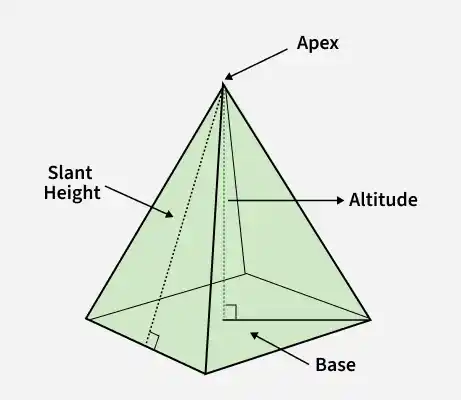
The diagram above shows the key parts of a pyramid—its apex, base, altitude (height), and slant height.
- The surface area of a pyramid is the total area covered by its base and all its triangular faces.
- The lateral surface area represents the area of all the triangular faces, and adding the base area gives the total surface area of the pyramid.
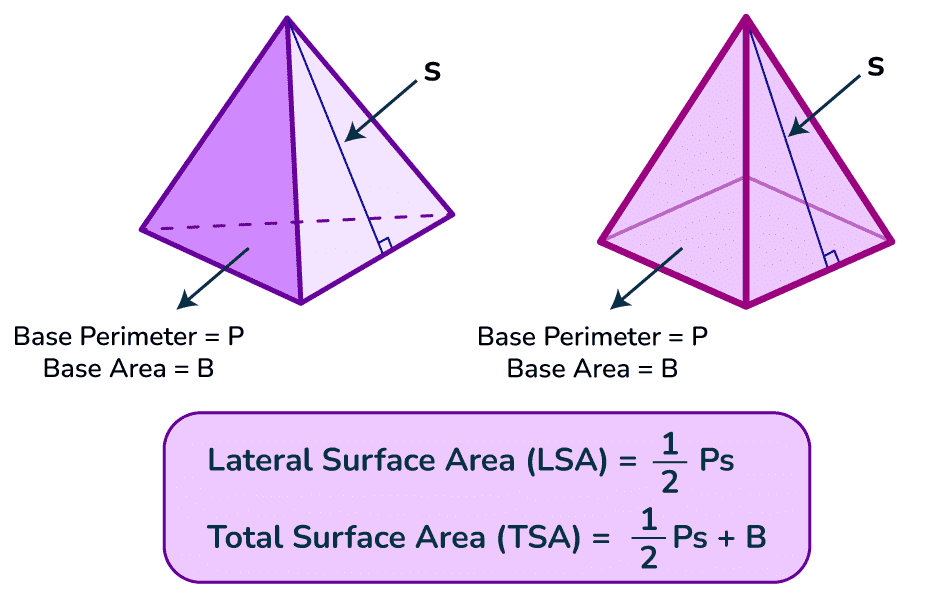
For a regular pyramid, it can be calculated using the following formulas:
- Lateral Surface Area (LSA) = (1/2) × P × s
- Total Surface Area (TSA) = (1/2) × P × s + B
Where:
P = perimeter of the base
s = slant height
B = base area
**Proof
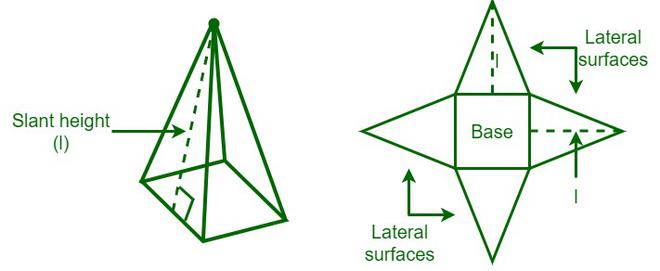
To derive the surface area formulas, consider a square pyramid with base side a and slant height l.
Base area (B) = a²
Perimeter of base (P) = 4aArea of one triangular face = (1/2) × a × l
Since there are 4 triangular faces,
Total lateral surface area = 4 × (1/2 × a × l)
= (1/2) × (4a) × l
= (1/2) × P × lSo,
Lateral Surface Area (LSA) = (1/2) × P × lNow, adding the base area,
Total Surface Area (TSA) = LSA + B
= (1/2) × P × l + BThis proves the formulas for the surface area of a pyramid.
Surface Area with Altitude
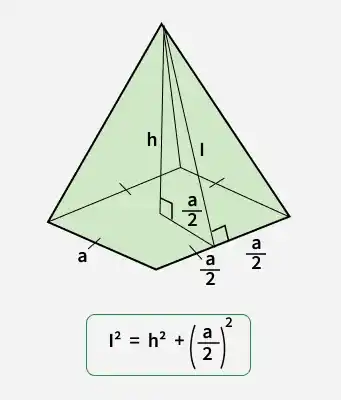
When the altitude (h) is given, the slant height (l) can be found using the Pythagorean theorem:
l² = h² + (a/2)²
Then, the surface area is calculated using:
TSA = (1/2) × P × l + B
**Surface Area of a Triangular Pyramid
A triangular pyramid is a pyramid having a triangular base, where the triangular base can be equilateral, isosceles, or a scalene triangle. It has three lateral (triangular) faces and a triangular base.
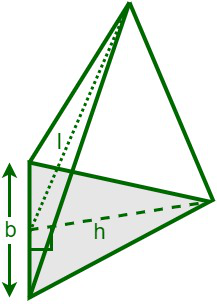
The total surface area of a pyramid (TSA) = Lateral surface area of the pyramid + Area of the base
Lateral surface area (LSA) = ½ × perimeter × slant height
So, TSA = ½ × perimeter × slant height + ½ × base × height
Total surface area (TSA) of a triangular pyramid = ½ × P × l + ½ bh
Where,
- P is perimeter of base,
- l is slant height of pyramid,
- b is base of base triangle, and
- h is height of pyramid.
**Surface Area of a Square Pyramid
A square pyramid is a pyramid having a square base. It has four lateral (triangular) faces and a square base.
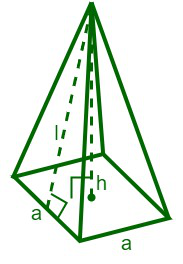
We know that,
The total surface area of a pyramid (TSA) = Lateral surface area of the pyramid + Area of the base
The slant height of the pyramid (l) = √[(a/2)2 + h2]
LSA = 4 × [½ × a × l] = 2al
Lateral surface area of the square pyramid (LSA)= 2al
So, TSA = 2al + a2
Total surface area of a square pyramid (TSA) = 2al + a2
Where,
- a is side of square base, and
- l is slant height of pyramid.
**Surface Area of a Rectangular Pyramid
A rectangular pyramid is a pyramid having a rectangular base. It has four lateral (triangular) faces and a rectangular base.
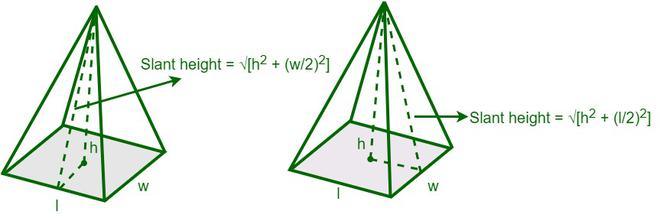
We know that,
The total surface area of a pyramid (TSA) = Lateral surface area of the pyramid + Area of the base
The slant height of length face of the pyramid = √[h2 + (l/2)2]
The slant height of width face of the pyramid = √[h2 + (w/2)2]
Lateral surface area of a rectangular pyramid = 2 × {½ × l ×√[h2 + (l/2)2]} + 2 × {½ × w ×√[h2 + (w/2)2]
So,
Total surface area of the rectangular pyramid = 2 × {½ × l ×√[h2 + (l/2)2]} + 2 × {½ × w ×√[h2 + (w/2)2] + l × w
Where,
- l is length of rectangle base,
- w is breadth of rectangle base, and
- h is height of pyramid.
**Surface Area of a Pentagonal Pyramid
A pentagonal pyramid is a pyramid having a pentagonal base. It has five lateral (triangular) faces and a pentagonal base.
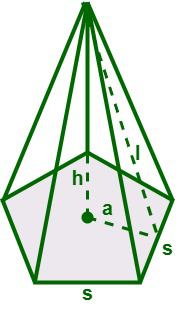
We know that,
The total surface area of a pyramid (TSA) = Lateral surface area of the pyramid + Area of the base
Apothem length of the base = a
Side length of the base = s
Slant height of the pyramid = l
Area of the pentagonal base = 5⁄2 (a × s)
Now,
LSA = 5 × [½ × base × height] = 5/2 × s × l
Lateral surface area of the pentagonal pyramid = 5⁄2 (s × l)
Total surface area of the pentagonal pyramid = 5⁄2 (s × l) + 5⁄2 (a × s)
Where,
- l is slant height of the pyramid,
- a apothem length of the base, and
- s side length of the base.
**Surface Area of a Hexagonal Pyramid
A hexagonal pyramid is a pyramid having a hexagonal base. It has six lateral (triangular) faces and a hexagonal base.
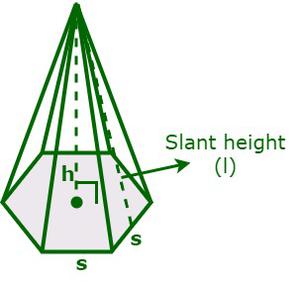
We know that,
The total surface area of a pyramid (TSA) = Lateral surface area of the pyramid + Area of the base
Side length of the base = s
Slant height of the pyramid = l
Area of the hexagonal base = 3√3/2 * s2
Now,
LSA = The sum of areas of the lateral surfaces (triangles) of the pyramid
⇒ LSA = 6 × [½ × base × height] = 3(s × l)
Lateral surface area of the hexagonal pyramid = 3(s × l)
Total surface area of the hexagonal pyramid = 3(s × l) + 3√3/2 (s)2
Where,
- **s is the side length of the base, and
- **l is the slant height of the pyramid.
**Related Articles
Sample Problems
**Problem 1: Determine the surface area of a square pyramid if the side length of the base is 16 inches and the slant height of the pyramid is 18 inches.
**Solution:
Given,
The side of the square base (a) = 16 inches, and
Slant height, l = 18 inches
The perimeter of the square base (P) = 4a = 4(16) = 64 inches
The lateral surface area of a square pyramid = (½) Pl
LSA = (½ ) × (64) × 18 = 576 sq. in
Now, the total surface area = Area of the base + LSA
= a2 + LSA
= (16)2 + 576 = 832 sq. in
Hence, the surface area of the given pyramid is 832 sq. in.
**Problem 2: Find the total surface area of a triangular pyramid in which all faces are equilateral triangles of side 24 cm.
**Solution:
Given:
Side of triangle (a) = 24 cm
Area of equilateral triangle = (√3/4) × a²**Calculation:
Area of one triangle = (√3/4) × (24)²
= (√3/4) × 576
= 144√3
≈ 144 × 1.732
≈ 249.41 sq. cmTotal surface area of pyramid = 4 × area of one triangle
= 4 × 249.41
= 997.64 sq. cm
**Problem 3: Determine the lateral surface area of a pentagonal pyramid if the side length of the base is 10 cm and the slant height of pyramid is 38.1 cm.
**Solution:
Given,
Side of the pentagonal base, a = 10 cm
Slant height, l = 38.1 cmPerimeter of the base,
P = 5a = 5 × 10 = 50 cmLateral Surface Area of a pentagonal pyramid,
LSA = (1/2) × P × l
= (1/2) × 50 × 38.1
= 25 × 38.1
= 952.5 cm²
**Problem 4: Determine the surface area of a hexagonal pyramid if the side length of the base is 12 inches and the slant height of the pyramid is 14 inches.
**Solution:
Given,
The side of the hexagonal base (a) = 12 inches, and
Slant height, l = 14 inches
The perimeter of the square base (P) = 6a = 6(12) = 72 inches
The surface area of a pentagonal pyramid = Area of the base + Area of lateral faces
Lateral surface area (LSA) = (½) Pl
= (½ ) × (72) × 14 = 504 sq. in
Area of the hexagonal base = 3√3/2 (a)2 = 3√3/2 (12) = 374.123 sq. in
The surface area of a pyramid = Area of the base + Area of lateral faces
= 374.123 sq. in + 504 sq. in = 878.123 sq. in
Hence, the surface area of the given pyramid is 878.123 sq. in.
**Problem 5: Determine the side length of a square pyramid if its lateral surface area is 600 square inches and the slant height of the pyramid is 20 inches.
**Solution:
Given,
The lateral surface area = 600 square inches
Slant height, l = 20 inches
Let the side length of a square base be "a".
Now, the perimeter of the base (P)= 4a
We know that
The lateral surface area of a square pyramid = (½) Pl
⇒ 600 = (½ ) × (4a) × 20
⇒ 80a = 1200 ⇒ a = 15 inches
Hence, the side length of the given pyramid is 15 in.
Practice Problems
**Problem 1: A square pyramid has a base side length of 6 cm and a slant height of 10 cm. Calculate the surface area of the pyramid.
**Problem 2: The base of a triangular pyramid has an area of 24 square cm, and each triangular face has a base of 8 cm with a height of 9 cm. Find the surface area of the pyramid.
**Problem 3: A regular hexagonal pyramid has a base side length of 4 cm and a slant height of 7 cm. Determine the surface area of the pyramid.
**Problem 4: A pentagonal pyramid has a base perimeter of 25 cm and a slant height of 12 cm. What is the surface area of the pyramid?
**Problem 5: Calculate the surface area of a square pyramid with a base side length of 5 cm and a height of 12 cm.