Surface Integral (original) (raw)
Last Updated : 10 Oct, 2025
Surface integrals are a key concept in advanced calculus that helps in calculating values across surfaces in three-dimensional space. They extend the idea of integration from lines and areas to more complex surfaces, making them essential for solving problems in physics, engineering, and computer graphics.
A surface integral is the process of integrating a function over a surface in three-dimensional space. This technique is vital for analyzing and solving complex surface integral problems related to fluid dynamics, electromagnetism, and other physical phenomena, like measuring the flow of a field through a surface or analyzing surface properties.
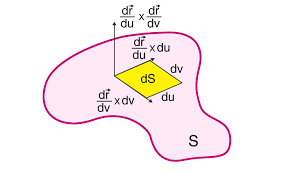
A surface integral is a way to calculate the integral of a scalar field or vector field over a surface. Imagine you have a flat or curved surface in three-dimensional space, and you want to Surface integral helps us to find out how much of a particular quantity, like electric field or magnetic field, is flowing through a three-dimensional curved or flat surface. In different areas of physics, like electromagnetism and hydrodynamics, one needs to use surface integrals to compute such values as electric flux density and fluid flow. The **surface integral's meaning can be understood as the total sum of a function's values over a surface area.
Surface Integral Formula
The formula for a surface integral depends on whether it's a scalar field or a vector field.
**Scalar Field:
\iint_S f(x, y, z) \, dS
Where
- ∬S denotes the surface integral over the surface S.
- f(x,y,z) is a scalar field and dS is an infinitesimal area on the surface S.
- dS represents an infinitesimally small element of the surface area.
**Vector Field:
For vector fields, if \mathbf{F} is a vector field and \mathbf{n} is the unit normal vector to the surface S, the surface integral can be expressed as:
\iint_S \mathbf{F} \cdot n\ d\mathbf{S}
Where
- \mathbf{F} \cdot n is the dot product of the vector field \mathbf{F} and the unit normal vector \mathbf{n}.
- dS is a vector representing an infinitesimal surface area element, normal to the surface.
Surface Area Parameterization
**Surface Area Parametrization in surface integrals is a technique used to describe and compute integrals over a surface in three-dimensional space by transforming the surface into a simpler, parameterized form. It involves expressing a surface in terms of two parameters, typically denoted as u and v. This parameterization helps in calculating the surface area and integrals over the surface.
**Parameterize the Surface:
- Define the surface S using a parameterization r(u,v).
**Compute the Tangent Vectors:
- Find the tangent vectors ru and rv.
**Compute the Normal Vector:
- Calculate the normal vector N = ru × rv.
**Evaluate the Surface Area:
- The surface area A is given by: A = \iint_D \|\mathbf{r}_u \times \mathbf{r}_v\| \, du \, dv
Types of Surface Integral
Surface integrals are categorized based on the type of field being integrated:
1. Surface Integral of Scalar Field
This integral calculates the sum of scalar values over a surface. The steps for deriving the surface integral of a scalar field are:
**Parameterization of the Surface:
- Define the surface S using a parameterization r (u,v)
**Compute the Differential Area Element:
- Find the tangent vectors ru and rv to the surface and compute the cross product to obtain the normal vector N = ru × rv
**Evaluate the Integral:
- The surface integral is then
\iint_S f(x, y, z) \, dS = \iint_D f(\mathbf{r}(u, v)) \|\mathbf{r}_u \times \mathbf{r}_v\| \, du \, dv
Where D is the parameter domain.
2. Surface Integral of Vector Field
This integral calculates the flux of a vector field across a surface. The steps for deriving the surface integral of a vector field are:
**Parameterization of the Surface:
- Define the surface S using a parameterization r(u,v).
**Compute the Differential Vector Area Element:
- Find the normal vector N=ru ×rv and the differential vector area element dS=N dudv.
**Evaluate the Integral:
- The surface integral of the vector field is then
\iint_S \mathbf{F} \cdot d\mathbf{S} = \iint_D \mathbf{F}(\mathbf{r}(u, v)) \cdot (\mathbf{r}_u \times \mathbf{r}_v) \, du \, dv
Where D is the parameter domain
Surface Integrals for Different Shapes
Surface integrals can be calculated for various shapes, including spheres and triangles. The method involves parameterizing the surface and then integrating over the parameter domain.
Surface Integrals of a Sphere
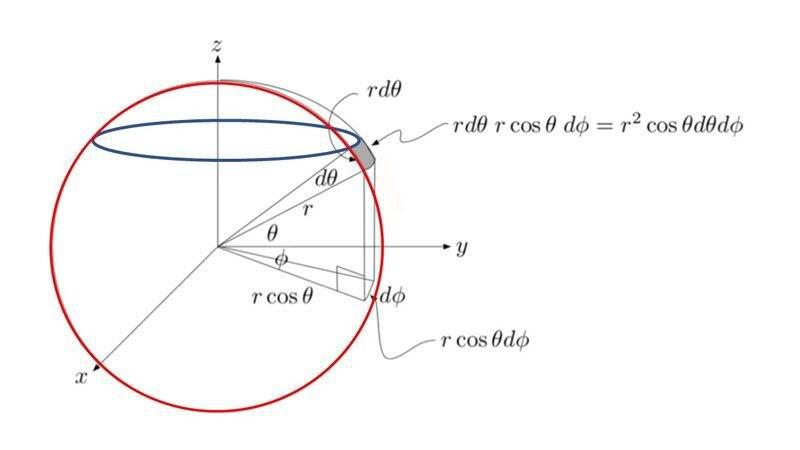
Surface Integrals of a Sphere
For a sphere of radius R, the parameterization is typically given in spherical coordinates.
**Parameterization:
\mathbf{r}(\theta, \phi) = (R \sin \phi \cos \theta, R \sin \phi \sin \theta, R \cos \phi)
Where θ∈[0,2π] and ϕ∈[0,π].
**Tangent Vectors:
\mathbf{r}_\theta = \left(-R \sin \phi \sin \theta, R \sin \phi \cos \theta, 0\right)
\mathbf{r}_\phi = \left(R \cos \phi \cos \theta, R \cos \phi \sin \theta, -R \sin \phi\right)
**Normal Vector:
\mathbf{N} = \mathbf{r}\theta \times \mathbf{r}\phi = (R^2 \sin^2 \phi \cos \theta, R^2 \sin^2 \phi \sin \theta, R^2 \sin \phi \cos \phi)
**Surface Integral:
For a scalar field f over the sphere,
\iint_S f(x, y, z) \, dS = \iint_D f(R \sin \phi \cos \theta, R \sin \phi \sin \theta, R \cos \phi) R^2 \sin \phi \, d\theta \, d\phi
Surface Integrals of a Triangle
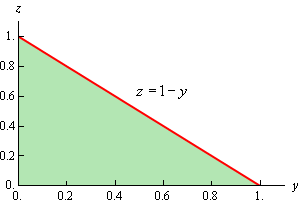
Surface Integrals of a Triangle
For a triangle in 3D space with vertices A, B, and C, the parameterization can be done using barycentric coordinates.
**Parameterization:
\mathbf{r}(u,v) = \mathbf{A} + u (\mathbf{B} - \mathbf{A}) + v (\mathbf{C} - \mathbf{A})
Where 0≤u≤1, 0≤v≤1, and u+v≤1.
**Tangent Vectors:
\mathbf{r}_u = \mathbf{B} - \mathbf{A}
\mathbf{r}_v = \mathbf{C} - \mathbf{A}
**Normal Vector:
\mathbf{N} = \mathbf{r}_u \times \mathbf{r}_v
**Surface Integral:
For a scalar field f over the triangle,
\iint_S f(x, y, z) \, dS = \iint_D f(\mathbf{r}(u, v)) \|\mathbf{r}_u \times \mathbf{r}_v\| \, du \, dv
Relation to Stokes' Theorem
Stokes' theorem connects surface integrals of vector fields to line integrals. It provides a powerful tool for converting difficult surface integrals into more manageable line integrals.
Stokes' theorem states that the surface integral of the curl of a vector field over a surface is equal to the line integral of the vector field over the boundary of the surface. Mathematically, this\iint_S (\nabla \times \mathbf{F}) \cdot d\mathbf{S} = \oint_{\partial S} \mathbf{F} \cdot d\mathbf{r} theorem is significant because it simplifies complex surface integrals by converting them into line integrals.
Application of Stokes' Theorem in Surface Integrals
Stokes’ theorem replaces the surface integrals with the line integrals along the boundary of the surface area. It is quite effective in areas like electromagnetic and fluid mechanics. For instance, whenever finding the circulation of a fluid, or the magnetic flux, there is a corollary that means one can use a boundary curve instead of the whole curve.
Applications of Surface Integrals in Real Life
**Surface integrals are used extensively in various fields. Here are a few applications
- **Fluid Flow and Flux Calculation: Used to measure the quantity of fluid passing through a surface, essential for designing pipelines and analyzing airflow.
- **Electromagnetic Field Analysis: Helps in calculating electric and magnetic flux through surfaces, which is crucial for electrical device design and electromagnetic field studies.
- **Surface Area Calculations: Applied in computer graphics to determine the surface area of 3D models, important for texture mapping and rendering.
- **Heat Transfer and Conduction: Used to analyze total heat flow through a surface, aiding in the design of cooling systems and understanding heat distribution.
- **Environmental and Geological Studies: Model pollutant dispersion and natural resource distribution, helping in environmental protection and geological exploration.
- **Structural Analysis in Engineering: Calculates forces and stresses on structural surfaces, ensuring the integrity of buildings, bridges, and other infrastructure.
Solved Examples on Calculating Surface Integrals
**Example 1: Calculate the surface integral\iint_S x^2 , dS, where S is the part of the plane z = 1-x-y that lies above the square in the xy-plane with vertices at (0, 0), (1, 0), (1, 1), and (0, 1).
**Solution:
**Parameterization of Surface:
Surface S can be parameterized as:
\mathbf{r}(u,v) = (u, v, 1 - u - v), \quad \text{where } (u,v) \in [0,1] \times [0,1].
**Compute the Differential Area Element:
Tangent vectors to the surface are:
\mathbf{r}_u = (1, 0, -1), \quad \mathbf{r}_v = (0, 1, -1).
**Normal vector N=r u × r v is:
\mathbf{N} = \mathbf{r}_u \times \mathbf{r}_v = (1, 1, 0).
**Magnitude of the normal vector is:
\|\mathbf{N}\| = \sqrt{1^2 + 1^2 + 0^2} = \sqrt{2}.
**Evaluate the Integral:
The surface integral is:
\iint_S x^2 \, dS = \iint_D x^2 \|\mathbf{N}\| \, du \, dv = \sqrt{2} \iint_D u^2 \, du \, dv
Where D is the unit square [0,1]×[0,1].
**Integrate Over the Domain:
\sqrt{2} \int_0^1 \int_0^1 u^2 \, du \, dv = \sqrt{2} \int_0^1 \left[ \frac{u^3}{3} \right]_0^1 \, dv = \sqrt{2} \int_0^1 \frac{1}{3} \, dv = \sqrt{2} \cdot \frac{1}{3} \cdot 1 = \frac{\sqrt{2}}{3}.
Example 2: Calculate the flux of the vector field F=(x,y,z) through the surface of the unit sphere x2 + y2 + z2 = 1.
**Solution:
**Parameterization of Surface:
Surface of the unit sphere can be parameterized in spherical coordinates as:
\mathbf{r}(\theta, \phi) = (\sin \phi \cos \theta, \sin \phi \sin \theta, \cos \phi), \quad \theta \in [0, 2\pi], \phi \in [0, \pi].
Compute the Differential Vector Area Element:
Tangent vectors to the surface are:
\mathbf{r}_\theta = (-\sin \phi \sin \theta, \sin \phi \cos \theta, 0),
\mathbf{r}_\phi = (\cos \phi \cos \theta, \cos \phi \sin \theta, -\sin \phi).
**Normal vector N = rθ × rϕ is:
\mathbf{N} = (\sin^2 \phi \cos \theta, \sin^2 \phi \sin \theta, \sin \phi \cos \phi).
**Evaluate Integral:
Surface integral of the vector field
F is:
\iint_S \mathbf{F} \cdot d\mathbf{S} = \iint_D \mathbf{F}(\mathbf{r}(\theta, \phi)) \cdot (\mathbf{r}\theta \times \mathbf{r}\phi) \, d\theta \, d\phi.
Substituting F= (sinϕ cosθ, sinϕ sinθ, cosϕ), we get:
\mathbf{F}(\mathbf{r}(\theta, \phi)) \cdot (\mathbf{r}\theta \times \mathbf{r}\phi) = (\sin \phi \cos \theta, \sin \phi \sin \theta, \cos \phi) \cdot (\sin^2 \phi \cos \theta, \sin^2 \phi \sin \theta, \sin \phi \cos \phi).
Simplifying this dot product:
= \sin^3 \phi \cos^2 \theta + \sin^3 \phi \sin^2 \theta + \sin \phi \cos^2 \phi
= \sin^3 \phi (\cos^2 \theta + \sin^2 \theta) + \sin \phi \cos^2 \phi
= \sin^3 \phi + \sin \phi \cos^2 \phi.
**Integrate Over the Domain:
\iint_D (\sin^3 \phi + \sin \phi \cos^2 \phi) \, d\theta \, d\phi = \int_0^{2\pi} \int_0^\pi (\sin^3 \phi + \sin \phi \cos^2 \phi) \, d\phi \, d\theta.
**Splitting into two integrals:
= \int_0^{2\pi} d\theta \int_0^\pi \sin^3 \phi \, d\phi + \int_0^{2\pi} d\theta \int_0^\pi \sin \phi \cos^2 \phi \, d\phi.
Evaluating each integral:
\int_0^{2\pi} d\theta = 2\pi,
\int_0^\pi \sin^3 \phi \, d\phi = \frac{4}{3},
\int_0^\pi \sin \phi \cos^2 \phi \, d\phi = \frac{2}{3}.
Therefore, the flux is:
2\pi \left( \frac{4}{3} + \frac{2}{3} \right) = 2\pi \cdot