Tautology in Math (original) (raw)
Last Updated : 20 Apr, 2026
Tautology in mathematics is a compound statement that always evaluates to true, regardless of the truth values of its individual components. This concept is fundamental in propositional logic, which deals with statements that are either true or false. For example, the statement "It will either snow today or it will not snow today" (p ∨ ¬p) is a tautology because it is always true: either it snows, or it doesn't.
**For example, the statement "A or not A" (where A is any proposition) is a tautology because it is always true whether A is true or false.
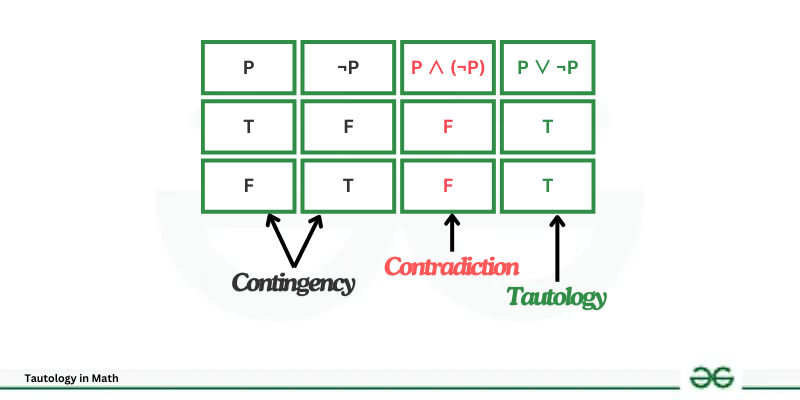
Examples of Tautology in Math
Some examples of tautology in maths are:
- **Logical Statement: The statement "If it is raining, then it is raining" is a tautology because it is always true.
- **Propositional Logic: The expression "P ∨ ¬P" (P or not P) is a classic example of a tautology.
- **Set Theory: The statement "A ⊆ A" (A is a subset of A) is always true for any set A, making it a tautology.
Truth Table for Tautology
A truth table lists all possible combinations of truth values for the variables involved and shows the resulting truth value of the logical expression for each combination.
Consider the logical expression P ∨ ¬ P (P OR NOT P). The truth table for this tautology is as follows:
| **P | **¬P | **P ∨ ¬P |
|---|---|---|
| T | F | T |
| F | T | T |
Another common example of a tautology would be ****(P ∧ Q) ∨ (¬P ∨ ¬Q)**:
| **P | **Q | **¬P | **¬Q | **P ∧ Q | **¬P ∨ ¬Q | ****(P ∧ Q) ∨ (¬P ∨ ¬Q)** |
|---|---|---|---|---|---|---|
| T | T | F | F | T | F | T |
| T | F | F | T | F | T | T |
| F | T | T | F | F | T | T |
| F | F | T | T | F | T | T |
Tautology, Contradiction, and Contingency
The difference between the tautology, contradiction, and contingency is given below.
| **Property | **Tautology | **Contradiction | **Contingency |
|---|---|---|---|
| **Definition | A statement that is always true regardless of the truth values of its components. | A statement that is always false regardless of the truth values of its components. | A statement that can be either true or false depending on the truth values of its components. |
| **Truth Table | All rows in the truth table result in true (T). | All rows in the truth table result in false (F). | Some rows in the truth table result in true (T), and some result in false (F). |
| **Logical Form | "P ∨ ¬P" (P or not P) | "P ∧ ¬P" (P and not P) | "P ∧ Q" (P and Q) or "P ∨ Q" (P or Q), where P and Q have varying truth values. |
| **Example | "It is either raining or it is not raining." | "It is raining and it is not raining." | "It is raining and it is cold." or "It is raining or it is cold." |
| **Usage | Used to validate logical arguments and simplify expressions. | Used to identify impossible situations or logical inconsistencies. | Used to represent realistic scenarios with variable outcomes. |
Consider the propositions P and Q.
| **P | **Q | **P ∨ ¬P (Tautology) | **P ∧ ¬P (Contradiction) | **P ∧ Q (Contingency) | **P ∨ Q (Contingency) |
|---|---|---|---|---|---|
| T | T | T | F | T | T |
| T | F | T | F | F | T |
| F | T | T | F | F | T |
| F | F | T | F | F | F |
In this truth table:
- P ∨ ¬P is always true (Tautology).
- P ∧ ¬P is always false (Contradiction).
- P ∧ Q and P ∨ Q have varying truth values (Contingencies).
Importance of Tautology in Computer Science
Tautology is an important concept in computer science, especially in areas involving logic, algorithms, and programming language theory:
- **In Compiler Optimization: Compilers sometimes detect tautological expressions (like
if (x == x)) and simplify or remove them for efficiency. - **In Artificial Intelligence: Logic-based AI systems (e.g., automated theorem provers) identify tautologies when reasoning about knowledge bases.
- **In Digital Circuit Design: A tautology in Boolean algebra means a circuit always outputs
1regardless of inputs — useful in logic simplification. - **In Propositional Logic & Proof Systems: Used in formal verification to prove that certain conditions always hold (e.g., safety properties in software).
**Related Articles
Solved Examples
**Example 1: Check whether the given statement p ∧ (q → r) → p is a tautology or not?
**Solution:
Given compound statement: p ∧ (q → r) → p
Truth table for above statement
p q r **q → r p **∧ (q → r) **p ∧ (q → r) → p T T T T T T T T F F F T T F T T T T T F F T T T F T T T F T F T F F F T F F T T F T F F F T F T Since the last column of truth table is all true then, the given statement p ∧ (q → r) → p is a tautology
**Example 2: Is the given statement ¬x ∧ (¬y ∨ ¬z) ↔ x → (y ∧ z)
**Solution:
Given compound statement: ¬x ∧ (¬y ∨ ¬z) ↔ x → (y ∧ z)
Truth table for above statement
x y z ¬x **¬y **¬z **¬y ∨ ¬z **¬x ∧ (¬y ∨ ¬z) ****(y ∧ z)** **x → (y ∧ z) **¬x ∧ (¬y ∨ ¬z)↔ x → (y∧ z) T T T F F F F F T T F T T F F F T T F F F T T F T F T F T F F F T T F F F T T T F F F T F T T T F F F F T T F F T F T F T T T F T T F F T T T F T T F T T F F F T T T T T F T T Since the last column of the truth table is not all true, the given statement ¬x ∧ (¬y ∨ ¬z) ↔ x → (y ∧ z) is not a tautology. It is a contingency.
Practice Questions
**Question 1: Check whether the given statement p ∨ (q ∧ r) → p is a tautology or not?
**Question 2: Is the given statement ¬a ∨ b → c ∧ b a tautology?
**Question 3: Find the given compound statement [(x→ y) ∨ z] ↔ ¬x ∨ ¬y ∧ z is a tautology or not?