Tricks to Solve Permutation and Combination (original) (raw)
Last Updated : 10 Mar, 2026
Permutations and combinations are essential topics in probability and quantitative aptitude, widely applicable in both competitive exams and everyday problem-solving. Mastering these concepts will help you solve problems related to arrangements and selections, which are common in various competitive exams, college placements, and more.
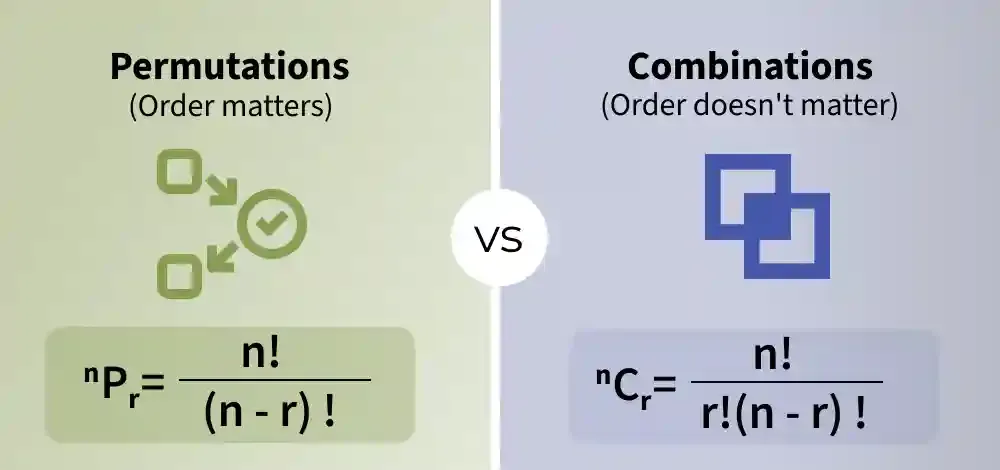
Permutation and Combination are the most fundamental concepts in mathematics related to picking items from a group or set.
Permutation and Combination
- Permutation is arranging items considering the order of selection from a certain group.
- Combination is selecting items without considering order.
In this article, we will cover various tips, tricks, and shortcuts to solve permutations and combinations questions.
**Concept of Factorial
Factorial is an important concept used in permutations and combinations. If n is a positive integer, the factorial of n is written as n!.
n! = n × (n − 1) × (n − 2) × (n − 3) × … × 1
This means we multiply all the positive integers from n down to 1 in decreasing order.
**Example:
4! = 4 × 3 × 2 × 1 = 24
6! = 6 × 5 × 4 × 3 × 2 × 1 = 720
0! = 1 and 1! = 1. This is a standard result .
**Common Factorial Values
0! = 1
1! = 1
2! = 2 × 1 = 2
3! = 3 × 2 × 1 = 6
4! = 4 × 3 × 2 × 1 = 24
5! = 5 × 4 × 3 × 2 × 1 = 120
6! = 6 × 5 × 4 × 3 × 2 × 1 = 720
**Tips and Tricks for Permutation and Combination
**1) The factorial of 1 is always 1 (1! = 1).
**2) The factorial of 0 is always 1 (0! = 1).
**3) The solution to a permutation problem involves the following two steps:
- Step 1: Identifying the objects and the positions involved in the problem.
- Step 2: Determining whether repetition of objects is permitted or not.
**4) In permutations, we only need the first r terms of n!, stopping at (n − r + 1).
**Example: The number of ways to arrange r items from a set of n = 7:
- P(7, 1) = 7 = 7
- P(7, 2) = 7 × 6 = 42
- P(7, 3) = 7 × 6 × 5 = 210
- P(7, 4) = 7 × 6 × 5 × 4 = 840
- P(7, 5) = 7 × 6 × 5 × 4 × 3 = 2520
- P(7, 6) = 7 × 6 × 5 × 4 × 3 × 2 = 5040
- P(7, 7) = 7 × 6 × 5 × 4 × 3 × 2 × 1 = 5040
**5) Simplified Formula for Combinations: Only consider the first r terms in the product.
For combinations, use the formula: C(n, r) = n × (n − 1) × (n − 2) … (n − r + 1)/ r!
- C(8, 1) = 8/1 = 8
- C(8, 2) = (8 × 7)/( 2 × 1) = 56/2 = 28
- C(8, 3) = (8 × 7 × 6)/( 3 × 2 × 1) = 336/6 = 56
- C(8, 4) = (8 × 7 × 6 × 5 )/(4 × 3 × 2 × 1) = 1680/24 = 70
- C(8, 5) = (8 × 7 × 6 × 5 × 4)/(5 × 4 × 3 × 2 × 1) = 6720/120 = 56
- C(8, 6) = (8 × 7 × 6 × 5 × 4 × 3)/(6 × 5 × 4 × 3 × 2 × 1) = 20160/720 =28
- C(8, 7) = (8 × 7 × 6 × 5 × 4 × 3 × 2)/(7 × 6 × 5 × 4 × 3 × 2 × 1) = 40320/5040 =8
- C(8, 8) = 1
**6) When you see clue words like arrangement, schedule, or order, it usually indicates that the problem involves permutations.
**7) When the order is **important use permutation.
**8) Every permutation involves order, but not every combination involves order.
****9)**The relationship between permutation and combination can be expressed as P(n, r) = C(n, r) × r!
**10) The number of ways to arrange **r objects from **n distinct objects, where repetition is allowed, is n r .
**11) If some objects are identical, the formula for permutations changes: n! / k1!k2!k3!...
Where k1, k2or,… are the frequencies of identical objects.
**12) When m specified objects must always come together in a permutation, treat those m objects as a single "block" or "unit," and the number of permutations of n objects is given by m! × (n − m + 1)!
**13) When you see clue words like group, committee, sample, selection, or subset, it usually indicates that the problem involves combinations.
**14) When the order is not **important use combination.
**15) Use the symmetry property of combinations: C(n, r) = C(n, n − r).
- Example: C(10, 3) = C(10,7), so you can choose the smaller value to reduce computation.
**16) If r = 1 or r = n, then C(n, 1) = n and C(n, n) = 1.
- Example: C(7, 1) = 7 and C(7, 7) = 1.
**17) Combinations with Repetition: For selecting r objects from n types with repetition allowed, the formula is:
- C(n + r − 1, r)
**18) When n and r are the same, the number of permutations will always be greater than the number of combinations.
**19) As the order does not matter in combinations, selecting the same k objects from a set of n elements will always result in the same outcome.
Permutations and Combinations - Questions and Answers
**Question 1: How many words can be formed by using 3 letters from the word "DELHI"?
**Solution :
The word "DELHI" has 5 different letters.
Therefore, required number of words = 5 P 3 = 5! / (5 - 3)!
Required number of words = 5! / 2! = 120 / 2 = 60
**Question 2: How many words can be formed by using the letters from the word "DRIVER" such that all the vowels are always together?
**Solution:
In these types of questions, we assume all the vowels to be a single character, i.e., "IE" is a single character.
So, now we have a total of 5 characters in the word, namely, D, R, V, R, IE. But, R occurs 2 times.
=> Number of possible arrangements = 5! / 2! = 60
Now, the two vowels can be arranged in 2! = 2 ways.
=> Total number of possible words such that the vowels are always together= 60 x 2 = 120
**Question 3 : In how many ways, can we select a team of 4 students from a given choice of 15 ?
**Solution :
Number of possible ways of selection = 15 C 4 = 15 ! / [(4 !) x (11 !)]
=> Number of possible ways of selection = (15 x 14 x 13 x 12) / (4 x 3 x 2 x 1) = 1365
**Question 4 : In how many ways can a group of 5 members be formed by selecting 3 boys out of 6 and 2 girls out of 5 ?
**Solution :
Number of ways 3 boys can be selected out of 6 = 6 C 3 = 6 ! / [(3 !) x (3 !)] = (6 x 5 x 4) / (3 x 2 x 1) = 20
Number of ways 2 girls can be selected out of 5 = 5 C 2 = 5 ! / [(2 !) x (3 !)] = (5 x 4) / (2 x 1) = 10
Therefore, total number of ways of forming the group of 5 members be formed by selecting 3 boys out of 6 and 2 girls out of 5 = 6 C 3 x 5 C 2 = 20 x 10 = 200 ways
**Question 5: How many words can be formed by using the letters from the word "DRIVER" such that all the vowels are never together?
**Solution:
We assume both the vowels to act as a single character, i.e., the vowels I and E are treated as one unit "IE".
So now the characters become D, R, V, R, IE, which means there are 5 characters in total. Since the letter R occurs twice, the number of possible arrangements is
5! / 2! = 120 / 2 = 60.
Within this unit, the vowels I and E can arrange themselves in 2! = 2 ways (IE or EI).
Therefore, the total number of words in which the vowels are always together = 60 × 2 = 120.
Now, the total number of words that can be formed from the letters of DRIVER is
6! / 2! = 720 / 2 = 360, since R is repeated twice.
Therefore, the number of words in which the vowels are never together =
360 − 120 = 240.