Types Of Sets (original) (raw)
Last Updated : 30 Sep, 2025
In mathematics, a set is defined as a well-defined collection of distinct elements that share a common property. These elements— like numbers, letters, or even other sets are listed in curly brackets "{ }" and represented by capital letters. For example, a set can include days of the week.
The different types of sets in maths are:

**Singleton Set
Singleton Sets are those sets that have only 1 element present in them.
**Example:
- Set A= {1} is a singleton set as it has only one element, that is, 1.
- Set P = {a : a is an even prime number} is a singleton set as it has only one element 2.
Similarly, all the sets that contain only one element are known as Singleton sets.
**Properties of Singleton Set:
- A singleton set has exactly one element, for example: {7}
- Its cardinality (size) is 1.
- A singleton set is always a finite set.
- It is a subset of any set that contains its elements, for example: {7} ⊆ {5, 6, 7}
- The power set of a singleton set has 2 elements:
Example: Power set of {a} = {∅, {a}} - Every element of a singleton set is also a singleton set in the power set.
**Empty Set
Empty sets are also known as Null sets or Void sets. They are the sets with no element/elements in them. They are denoted as ϕ, also known as phi.
**Example:
- Set A= {a: a is a number greater than 5 and less than 3}
- Set B= {p: p are the students studying in class 7 and class 8}
**Properties of Empty Set (∅):
- ∅ has no elements (0 elements).
- ∅ is a subset of every set.
- There is only one empty set.
- ∅ is not a singleton set.
- The intersection of disjoint sets is ∅.
- The power set of ∅ is {∅} (has 1 element).
**Finite Set
A finite set is a set that has a countable number of elements.
In other words, you can count how many elements it has, and the counting ends. They will be called a Finite set.
**Example:
- A = {1, 2, 3, 4} → Finite (4 elements)
- B = {"apple", "banana"} → Finite (2 elements)
- C = ∅ (Empty set) → Also a finite set (0 elements)
**Properties of Finite Set:
- Has a fixed number of elements.
- The number of elements is a whole number (0 or more).
- You can count the elements and finish counting.
- The empty set is also finite (with 0 elements).
- All singleton sets are finite.
- The union, intersection, or difference of two finite sets is also a finite set.
**Infinite Set
Infinite Sets are those that have an infinite number of elements present, cases in which the number of elements is hard to determine are known as infinite sets.
**Example:
- A = {1, 2, 3, 4, 5, 6, ...} → Infinite
- B = Set of all stars in the sky → Infinite
- C = Set of all natural numbers → Infinite
**Properties of Infinite Set:
- Has unlimited or endless elements.
- You cannot count all the elements — counting never ends.
- Removing or adding a finite number of elements doesn’t make it finite.
- Infinite sets can be countable (like natural numbers) or uncountable (like real numbers).
- The power set of an infinite set is also infinite.
**Equal Set
Two sets having the same elements and an equal number of elements are called equal sets. The elements in the set may be rearranged, or they may be repeated, but they will still be equal sets.
**Example:
- Set A = {1, 2, 6, 5}
- Set B = {2, 1, 5, 6}
In the above example, the elements are 1, 2, 5, 6. Therefore, A= B.
**Properties of Equal Sets :
- Two sets are equal if every element of one set is also in the other set.
- The order of theelements doesn't matter.
- The repetition of elements doesn’t matter (sets don’t allow duplicates).
- If A = B, then A ⊆ B and B ⊆ A.
- Equal sets have the same number of elements (same cardinality).
**Equivalent Set
Equivalent Sets are those which have the same number of elements present in them. It is important to note that the elements may be different in both sets but the number of elements present is equal. For Instance, if a set has 6 elements in it, and the other set also has 6 elements present, they are equivalent sets.
**Example:
- Set A= {2, 3, 5, 7, 11}
- Set B = {p, q, r, s, t}
- Set A and Set B both have 5 elements hence, both are equivalent sets.
**Properties of Equivalent Sets :
- Equivalent sets have the same number of elements.
- The elements can be different; it only the count matters.
- If two sets A and B are equivalent, we write: A ≈ B
- All equal sets are equivalent, but not all equivalent sets are equal.
**Subset
Set A will be called the Subset of Set B if all the elements present in Set A already belong to Set B. The symbol used for the subset is **⊆.
If A is a Subset of B, it will be written as A ⊆ B
**Example:
- Set A= {33, 66, 99}
- Set B = {22, 11, 33, 99, 66}
Then, Set A ⊆ Set B
**Properties of Subsets :
- A ⊆ A (Every set is a subset of itself)
- ∅ ⊆ A (Empty set is a subset of every set)
- If A ⊆ B and B ⊆ C, then A ⊆ C (transitive property)
- If A ⊆ B and A ≠ B, then A is a proper subset of B (written A ⊂ B)
- A set with n elements has 2ⁿ subsets (including ∅ **the set itself)
Proper Subset
A proper subset is a subset that contains some but not all elements of the original set. It is not equal to the original set. If A and B are sets, and A is a proper subset of B, we write: A ⊂ B
**Example:
Let **B = {1, 2, 3}
- Proper subsets of B are:
**∅, {1}, {2}, {3}, {1, 2}, {1, 3}, {2, 3}- ****{1, 2, 3}** is a subset of B, but **not a proper subset, because it is equal to B.
**Properties of Proper Subset:
- A proper subset has fewer elements than the original set.
- Every proper subset is a subset, but not every subset is proper.
- The empty set (∅) is a proper subset of any non-empty set.
- The original set is not a proper subset of itself.
Power Set
The set of any set A is defined as the set containing all the subsets of set A. It is denoted by the symbol **P(A) and read as the Power set of A.
For any set A containing n elements, the total number of subsets formed is 2n. Thus, the power set of A, P(A) has 2n elements.
It includes:
- **The empty set (∅)
- **All individual elements as sets
- **All combinations of elements
- **The set itself
**Example: For any set A = {a,b,c}, the power set of A is?
**Solution:
Power Set P(A) is,
P(A) = {ϕ, {a}, {b}, {c}, {a, b}, {b, c}, {c, a}, {a, b, c}}
**Properties of Power Set :
1. If a set has n elements, its power set has 2ⁿ subsets.
- Example: A = {a, b, c} → 3 elements → power set has 2³ = 8 subsets
2. The power set always includes:
- The empty set (∅)
- The original set
3. Power set of ∅ is: P(∅) = {∅}
4. The power set is always larger than the original set (except when the set is empty).
**Universal Set
A universal set is a set that contains all the elements of the rest of the sets. It can be said that all the sets are the subsets of Universal sets. The universal set is denoted as U.
**Example:For Set A = {a, b, c, d} and Set B = {1,2}, find the universal set containing both sets.
**Solution:
Universal Set U is,
U = {a, b, c, d, e, 1, 2}
**Properties of Universal Set:
- Contains all the elements being discussed.
- Every set is a subset of the universal set.
- The complement of a set is taken disjointed from the universal set.
- It is usually finite or defined by context (can be infinite in some cases).
- The intersection of U with any set A is A:
U ∩ A = A - The union of U with any set A is U:
U ∪ A = U
Disjoint Sets
**That have two sets A and B that do have no common elements are called Disjoint Sets. The intersection of the Disjoint set is ϕ, now for set A and set B A∩B = ϕ.
**Example: Check whether Set A = {a, b, c, d} and Set B = {1, 2} are disjoint or not.
**Solution:
Set A ={a, b, c, d}
Set B= {1,2}Here, A∩B = ϕ
Thus, Set A and Set B are disjoint sets.
**Properties of Disjoint Sets :
- No common elements → A ∩ B = ∅
- If sets are disjoint, their intersection is the empty set.
- Disjoint sets can be finite or infinite.
- Two sets can be disjointed even if one or both are empty.
- In Venn diagrams, disjoint sets do not overlap.
Summarizing Types of Set
There are different types of sets categorized on various parameters. Some types of sets are mentioned below:
| Set Name | Description | Example |
|---|---|---|
| Empty Set | A set containing no elements whatsoever. | { } |
| Singleton Set | A set containing exactly one element. | {1} |
| Finite Set | A set with a limited, countable number of elements. | {apple, banana, orange} |
| Infinite Set | A set with an uncountable number of elements. | {natural numbers (1, 2, 3, ...)} |
| Equivalent Sets | Sets that have the same number of elements and their elements can be paired one-to-one. | Set A = {1, 2, 3} and Set B = {a, b, c} (assuming a corresponds to 1, b to 2, and c to 3) |
| Equal Sets | Sets **that have **the same elements. | Set A = {1, 2} and Set B = {1, 2} |
| Universal Set | A set containing all elements relevant to a specific discussion. | The set of all students in a school (when discussing student grades) |
| Unequal Sets | Sets that do not have all the same elements. | Set A = {1, 2, 3} and Set B = {a, b} |
| Power Set | The set contains all possible subsets of a given set. | Power Set of {a, b} = { {}, {a}, {b}, {a, b} } |
| Overlapping Sets | Sets****,** share a least one common element. | Set A = {1, 2, 3} and Set B = {2, 4, 5} |
| Disjoint Sets | Sets that have no elements in common. | Set A = {1, 2, 3} and Set B = {a, b, c} |
| Subset | A set where all elements are also members of another set. | {1, 2} is a subset of {1, 2, 3} |
Solved Examples of Types of Sets
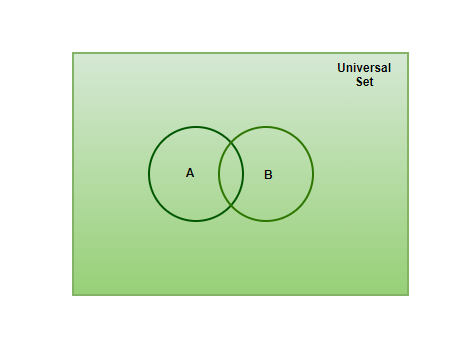
**Example 1: Represent a universal set on a Venn Diagram.
**Solution:
Universal Sets are those that contain all the sets in it. In the below given Venn diagram, Set A and B are given as examples for better understanding of Venn Diagram.
**Example:
Set A= {1,2,3,4,5}, Set B = {1,2, 5, 0}
U= {0, 1, 2, 3, 4, 5, 6, 7}
**Example 2: Which of the given below sets are equal, and which are equivalent in nature?
- Set A = {2, 4, 6, 8, 10}
- Set B = {a, b, c, d, e}
- Set C = {c: c ∈ N, c is an even number, c ≤ 10}
- Set D = {1, 2, 5, 10}
- Set E = {x, y, z}
**Solution:
Equivalent sets are those which have the equal number of elements, whereas, Equal sets are those which have the equal number of elements present as well as the elements are same in the set.
Equivalent Sets = Set A, Set B, Set C.
Equal Sets = Set A, Set C.
**Example 3: Determine the types of the below-given sets,
- Set A = {a: a is the number divisible by 10}
- Set B = {2, 4, 6}
- Set C = {p}
- Set D = {n, m, o, p}
- Set E = ϕ
**Solution:
From the knowledge gained above in the article, the above-mentioned sets can easily be identified.
- Set A is an Infinite set.
- Set B is a Finite set
- Set C is a singleton set
- Set D is a Finite set
- Set E is a Null set
**Example 4: Explain which of the following sets are subsets of Set P,
Set P = {0, 2, 4, 6, 8, 10, 12, 14, 16, 18, 20}
- Set A = {a, 1, 0, 2}
- Set B = {0, 2, 4}
- Set C = {1, 4, 6, 10}
- Set D = {2, 20}
- Set E = {18, 16, 2, 10}
**Solution:
- Set A has elements a, 1, which are not present in the Set P. Therefore, set A is not a Subset.
- Set B has elements which are present in set P, Therefore, Set B ⊆ Set P
- Set C has 1 as an extra element. Hence, not a subset of P
- Set D has 2, 20 as element. Therefore, Set D ⊆ Set P
- Set E has all its elements matching the elements of set P. Hence, Set E ⊆ Set P.
Practice Questions on Types of Sets
**Question 1: Represent a universal set on a Venn Diagram.
Given the following sets, represent them on a Venn diagram:
- Set A = {3, 5, 7, 9, 11}
- Set B = {1, 5, 7, 11, 13}
- Universal Set U = {1, 2, 3, 4, 5, 6, 7, 8, 9, 10, 11, 12, 13}
**Question 2: Identify which of the following sets are equal and which are equivalent.
- Set A = {10, 20, 30, 40, 50}
- Set B = {a, b, c, d, e}
- Set C = {x: x is a multiple of 10, and 10 ≤ x ≤ 50}
- Set D = {100, 200, 300, 400, 500}
- Set E = {m, n, o}
**Question 3: Determine the types of the following sets:
- Set A = {a: a is a positive integer divisible by 3}
- Set B = {1, 4, 7, 10}
- Set C = {p, q}
- Set D = {n, m, p, q, r}
- Set E = ϕ
**Question 4: Explain which of the following sets are subsets of Set Q.
Set Q = {0, 1, 2, 3, 4, 5, 6, 7, 8, 9, 10}
- Set A = {0, 1, 2, 3}
- Set B = {1, 3, 5, 7}
- Set C = {5, 6, 9, 11}
- Set D = {3, 6, 9}
- Set E = {0, 2, 4, 6, 8, 10}