Volume of Cone Formula, Derivation and Examples (original) (raw)
Last Updated : 22 Apr, 2026
A cone is a three-dimensional solid that has a circular base and a single vertex, with a curved surface joining them, and the perpendicular distance from the base to the vertex is called its height. The volume of a cone is the space enclosed within it and is measured in cubic units such as cm³, m³, or in³.
Cones are of two types:
- **Right Circular Cone: The vertex lies directly above the centre of the base.
- **Oblique Cone: The vertex is not directly above the centre of the base.
**Formula
The volume of a cone is equal to one-third of the product of the area of its circular base and its height. A cone can be considered similar to a pyramid with a circular base. By knowing the radius and height, the volume can be easily calculated.
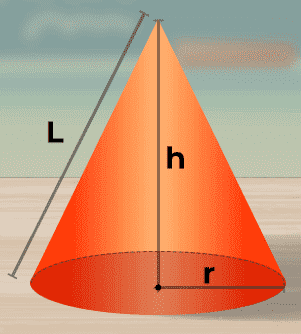
**Formula of Volume of Cone:
V = 1/3 πr2h
Where,
- r is the Radius of the Cone
- h is the Height of the Cone
- π is a constant with a value of 22/7 or 3.14
Volume of Cone Using Different Parameters
• **With Height and Radius
The volume of a cone is calculated using its radius and height:
Volume = (1/3)πr²h cubic units
• **With Height and Diameter
Since the diameter (d) is twice the radius (r), the formula becomes:
Volume = (1/12)πd²h cubic units
• **With Slant Height
Using the Pythagorean theorem, the relationship between height (h), radius (r), and slant height (L) is:
h² + r² = L²
⇒ h = √(L² − r²)Substituting the value of h in the volume formula:
Volume = (1/3)πr²√(L² − r²)
**Derivation
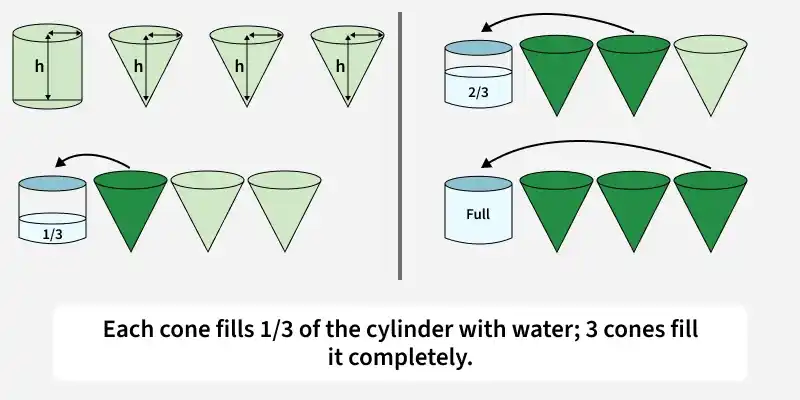
Take three identical cones. When each cone is filled with water and poured into the cylinder:
- 1 cone fills 1/3 of the cylinder.
- 2 cones fill 2/3 of the cylinder.
- 3 cones fill the cylinder.
Thus, three cones equal one cylinder.
Steps to find volume
The volume of a cone can be calculated using its radius or diameter along with height or slant height.
**Step 1: Identify the given values:
- Radius (r) or Diameter (d)
- Height (h) or Slant height (L)
**Step 2: Choose the appropriate formula:
- Using radius:
V = (1/3)πr²h
or
V = (1/3)πr²√(L² − r²)- Using diameter:
V = (1/12)πd²h
or
V = (1/12)πd²√(L² − r²)**Step 3: Substitute the values and calculate.
**Step 4: Write the final answer in **cubic units (e.g., cm³, m³).
Related Articles
Solved Examples
**Example 1. Find the Volume of a cone for a radius of 7 cm and a height of 14 cm.
**Solution:
We have,
- r = 7
- h = 14
Volume of Cone = 1/3 πr2h
= (1/3) × 22 × 7 × 14
= (1/3) × 22 × 98
= (1/3) × 2156
= 718.67 cm³
**Example 2. Find the Volume of a cone for a radius of 5 cm and a height of 9 cm.
**Solution:
We have,
- r = 5
- h = 9
Volume of Cone = 1/3 πr2h
V = (1/3) (3.14) (5) (5) (9)
V = (3.14) (5) (5) (3)
V = 235.5 cm3
**Example 3. Find the volume of a cone with a radius of 7 cm and a height of 12 cm.
**Solution:
We have,
- r = 7
- h = 12
Volume of Cone = 1/3 πr2h
V = (1/3) (22/7) (7) (7) (12)
V = (22) (7) (4)
V = 616 cm3
**Example 4. Find the Volume of a cone for a radius of 8 cm and a height of 15 cm.
**Solution:
We have,
- r = 8
- h = 15
Volume of Cone = 1/3 πr2h
V = (1/3) (22/7) (8) (8) (15)
V = 1005.71 cm3
Practice Questions
**Q1. Find the radius of a cone if its volume is 121 cm3 and its height is 2 cm.
**Q2. Calculate the Volume of a cone for a height of 5 cm and a slant height of 13 cm.
**Q3. What will be the Volume of a cone with a height of 21 cm and a base diameter of 12 cm?
**Q4. Find the Volume of a cone for a radius of 9 cm and a height of 4 cm.
**Answer:-
- 7.6 cm
- 752.8 cm3
- 791.76 cm3
- 339.12 cm³