What are the 7 Different Types of Angles? (original) (raw)
Last Updated : 23 Jul, 2025
An angle is a measure formed when two rays meet at a common point (called the **Vertex). The amount of turn between the two rays is measured in **degrees or **radians, and this measurement represents the angle.
- When we talk about the _inclination of two lines, we’re referring to the **angle between them.
- Formally, this is often called the **angle of inclination.
- It’s typically measured using the **interior angle formed between the two intersecting lines.
The 7 types of angles commonly used in mathematics are as follows:
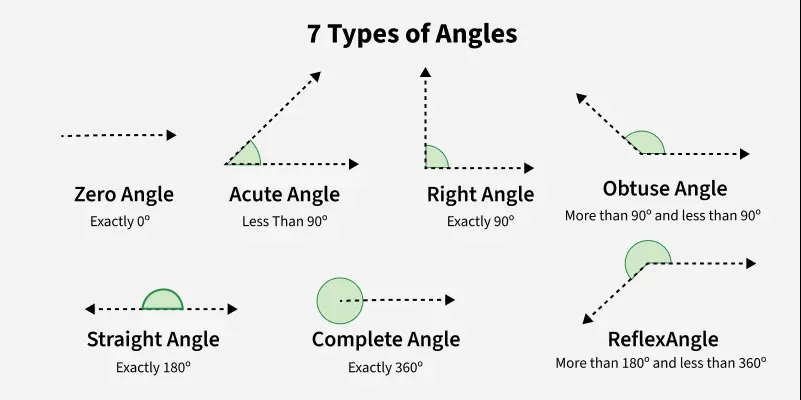
7 different types of angles
Now, let’s take a closer look at the different types of angles we just mentioned.
**Zero Angle
A zero angle is an angle that measures exactly 0 degrees. It is formed when the two rays or lines lie **on top of each other, starting from the same point and extending in the **same direction. Since there is no opening between the rays, the inclination between them is **zero. The image below shows the zero angle:
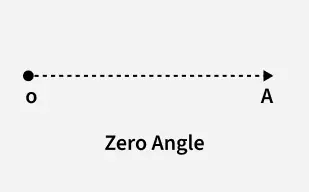
Zero angle
**➣Read More on [ Zero Degree Angle ]
**Acute Angle
An acute angle is an angle that is **less than 90 degrees but greater than 0 degrees. The image below shows the acute angle:
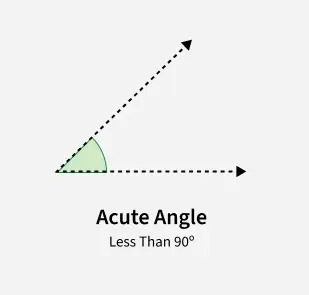
Acute Angle
**➣Read More on [ Acute Angle ]
**Right Angle
The angle that is exactly **90 degrees is called a right angle. It creates an **L-shape when formed. The image below shows the Right angle:
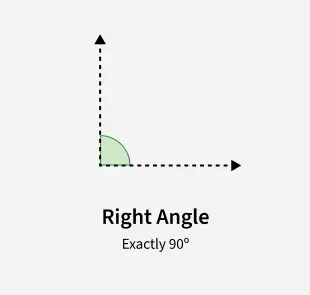
Right Angle
**➣Read More on [ Right Angle ]
**Obtuse Angle
An Obtuse angle is an angle which is **greater than 90 degree but less than 180 degree. The image below shows the Obtuse angle.
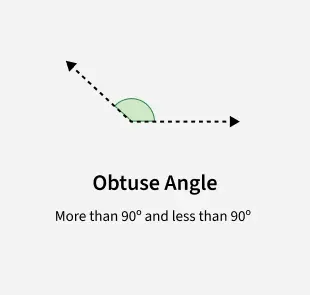
Obtuse Angle
**➣Read More on [ Obtuse Angle ]
**Straight Angle
It is formed when the two rays of the angle lie in exactly opposite directions, making a straight line. The inclination between them is exactly **180°, and such an angle is known as a **straight angle. The image below shows the straight angle:
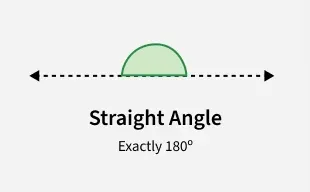
Straight Angle
**➣Read More on [ Straight Angle ]
**Reflex Angle
A reflex angle is greater than 180 degrees but less than 360 degrees. The image below shows the reflex angle:
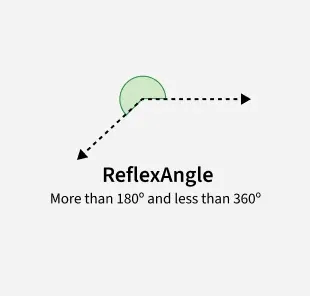
Reflex Angle
**➣Read More on [ Reflex Angle ]
**Complete Angle
It is formed when the two rays of the angle make a full rotation and overlap each other after turning **360° around the vertex. This type of angle is known as a **complete angle. The image below shows the Complete angle:
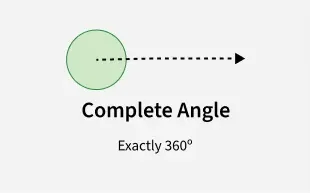
Complete Angle
**➣Read More on [ Complete Angle ]
**Types of Angles in Maths
| **➣Consecutive Interior Angles | **➣Alternate Exterior Angles | **➣Alternate Interior Angles |
|---|---|---|
| **➣Adjacent Angles | **➣Complementary Angles | **➣Supplementary Angles |
Solved Problems on Types of Angles
**Problem 1: Angle A measures 135° in measure. Which type of category does Angle A fall into?
**Solution:
Angle A lies between 90° to 180° in measure. Angle A is, therefore, an Obtuse Angle.
**Problem 2: An Angle S measures 35° in measure. Which type of category does Angle S fall into?
**Solution:
Angle S lies between 0° to 90° in measure. Angle S is therefore an Acute Angle.
**Problem 3: An Angle X measures 235 degrees in measure. Which type of category Angle X fall intomake?
**Solution:
Angle X lies between 180° to 360° in measure. Angle X is therefore a Reflex Angle.
**Problem 4: An Angle Z measures 335° in measure. Which type of category does Angle Z fall into?
**Solution:
Angle Z lies between 180° to 360° in measure. Angle Z is therefore a Reflex Angle.
Practice Questions on Types of Angles
**Question 1: Write the names of the following angles
- 30°
- 65°
- 91°
- 90°
- 275°
- 360°
**Question 2: The foot and top of the table mmake90° with each other. What kind of amgle it is?
**Question 3: The screen makes an angle of 120° with the keyboard. What kind of angle does it make?
**Question 4: When the door opens, it forms an angle of about 45° with the door frame. What kind of angle does the door make?
Conclusion
Angles are essential in geometry for measuring the inclination between two rays. Understanding the seven types of angles—zero, acute, right, obtuse, straight, reflex, and complete—provides a solid foundation for studying more advanced geometric concepts. These angles play a significant role in both theoretical and practical applications, enhancing your overall understanding of shapes and measurements.
**Also check: