Geometric Progression (GP) (original) (raw)
Last Updated : 23 Apr, 2026
Geometric Progression (GP) is a sequence of numbers where each term after the first is found by multiplying the previous term by a constant called the common ratio.
**For example, the sequence given below forms a GP with a common ratio of 2
1 2 4 8 16 . . . n
**⇑ ⇑ ⇑ ⇑ ⇑ . . .
1 st 2 nd 3 rd 4 th 5 th . . . n th Terms
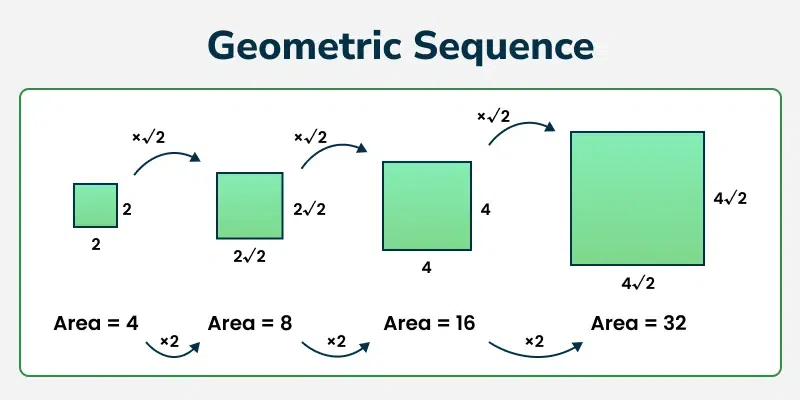
**Note: Geometric Progression is also known as Geometric Sequence.
**Some Other Examples of GP
- **All Same Numbers
For example, 5, 5, 5, .... form a GP with a common ratio 1. - **Branches of a Perfect Tree
For instance, if a tree branches into two new branches at each level, the number of branches can be represented as 1, 2, 4, 8, .. which forms a GP with a common ratio of 2. - **Return on Investment
For example, if your invested money becomes 1.2x every year.
If your initial investment is 10, then your money after every year will be 12, 14.4, 17.28, .... which forms a GP with common ratio 1.2 - 100, 50, 25, 12.5, 6.25 . . . is a GP with common ratio r = 0.5
- -3, 6, -12, 24, -48 . . . is a GP with common ratio -2
- 2, -2, 2, -2, ..... is a GP with common ratio r = -1
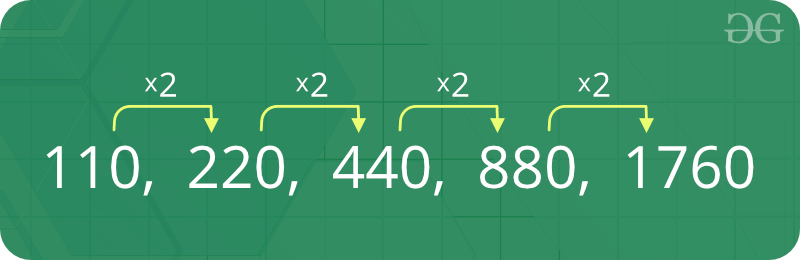
The below diagram shows a sequence in GP with a common ratio of 2.
Properties
- The square of a term in GP is a product of its adjacent terms: a2k = ak-1 × ak+1
- In a finite GP, the product of the terms at the same distance from the beginning and the end is the same. It means, a1 × an = a2 × an-1 =...= ak × an-k+1
- If we multiply or divide a non-zero quantity by each term of the GP, then the resulting sequence is also in GP with the same common ratio. Please note that addition and subtraction do not keep a GP as GP. It is true for AP only.
- The reciprocal of all the terms in GP also forms a GP with a common ratio of 1/r
- If all the terms in a GP are raised to the same power, then the new series is also in GP.
- If three non-zero terms x, y, and z are in GP, then y2 = xz.
- Geometric progressions typically mean either exponential growth or exponential decay, depending on whether the common ratio is 0 < r < 1 or r > 1. This makes it useful in modeling things like population growth, radioactive decay, and interest compounding.
- If we take the log of GP terms, we get an Arithmetic Progression or AP. For example, if the terms of the GP are a, ar, ar2, ar3,… the logarithms of these terms will be loga, loga + logr, loga+2logr, … which form an AP.
- If we select terms at regular intervals (say every kth term) from a GP, those terms also form a GP with a common ratio rk. For example, if we select every third term from 1, 2, 4, 8, 16, 32, 64, ... we get 1, 8, 64, ... which is again a GP with common ratio as 8.
General Form
A geometric sequence is a series of numbers in which the ratio between two consecutive terms is constant. This ratio is known as the common ratio denoted by 'r', where r ≠ 0.
The nth term of the Geometric series is denoted byanand the elements of the sequence are written as a1, a2, a3, a4, ..., an.
a1 = a,
a2 = a*r
a3 = a*r2
a4 = a*r3
an = a*rn-1
**Conditions for the given sequence to be a geometric sequence:
For any sequence to be considered a GP, the ratio of any two successive terms must remain constant:
a2/a1 = a3/a2 = ... = an/an-1 = r (common ratio).
Formulas
The following table shows Key Formulas and Properties:
| Concept | Formula | Description |
|---|---|---|
| General Form | (a, ar, ar^2, \dots) | (a): first term, (r): common ratio |
| nth Term | (T_n = ar^{n-1}) | nth term formula |
| Common Ratio | (r = \frac{T_n}{T_{n-1}}) | Ratio of consecutive terms |
| Sum of n Terms | (\frac{a(r^n - 1)}{r - 1}) | Valid for (r \ne 1) |
| nth from End | (T_n = \frac{l}{r^{n-1}}) | (l): last term |
| Infinite Sum | (\frac{a}{1 - r}) | Only if (0 < r < 1) |
| Geometric Mean | (b^2 = ac) | (b = \sqrt{ac}) |
| kth from End | (T_k = ar^{n-k}) | (n): total terms |
General Form of Geometric Progression
The given sequence can also be written as:
a, ar, ar2, ar3, ... , arn-1
Here, r is the common ratio and a is the scale factor
The common ratio of a Geometric Series is given by:
r = successive term/preceding term = ar^{n-1} / ar^{n-2}
Nth Term of Geometric Progression
The terms of a GP are represented as a1, a2, a3, a4, …, an.
Expressing all these terms according to the first term a1, we get
a1 = a
a2 = a1r
a3 = a2r = (a1r)r = a1r2
a4 = a3r = (a1r2)r = a1r3
…
am = a1rm−1
…
Similarly,
**a n **= a 1 r n - 1
General term or nth term of a geometric sequence a, ar, ar2, ar3, ar4 is given by :
**a n = ar n-1
where,
a1 = first term,
a2 = second term
an = last term (or the nth term)
Nth Term from the Last Term is given by:
**a n = l/r n-1
where, **l is the last term
Geometric Progression Sum of N Terms
The geometric progression summation is given by
**S = a 1 **+ a 2 **+ a 3 **+ … + a n
S = a1 + a1r + a1r2 + a1r3 + … + a1rn−1 ....equation (1)
Multiply both sides of Equation (1) by r (common ratio), and we get
S × r= a1r + a1r2 +a1r3 + a1r4 + … + a1rn ....equation (2)Subtract Equation (2) from Equation (1)
S - Sr = a1 - a1rn
(1 - r)S = a1(1 - rn)
Sn = a1(1 - rn)/(1 - r), if r<1Now, Subtracting Equation (1) from Equation (2) will give
Sr - S = a1rn -a1
(r - 1)S = a1(rn-1)
Hence, the **Sum of the First n Terms of a GP is given by:
Sn = a(1 - rn)/(1 - r), if r < 1
Sn = a(rn -1)/(r - 1), if r > 1
Sum of an Infinite Geometric Progression
The number of terms in an infinite geometric progression will approach infinity (n = ∞). The sum of an infinite geometric progression can only be defined at the ratio of |r| < 1.
Let us take a geometric sequence a, ar, ar2, ..., which has infinite terms. S∞ denotes the sum of the infinite terms of that sequence, then
S∞ = a + ar + ar2 + ar3+ ... + arn +..(1)
Multiply both sides by r,
rS∞ = ar + ar2 + ar3+ ... ... (2)subtracting eq (2) from eq (1),
S∞ - rS∞ = a
S∞ (1 - r) = a
Thus, the Sum of an Infinite Geometric Progression is given by,
**S ∞ = a/(1-r), where |r| < 1
Geometric Sequence Recursive Formula
A recursive formula defines the terms of a sequence in relation to the previous value. As opposed to an explicit formula, which defines it in relation to the term number.
**For an example, let's look at the sequence: 1, 2, 4, 8, 16, 32
Recursive formula of Geometric Series is given by
term(n) = term(n - 1) × 2
To find any term, we must know the previous one. Each term is the product of the common ratio and the previous term.
term(n) = term(n - 1) × r
**Example: Write a recursive formula for the following geometric sequence: 8, 12, 18, 27, …
**Solution:
Given sequence: 8, 12, 18, 27, …
Common ratio: r = 12/8 = 3/2
Recursive formula:
aₙ = aₙ₋₁ × 3/2, for n ≥ 2Initial term:
a₁ = 8Final Answer:
a₁ = 8, aₙ = (3/2)aₙ₋₁ for n ≥ 2.
Types of GP
GP is further classified into two types, which are:
- Finite Geometric Progression (Finite GP)
- Infinite Geometric Progression (Infinite GP)
Finite Geometric Progression
A finite G.P. is a sequence that contains finite terms in a sequence and can be written as a, ar, ar2, ar3,……arn-1, arn.
An example of Finite GP is 1, 2, 4, 8, 16,......512
Infinite Geometric Progression
Infinite G.P. is a sequence that contains infinite terms in a sequence and can be written as a, ar, ar2, ar3,……arn-1, arn......, i.e., it is a sequence that never ends.
Examples of Infinite GP are:
- 1, 2, 4, 8, 16,........
- 1, 1/2, 1/4, 1/8, 1/16,.........
**Related Articles
Solved Examples
**Example 1: Suppose the first term of a GP is 4 and the common ratio is 5, then the first five terms of the GP are?
First term, a = 4
Common ratio, r = 5
Now, the first five term of GP is
a, ar, ar2, ar3, ar4
a = 4
ar = 4 × 5 = 20
ar2 = 4 × 25 = 100
ar3 = 4 × 125 = 500
ar4 = 4 × 625 = 2500
Thus, the first five terms of GP with first term 4 and common ratio 5 are:
4, 20, 100, 500, and 2500
**Example 2: Find the sum of GP: 1, 2, 4, 8, and 16.
Given GP is 1, 2, 4, 8 and 16
First term, a = 1
Common ratio, r = 2/1 = 2 > 1
Number of terms, n = 5
Sum of GP is given by;
Sn = a[(rn – 1)/(r – 1)]
S5 = 1[(25 – 1)/(2 – 1)]
= 1[(32 – 1)/1]
= 1[31/1]
= 1 × 31
= 31
**Example 3: If 3, 9, 27,…., is the GP, then find its 9th term.
nth term of GP is given by:
**a n = ar n-1
given, GP 3, 9, 27,….
Here, a = 3 and r = 9/3 = 3
Therefore,
a9 = 3 x 39 – 1
= 3 × 6561
= 19683
Practice Questions
**Question 1: What is the common ratio of the following sequence: 2, 6, 18, 54, ...? How can this be confirmed?
**Question 2: If the first term of a geometric progression is 3 and the common ratio is 0.5, what are the first five terms of the GP?
**Question 3: In a geometric progression where the first term is 5 and the common ratio is -2, find the 7th term of the sequence.
**Question 4: Calculate the sum of the first 6 terms of the geometric progression: 10, 20, 40, 80, 160, 320.
**Question 5: How would you derive the formula for the nth term of a geometric progression using the first term and the common ratio?
**Question 6 If the sum of the first n terms of a geometric progression is 120, the first term is 5, and the common ratio is 2, what is the value of n?
**Question 7: Determine the 9th term of a geometric progression that starts with 1 and has a common ratio of 3.
**Question 8: How can you find the sum of an infinite geometric progression with a first term of 2 and a common ratio of 0.5?