Creating Relationships in MongoDB (original) (raw)
Last Updated : 5 May, 2026
MongoDB models relationships between data using embedded documents, references (normalized model), and the $lookupaggregation stage, allowing you to balance performance, structure, and query flexibility based on application needs.
- **Embedded documents: Store related data within a single document for faster reads and data locality when accessed together.
- **References (normalized model): Link related documents across collections using IDs for large or independently accessed data and reduced duplication.
- ****$lookup (aggregation):** Perform joins between collections for complex relationships (e.g., many-to-many) when embedding isn’t suitable.
These techniques provide flexibility in handling various data relationships, optimizing both storage and access patterns.
Embedded Document Model
In the Embedded Document Model, related data is stored within a single MongoDB document, allowing associated information (e.g., student and address) to be retrieved in one query for faster access.
- Stores related data as sub-documents in one document.
- Enables single-query retrieval of related information.
- Improves read performance by keeping data together.
- Best for data that is frequently accessed together.
1. One-to-One Relationships with Embedded Documents
Using embedded documents, a one-to-one relationship can be modeled by storing related data (e.g., a student’s address) inside the parent document. This reduces the number of read operations and enables single-query retrieval.
**Before Embedding (Separate Documents)
/// Student document
{
"StudentName": "GeeksA",
"StudentId": "g_f_g_1209",
"Branch": "CSE"
}
// Address document
{
"StudentName": "GeeksA",
"PermanentAddress": "XXXXXXX",
"City": "Delhi",
"PinCode": 202333
}
**Problem with Separate Documents
When address data is frequently accessed, querying separate collections using the same key (e.g., StudentName) requires multiple queries, increasing complexity and read overhead.
**After Embedding (Single Document)
{
"StudentName": "GeeksA",
"StudentId": "g_f_g_1209",
"Branch": "CSE",
"Address": {
"PermanentAddress": "XXXXXXX",
"City": "Delhi",
"PinCode": 202333
}
}
**Advantages
- Single-query retrieval of related data.
- Improved read performance.
- Better data locality.
- Atomic updates within one document.
**Limitations
- Document size can grow as more data (e.g., academics, athletics) is embedded.
- Large documents may slow down reads.
**Subset Pattern (When Documents Grow Large)
If only a subset of fields is frequently accessed, move large or infrequently used data into separate collections (subset pattern) to keep the main document lightweight.
**Trade-off of Subset Pattern
- Improves read performance for common queries.
- Increases maintenance complexity and makes data tracking harder due to data being split across collections.
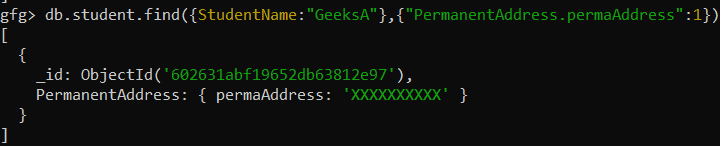
**Example: Display the address of the student
Here, we are working with:
**Database: gfg
**Collection: student
**Documents: One document that contains the details of a student
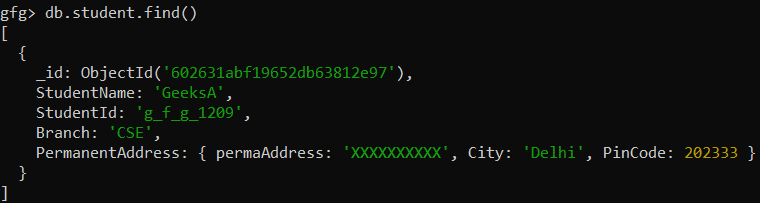
**Query:
db.student.find({StudentName:"GeeksA"},{"PermanentAddress.permaAddress":1})
**Output:
2. One-to-Many Relationships with Embedded Documents
A one-to-many relationship can be modeled using embedded documents when multiple related items (e.g., multiple addresses) belong to a single parent document. This enables efficient single-query retrieval and reduces read operations.
**Before Embedding (Separate Documents)
// Student document
{
"StudentName": "GeeksA",
"StudentId": "g_f_g_1209",
"Branch": "CSE"
}
// Permanent Address document
{
"StudentName": "GeeksA",
"AddressType": "Permanent",
"Address": "XXXXXXX",
"City": "Delhi",
"PinCode": 202333
}
// Current Address document
{
"StudentName": "GeeksA",
"AddressType": "Current",
"Address": "XXXXXXX",
"City": "Mumbai",
"PinCode": 334509
}
**After Embedding (Single Document with Array of Addresses)
{
"StudentName": "GeeksA",
"StudentId": "g_f_g_1209",
"Branch": "CSE",
"Addresses": [
{
"Type": "Permanent",
"Address": "XXXXXXX",
"City": "Delhi",
"PinCode": 202333
},
{
"Type": "Current",
"Address": "XXXXXXX",
"City": "Mumbai",
"PinCode": 334509
}
]
}
**Advantages
- Retrieves all related data in a single query.
- Reduces read operations and query complexity.
- Supports one-to-many relationships using arrays.
- Preserves data locality within one document.
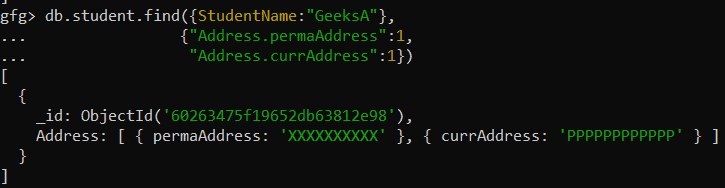
**Example: Display all the addresses of the student
Here, we are working with:
**Database: gfg
**Collection: student
**Documents: One document that contains the details of a student
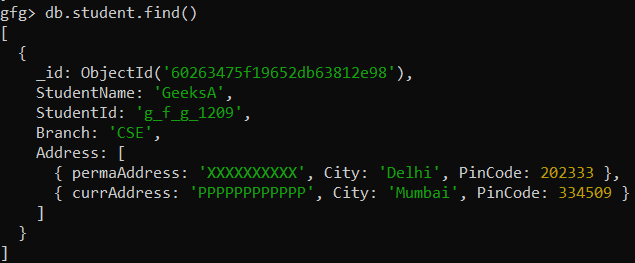
**Query:
db.student.find({StudentName:"GeeksA"},
{"Address.permaAddress":1,
"Address.currAddress":1})
**Output:
**Note:
- Store multiple related items as a bounded array within the parent document.
- Use embedding when related data is frequently accessed together.
Reference Model
In the Normalized (Reference) Data Model, related data is stored in separate collections and linked using references (IDs), enabling normalized relationships and independent access to each entity.
- Stores related data in separate documents/collections.
- Uses reference IDs to link related entities.
- Supports independent queries and updates of related data.
- Suitable for normalized relationships and larger, shared datasets.
1. One-to-Many relationships with the document reference
In the reference model, related data is stored in separate collections, and the parent document maintains references (IDs) to multiple child documents. This is suitable for one-to-many relationships where related entities (e.g., classes) are accessed independently or can grow over time.
**Before Referencing (Separate Documents)
// Teacher document
{
"name": "Sam",
"TeacherId": "g_f_g_1209"
}
// Class 1 document
{
"TeacherId": "g_f_g_1209",
"ClassId": "C_123",
"ClassName": "GeeksA",
"StudentCount": 23,
"Subject": "Science"
}
// Class 2 document
{
"TeacherId": "g_f_g_1209",
"ClassId": "C_234",
"ClassName": "GeeksB",
"StudentCount": 33,
"Subject": "Maths"
}
**Problem
Retrieving all classes taught by a teacher requires multiple queries across collections, increasing query complexity.
**After Referencing (Using IDs in Parent Document)
// Teacher document
{
"name": "Sam",
"TeacherId": "g_f_g_1209",
"ClassIds": ["C_123", "C_234"]
}
Now using these classIds field teacher can easily retrieve the data of class 1 and 2.
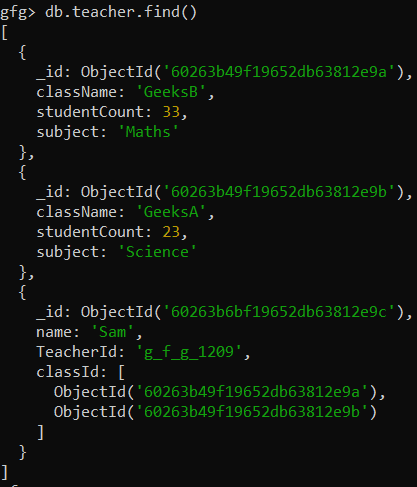
**Example: Display the values of classId field
Here, we are working with:
**Database: gfg
**Collection: teacher
**Documents: Three document that contains the details of the classes
**Query:
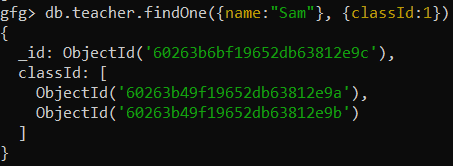
db.teacher.findOne({name:"Sam"}, {classId:1})
**Output: