ThreeTier Architecture of Data Warehouse (original) (raw)
Last Updated : 11 Nov, 2025
Data warehousing helps businesses make informed decisions using large datasets. The Three-Tier Architecture is widely used for its clear structure, dividing data processing into three layers for efficient access and management.
- Bottom Tier (Data Sources and Data Storage)
- Middle Tier (OLAP Engine)
- Top Tier (Front-End Tools)
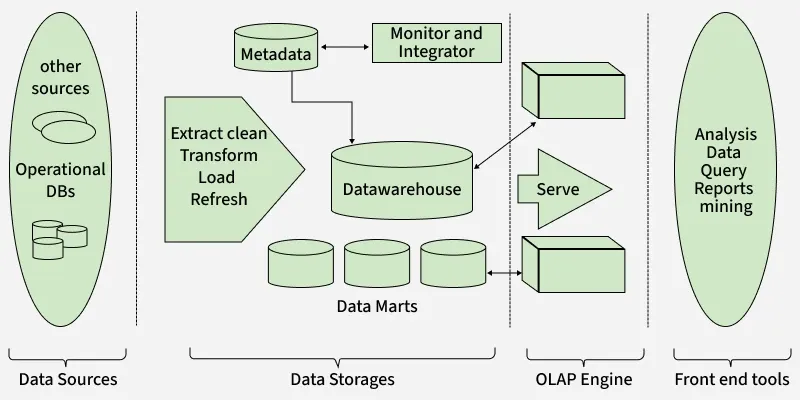
Three/Multi-tier Architecture of Data Warehouse
Bottom Tier
Bottom Tier is the foundation of the data warehouse, responsible for collecting****,** processingand storing data from multiple sources. It plays a critical role in preparing data for analysis.
Key Components:
- **Data Sources: Includes operational databases (OLTP systems), flat files, spreadsheets, external APIs, CRM/ERP systems and web logs. These are the raw inputs feeding into the data warehouse.
- **Data Storage: Processed data is stored in a Relational Database Management System (RDBMS) or a multidimensional database designed to support structured querying and analysis.
This is the core function of the bottom tier:
- **Extract: Gathers raw data from different, often incompatible sources.
- **Transform: Converts data into a consistent format, applying business rules, cleansing errors, handling missing values and resolving duplicates.
- **Load: Loads the transformed data into the warehouse, organizing it for fast access and analysis.
**Note: This process ensures the warehouse contains clean, reliable and business-ready data.
Common Challenges in Bottom Tier
Integrating data from diverse sources presents several challenges such as:
- **Data Quality: Inconsistent data can lead to errors and unreliable analytics.
- **Data Compatibility: Different data formats and structures can complicate integration.
- **Scalability: Handling increasing volumes of data efficiently.
Solutions
- **Implement Robust ETL Tools: Utilize powerful ETL tools like Informatica, Microsoft SSIS or Confluent to streamline the data integration process.
- **Standardize Data Formats: Standardizing data at the point of entry minimizes compatibility issues.
- **Continuous Data Quality Management: Regularly check and clean data to maintain high quality.
- **Scalability Planning: Design data storage solutions that can expand as data volume grows, ensuring that the architecture can handle future increases in data without performance degradation.
Middle Tier
The Middle Tier hosts the OLAP server, which processes complex analytical queries. It acts as a bridge between the data storage layer (bottom tier) and the user interface (top tier), ensuring data is quickly retrieved, aggregated and ready for reporting and analysis. It is designed for high-speed analytical processing. OLAP server models come in three different categories, including:
- **ROLAP (Relational OLAP):This model uses a relational database to store and manage warehouse data. It is ideal for handling large data volumes as it operates directly on relational databases.
- **MOLAP (Multidimensional OLAP): This model stores data in a multidimensional cube. The storage and retrieval processes are highly efficient, making MOLAP suitable for complex analytical queries that require aggregation.
- **HOLAP (Hybrid OLAP): It is combination of relational and multidimensional online analytical processing paradigms. HOLAP is the ideal option for a seamless functional flow across the database systems when the repository houses both the relational database management system and the multidimensional database management system.
**Note: OLAP is a powerful technology for complex calculations, trend analysis and data modeling.
Common Challenges in Middle Tier
- **Data Latency: Delays in data availability can impact decision-making.
- **Query Performance: Managing large volumes of data can slow down query performance.
- **Data Integration: Combining data from different sources with varying formats can be challenging.
Solutions
- **Real-Time & Incremental Loading: Update data frequently using real-time and incremental loading to reduce latency and support faster decision-making.
- **Query Optimization: Improve performance with indexing, partitioning and optimized SQL for faster data retrieval.
- **Standardization & Integration Tools: Standardize data formats and use tools like Talend or Informatica for seamless integration and improved data quality.
Top Tier
The Top Tier in the Three-Tier Data Warehouse Architecture comprises the front-end client layer, which is essential for interacting with the data stored and processed in the lower tiers. This layer includes a variety of business intelligence (BI) tools and techniques designed to facilitate easy access and manipulation of data for reporting, analysis, and decision-making.
BI tools are critical components of the Top Tier, providing robust platforms through which users can query, report, and analyze data. Popular BI tools include:
- **IBM Cognos: Offers comprehensive reporting capabilities.
- **Microsoft BI Platform: Integrates well with existing Microsoft products, providing a familiar interface for users.
- **SAP BW: Specializes in managing large datasets and integrating with other SAP products.
- **Crystal Reports: Known for its powerful reporting features.
- **SAS Business Intelligence: Provides advanced analytics.
- **Pentaho: A versatile tool for data integration and visualization.
**Note: The Top Tier is crucial for decision-making as it provides the interface through which insights are accessed and explored. By presenting data in visual formats such as graphs, charts and dashboards, these tools allow decision-makers to quickly grasp complex patterns, trends and anomalies, leading to faster and more effective decision-making.
Common Challenges in Top Tier
- **Usability Issues: Complex tools can hinder user adoption and effectiveness.
- **Integration Difficulties: Ensuring seamless integration with other tiers can be challenging.
Solutions
- **User Training and Support: Offering comprehensive training sessions to help users fully leverage the capabilities of BI tools.
- **Choosing Integrative Tools: Select tools that easily integrate with existing systems in the data warehouse architecture, ensuring consistency and reliability in data handling.