Lemmatization vs. Stemming (original) (raw)
Last Updated : 5 Jan, 2026
Lemmatization and stemming are two popular text‑preprocessing techniques in NLP used to reduce words to their base form. While stemming cuts words down to their root by trimming endings, lemmatization uses linguistic rules to return meaningful base words (lemmas). Understanding the difference helps improve text analysis, search accuracy and NLP model performance.
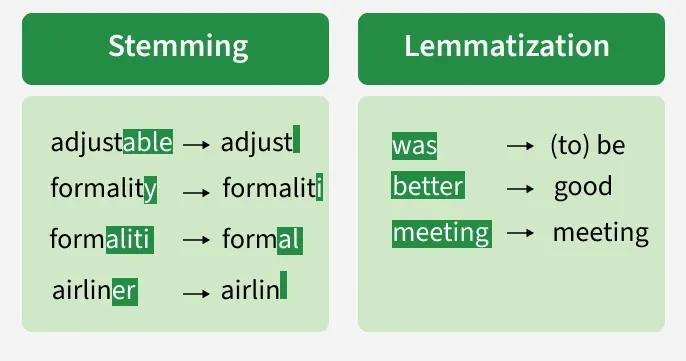
Lemmatization vs. Stemming
Stemming
Stemming is a rule-based text normalisation technique that reduces words to their root form by removing prefixes or suffixes. The resulting form called a stem, may not be a valid or meaningful word in the language.
- Each word is processed independently without considering context
- The algorithm checks for common suffixes or prefixes
- Predefined heuristic rules are applied to strip these affixes
- The remaining part of the word is returned as the stem
- No grammatical or semantic validation is performed
In essence, stemming performs mechanical truncation of words.
Techniques Used
- **Suffix Stripping: Removes common endings like -ing, -ed, -es
- **Rule-Based Truncation: Applies fixed linguistic rules
- **Aggressive Reduction: Shortens words for maximum generalization
**Example:
| Original Word | Stem |
|---|---|
| running | run |
| studies | studi |
| smiling | smile |
| communication | commun |
Implementation
Python `
from nltk.stem import PorterStemmer stemmer = PorterStemmer() words = ["running", "studying", "smiling", "communication"] stemmed_words = [stemmer.stem(word) for word in words] print(stemmed_words)
`
**Output:
['run', 'studi', 'smile', 'commun']
Applications
- **Search Engines: Stemming improves query matching by treating different morphological forms of a word as the same term, thereby increasing recall in search results.
- **Information Retrieval Systems: It helps retrieve relevant documents even when query terms and document terms differ in grammatical form.
- **Document Indexing: It reduces the number of unique terms stored in indexes, improving storage efficiency and retrieval speed.
- **Text Classification: It simplifies feature representation by grouping related word forms under a single stem.
- **Keyword Matching Systems: Stemming enables approximate matching of keywords in rule-based or lightweight NLP systems.
Lemmatization
Lemmatization is a linguistically driven text normalization technique that converts words into their base dictionary form, known as a lemma, by considering grammar, vocabulary and context.
- Considers part of speech (POS) of the word that is identified
- The word is matched against a lexical database
- Grammar-based rules are applied
- Inflected forms are mapped to their base lemma
- A valid dictionary word is returned
- Context-aware and accurate
- Computationally more expensive
Techniques Used
- **Dictionary Lookup: Maps words to valid base forms
- **POS Tagging: Determines grammatical role
- **Morphological Analysis: Handles inflection and derivation
Example
| Original Word | Lemma | POS |
|---|---|---|
| running | run | Verb |
| better | good | Adjective |
| studies | study | Noun |
| was | be | Verb |
Implementation
Python `
from nltk.stem import WordNetLemmatizer from nltk.corpus import wordnet lemmatizer = WordNetLemmatizer() words = ["running", "better", "studies", "was"] lemmas = [ lemmatizer.lemmatize("running", pos=wordnet.VERB), lemmatizer.lemmatize("better", pos=wordnet.ADJ), lemmatizer.lemmatize("studies", pos=wordnet.NOUN), lemmatizer.lemmatize("was", pos=wordnet.VERB) ] print(lemmas)
`
**Output:
['run', 'good', 'study', 'be']
Applications
- **Sentiment Analysis: Lemmatization preserves word meaning, leading to more accurate sentiment classification.
- **Text Summarization: It helps identify core concepts by reducing words to meaningful base forms.
- **Chatbots and Conversational AI: Ensures correct understanding of user intent by maintaining semantic integrity.
- **Question Answering Systems: Improves matching between questions and answers by using valid base words.
- **Topic Modeling: Produces coherent topics by grouping semantically related words correctly.
Lemmatization vs. Stemming
Let's compare the two techniques:
| Aspect | Lemmatization | Stemming |
|---|---|---|
| Definition | Converts words to their base or dictionary form (lemma). | Reduces words to their root form (stem) which may not be a valid word. |
| Complexity | Higher complexity, context-aware. | Lower complexity, context-agnostic. |
| Algorithms | Uses dictionaries and morphological analysis. | Uses rule-based algorithms like Porter, Snowball and Lancaster Stemmers. |
| Accuracy | Produces more accurate and meaningful words. | Less accurate, may produce non-meaningful stems. |
| Output Example | "Running" → "run", "Better" → "good". | "Running" → "run" or "runn", "Better" → "bett". |
| Use in Search Engines | Better search results through understanding context. | Useful for quick search indexing |
| Text Analysis | Essential for tasks needing accurate word forms (e.g., sentiment analysis, topic modeling) | Used for initial stages of preprocessing to reduce word variability |
| Machine Translation | Helps in producing grammatically correct translations | Less common due to potential inaccuracy |
| Information Retrieval | Suitable for detailed and precise analysis | Useful for reducing data dimensionality |