What is Text Embedding? (original) (raw)
Last Updated : 23 Jul, 2025
**Text embeddings are vector representations of text that map the original text into a mathematical space where words or sentences with similar meanings are located near each other. Unlike traditional one-hot encoding, where each word is represented as a sparse vector with a single '1' for the corresponding word and '0's elsewhere, text embeddings allow for more nuanced representations, capturing relationships and meanings of words.
Text embeddings are generated by neural network models that learn to map text to vectors such that words with similar meanings have similar representations. These vectors contain a compressed version of the original text, preserving semantic properties, such as word similarity and syntactic relationships.
Types of Text Embeddings
**1. Word Embeddings
- **Word2Vec: One of the earliest and most popular algorithms for generating word embeddings. Word2Vec uses a shallow neural network model to learn word representations based on context. The two main architectures of Word2Vec are:
- **Continuous Bag of Words (CBOW): Predicts the target word based on the context words.
- **Skip-gram: Predicts the context words based on the target word.
- **GloVe: GloVe (Global Vectors for Word Representation) is another popular algorithm. It differs from Word2Vec by constructing a co-occurrence matrix and factorizing it to create word embeddings. GloVe captures global statistical information about word usage.
**2. Sentence Embeddings
- **Doc2Vec: An extension of Word2Vec that generates vector representations for entire documents, rather than individual words.
- **Universal Sentence Encoder (USE): This model generates fixed-length sentence embeddings and is used in a variety of NLP tasks, such as semantic textual similarity.
- **Sentence-BERT (SBERT): A modification of BERT (Bidirectional Encoder Representations from Transformers) designed specifically for generating sentence embeddings. It allows for better semantic search and sentence similarity tasks.
**3. Contextualized Embeddings
- **BERT (Bidirectional Encoder Representations from Transformers): BERT generates contextual embeddings where the representation of each word depends on the surrounding words in the sentence. This enables BERT to capture word meanings more accurately in different contexts.
- **GPT (Generative Pre-trained Transformer): Like BERT, GPT generates contextual embeddings but in a unidirectional manner, which makes it more suitable for text generation tasks.
Why Are Text Embeddings Important?
- **Capturing Semantic Relationships: Traditional methods like one-hot encoding cannot capture relationships between words. For example, words like "cat" and "dog" are very similar in meaning, but one-hot encoding treats them as completely different entities. With text embeddings, the vector space ensures that these similar words are represented closely to each other.
- **Efficient Representation: Embeddings allow for compact representation of text data. Instead of using sparse vectors (like one-hot encoding), dense vectors represent the text more efficiently, reducing memory usage and computation time.
- **Transferability: Pre-trained embeddings, such as Word2Vec, GloVe, and BERT, can be fine-tuned for specific tasks. This enables transfer learning, where a model trained on a large dataset can be adapted to a smaller, task-specific dataset, reducing the need for large amounts of labeled data.
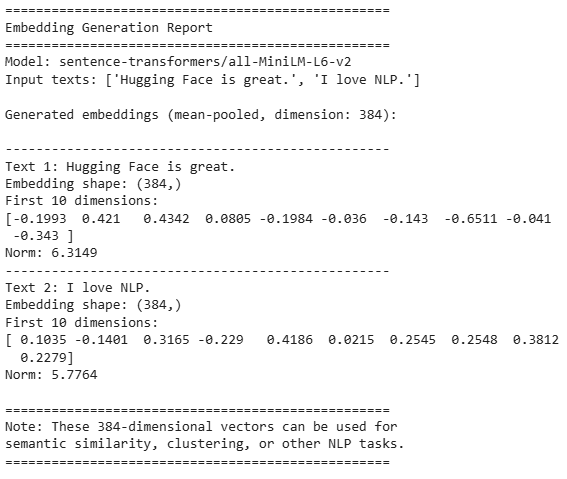
Text Embedding using Sentence Transformer (HuggingFace)
Python `
from transformers import AutoTokenizer, AutoModel import torch import numpy as np
Load pre-trained model and tokenizer
model_name = "sentence-transformers/all-MiniLM-L6-v2" tokenizer = AutoTokenizer.from_pretrained(model_name) model = AutoModel.from_pretrained(model_name)
texts = ["Hugging Face is great.", "I love NLP."] inputs = tokenizer(texts, padding=True, truncation=True, return_tensors="pt")
with torch.no_grad(): outputs = model(**inputs)
Extracting embeddings (mean pooling)
embeddings = outputs.last_hidden_state.mean(dim=1) embeddings_np = embeddings.numpy().round(decimals=4)
Output
print(f"\n{'='*50}") print(f"Embedding Generation Report") print(f"{'='*50}") print(f"Model: {model_name}") print(f"Input texts: {texts}") print(f"\nGenerated embeddings (mean-pooled, dimension: {embeddings.shape[1]}):\n")
for i, (text, embedding) in enumerate(zip(texts, embeddings_np)): print(f"{'-'*50}") print(f"Text {i+1}: {text}") print(f"Embedding shape: {embedding.shape}") print(f"First 10 dimensions:\n{embedding[:10]}") print(f"Norm: {np.linalg.norm(embedding):.4f}")
print(f"\n{'='*50}") print(f"Note: These {embeddings.shape[1]}-dimensional vectors can be used for") print(f"semantic similarity, clustering, or other NLP tasks.") print(f"{'='*50}")
`
**Output:
How Are Text Embeddings Used?
- **Semantic Search: Text embeddings are used to build search engines that return results based on the semantic meaning of queries rather than simple keyword matches. This is particularly useful in systems like search engines, recommendation systems, and question-answering bots.
- **Clustering and Similarity Analysis: Embeddings can be used to cluster similar documents or sentences together. For example, you can group news articles or product descriptions that are related to the same topic or category. Embeddings also allow for efficient similarity computation, making it easier to find similar items.
- **Machine Translation: Text embeddings are used in translation models to represent words and sentences in a language-neutral space. By aligning text embeddings from different languages, machine translation models can map words from one language to another effectively.
- **Text Classification: Text embeddings are often used as input features for classifiers. For example, sentiment analysis models use sentence embeddings to determine whether a given text has a positive or negative sentiment.
- **Feature Engineering: In many NLP tasks, embeddings can serve as features that feed into other machine learning models. These models can learn to make predictions or classify data based on the embeddings.
Challenges and Limitations
- **Interpretability: Text embeddings are often seen as a "black box" because it’s difficult to directly interpret what a specific dimension in the vector represents. This can make it challenging to understand the reasoning behind the model’s decisions.
- **Biases: Like any machine learning model, text embeddings can inherit biases present in the training data. If the training data contains gender, racial, or other biases, the embeddings might reflect those biases, leading to biased predictions and decisions.
- **Context Limitations: While models like BERT provide contextualized embeddings, they may still struggle with capturing extremely complex or domain-specific relationships. Fine-tuning is often required to adapt embeddings to specific tasks.