Buddy Memory Allocation Program | Set 2 (Deallocation) (original) (raw)
Last Updated : 11 Jul, 2025
Prerequisite - Buddy Allocation | Set 1
**Question: Write a program to implement the buddy system of memory allocation and deallocation in Operating Systems.
**Explanation -
As we already know from Set 1, the allocation is done via the usage of free lists. Now, for deallocation, we will maintain an extra data structure-a Map (unordered_set in C++, HashMap in Java) with the starting address of segment as key and size of the segment as value and update it whenever an allocation request comes. Now, when a deallocation request comes, we will first check the map to see if it is a valid request. If so, we will then add the block to the free list tracking blocks of their sizes. Then, we will search the free list to see if its _buddy is free-if so, we will merge the blocks and place them on the free list above them (which tracks blocks of double the size), else we will not coalesce and simply return after that.
How to know which block is a given block's buddy?
Let us define two terms-**buddyNumber and **buddyAddress. The **buddyNumber of a block is calculated by the formula:
(base_address-starting_address_of_main_memory)/block_size
We note that this is always an integer, as both numerator and denominator are powers of 2. Now, a block will be another block's buddy if both of them were formed by the splitting of the same bigger block. For example, if 4 consecutive allocation requests of 16 bytes come, we will end up with blocks 0-15, 16-31, 32-47, 48-63 where blocks 0-15 and 16-31 are buddies (as they were formed by splitting block 0-32) but 0-15 and 32-47 aren't. The **buddyAddress of a block is the starting index of its buddy block, given by the formula:
block_starting_address+block_size (if buddyNumber is even)
block_starting_address-block_size (if buddyNumber is odd)
Thus, all we have to do is find this **buddyAddress in the free list (by comparing with all the starting addresses in that particular list), and if present, coalescing can be done.
**Examples:
Let us see how the algorithm proceeds by tracking a memory block of size 128 KB. Initially, the free list is: {}, {}, {}, {}, {}, {}, {}, { (0, 127) }
- **Allocation Request: 16 bytes
No such block found, so we traverse up and split the 0-127 block into 0-63, 64-127; we add 64-127 to list tracking 64-byte blocks and pass 0-63 downwards; again it is split into 0-31 and 32-63; we add 32-63 to list tracking 32-byte blocks, passing 0-31 downwards; one more splits done and 0-15 is returned to the user while 16-31 is added to free list tracking 16-byte blocks.
List is: {}, {}, {}, {}, { (16, 31) }, { (32, 63) }, { (64, 127) }, {} - **Allocation Request: 16 bytes
Straight-up memory segment 16-31 will be allocated as it already exists.
List is: {}, {}, {}, {}, {}, { (32, 63) }, { (64, 127) }, {} - **Allocation Request: 16 bytes
No such block was found, so we will traverse up to block 32-63 and split it into blocks 32-47 and 48-63; we will add 48-63 to list tracking 16-byte blocks and return 32-47 to a user.
List is: {}, {}, {}, {}, { (48, 63) }, {}, { (64, 127) }, {} - **Allocation Request: 16 bytes
Straight-up memory segment 48-63 will be allocated as it already exists.
List is: {}, {}, {}, {}, {}, {}, { (64, 127) }, {} - **Deallocation Request: StartIndex = 0
Deallocation will be done but no coalescing is possible as its **buddyNumber is 0 and **buddyAddress is 16 (via the formula), none of which is in the free list.
List is: {}, {}, {}, {}, { (0, 15) }, {}, { (64, 127) }, {} - **Deallocation Request: StartIndex = 9
Result: Invalid request, as this segment was never allocated.
List is: {}, {}, {}, {}, { (0, 15) }, {}, { (64, 127) }, {} - **Deallocation Request: StartIndex = 32
Deallocation will be done but no coalescing is possible as the **buddyNumber of the blocks are 0 and 2 **buddyAddress of the blocks are 16 and 48, respectively, none of which is in the free list.
List is: {}, {}, {}, {}, { (0, 15), (32-47) }, {}, { (64, 127) }, {} - **Deallocation Request: StartIndex = 16
Deallocation will be done and coalescing of the blocks 0-15 and 16-31 will also be done as the **buddyAddress of block 16-31 is 0, which is present in the free list tracking 16-byte blocks.
List is: {}, {}, {}, {}, { (32-47) }, { (0, 31) }, { (64, 127) }, {}
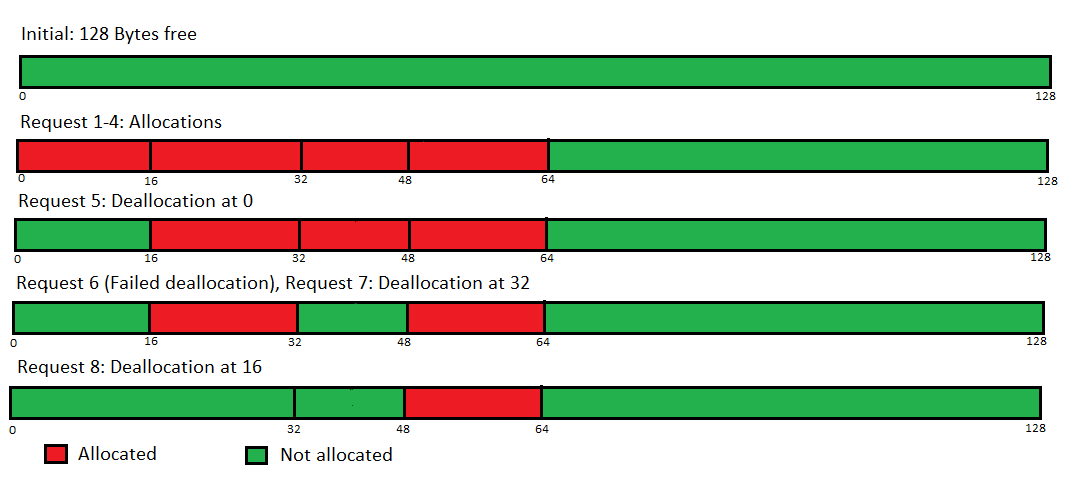
Figure - Buddy algorithm-allocation and deallocation
**Implementation -
Below is the complete program.
C++ `
#include<bits/stdc++.h> using namespace std;
// Size of vector of pairs int size;
// Global vector of pairs to track all // the free nodes of various sizes vector<pair<int, int>> arr[100000];
// Map used as hash map to store the // starting address as key and size // of allocated segment key as value map<int, int> mp;
void Buddy(int s) {
// Maximum number of powers of 2 possible
int n = ceil(log(s) / log(2));

size = n + 1;
for(int i = 0; i <= n; i++)
    arr[i].clear();

// Initially whole block of specified
// size is available
arr[n].push_back(make_pair(0, s - 1));
}
void allocate(int s) {
// Calculate index in free list
// to search for block if available
int x = ceil(log(s) / log(2));

// Block available
if (arr[x].size() > 0)
{
    pair<int, int> temp = arr[x][0];

    // Remove block from free list
    arr[x].erase(arr[x].begin());

    cout << "Memory from " << temp.first
         << " to " << temp.second
         << " allocated" << "\n";

    // Map starting address with
    // size to make deallocating easy
    mp[temp.first] = temp.second -
                     temp.first + 1;
}
else
{
    int i;

    // If not, search for a larger block
    for(i = x + 1; i < size; i++)
    {

        // Find block size greater
        // than request
        if (arr[i].size() != 0)
            break;
    }

    // If no such block is found
    // i.e., no memory block available
    if (i == size)
    {
        cout << "Sorry, failed to allocate memory\n";
    }

    // If found
    else
    {
        pair<int, int> temp;
        temp = arr[i][0];

        // Remove first block to split
        // it into halves
        arr[i].erase(arr[i].begin());
        i--;

        for(;i >= x; i--)
        {

            // Divide block into two halves
            pair<int, int> pair1, pair2;
            pair1 = make_pair(temp.first,
                              temp.first +
                             (temp.second -
                              temp.first) / 2);
            pair2 = make_pair(temp.first +
                             (temp.second -
                              temp.first + 1) / 2,
                              temp.second);

            arr[i].push_back(pair1);

            // Push them in free list
            arr[i].push_back(pair2);
            temp = arr[i][0];

            // Remove first free block to
            // further split
            arr[i].erase(arr[i].begin());
        }

        cout << "Memory from " << temp.first
             << " to " << temp.second
             << " allocate" << "\n";

        mp[temp.first] = temp.second -
                         temp.first + 1;
    }
}
}
void deallocate(int id) {
// If no such starting address available
if(mp.find(id) == mp.end())
{
    cout << "Sorry, invalid free request\n";
    return;
}

// Size of block to be searched
int n = ceil(log(mp[id]) / log(2));

int i, buddyNumber, buddyAddress;

// Add the block in free list
arr[n].push_back(make_pair(id,
                           id + pow(2, n) - 1));
cout << "Memory block from " << id
     << " to "<< id + pow(2, n) - 1
     << " freed\n";

// Calculate buddy number
buddyNumber = id / mp[id];

if (buddyNumber % 2 != 0)
    buddyAddress = id - pow(2, n);
else
    buddyAddress = id + pow(2, n);

// Search in free list to find it's buddy
for(i = 0; i < arr[n].size(); i++)
{

    // If buddy found and is also free
    if (arr[n][i].first == buddyAddress)
    {

        // Now merge the buddies to make
        // them one large free memory block
        if (buddyNumber % 2 == 0)
        {
            arr[n + 1].push_back(make_pair(id,
               id + 2 * pow(2, n) - 1));

            cout << "Coalescing of blocks starting at "
                 << id << " and " << buddyAddress
                 << " was done" << "\n";
        }
        else
        {
            arr[n + 1].push_back(make_pair(
                buddyAddress, buddyAddress +
                2 * pow(2, n) - 1));

            cout << "Coalescing of blocks starting at "
                 << buddyAddress << " and "
                 << id << " was done" << "\n";
        }
        arr[n].erase(arr[n].begin() + i);
        arr[n].erase(arr[n].begin() +
        arr[n].size() - 1);
        break;
    }
}

// Remove the key existence from map
mp.erase(id);
}
// Driver code int main() {
// Uncomment following code for interactive IO
/*
int total,c,req;
cout<<"Enter Total Memory Size (in Bytes) => ";
cin>>total;
initialize(total);
label:
while(1)
{
    cout<<"\n1. Add Process into Memory\n
    2. Remove Process \n3. Allocation Map\n4. Exit\n=> ";
    cin>>c;
    switch(c)
    {
        case 1:
        cout<<"Enter Process Size (in Bytes) => ";
        cin>>req;
        cout<<"\n===>";
        allocate(req);
        break;

        case 2:
        cout<<"Enter Starting Address => ";
        cin>>req;
        cout<<"\n===>";
        deallocate(req);
        break;

        case 3:
        print();
        break;

        case 4:
        exit(0);
        break;

        default:
        goto label;
    }
}*/

Buddy(128);
allocate(16);
allocate(16);
allocate(16);
allocate(16);
deallocate(0);
deallocate(9);
deallocate(32);
deallocate(16);

return 0;
}
// This code is contributed by sarthak_eddy
Java
import java.io.; import java.util.;
class Buddy {
// Inner class to store lower
// and upper bounds of the allocated memory
class Pair {

    int lb, ub;
    Pair(int a, int b)
    {
        lb = a;
        ub = b;
    }
}

// Size of main memory
int size;

// Array to track all
// the free nodes of various sizes
ArrayList<Pair> arr[];

// Hashmap to store the starting
// address and size of allocated segment
// Key is starting address, size is value
HashMap<Integer, Integer> hm;

// Else compiler will give warning
// about generic array creation
@SuppressWarnings("unchecked")
Buddy(int s)
{

    size = s;
    hm = new HashMap<>();

    // Gives us all possible powers of 2
    int x = (int)Math.ceil(Math.log(s) / Math.log(2));

    // One extra element is added
    // to simplify arithmetic calculations
    arr = new ArrayList[x + 1];

    for (int i = 0; i <= x; i++)
        arr[i] = new ArrayList<>();

    // Initially, only the largest block is free
    // and hence is on the free list
    arr[x].add(new Pair(0, size - 1));
}

void allocate(int s)
{

    // Calculate which free list to search to get the
    // smallest block large enough to fit the request
    int x = (int)Math.ceil(Math.log(s) / Math.log(2));

    int i;
    Pair temp = null;

    // We already have such a block
    if (arr[x].size() > 0) {

        // Remove from free list
        // as it will be allocated now
        temp = (Pair)arr[x].remove(0);
        System.out.println("Memory from " + temp.lb
                        + " to " + temp.ub + " allocated");

        // Store in HashMap
        hm.put(temp.lb, temp.ub - temp.lb + 1);
        return;
    }

    // If not, search for a larger block
    for (i = x + 1; i < arr.length; i++) {

        if (arr[i].size() == 0)
            continue;

        // Found a larger block, so break
        break;
    }

    // This would be true if no such block was found
    // and array was exhausted
    if (i == arr.length) {

        System.out.println("Sorry, failed to allocate memory");
        return;
    }

    // Remove the first block
    temp = (Pair)arr[i].remove(0);

    i--;

    // Traverse down the list
    for (; i >= x; i--) {

        // Divide the block in two halves
        // lower index to half-1
        Pair newPair = new Pair(temp.lb, temp.lb
                                + (temp.ub - temp.lb) / 2);

        // half to upper index
        Pair newPair2 = new Pair(temp.lb
                                + (temp.ub - temp.lb + 1) / 2,
                                temp.ub);

        // Add them to next list
        // which is tracking blocks of smaller size
        arr[i].add(newPair);
        arr[i].add(newPair2);

        // Remove a block to continue the downward pass
        temp = (Pair)arr[i].remove(0);
    }

    // Finally inform the user
    // of the allocated location in memory
    System.out.println("Memory from " + temp.lb
                    + " to " + temp.ub + " allocated");

    // Store in HashMap
    hm.put(temp.lb, temp.ub - temp.lb + 1);
}
void deallocate(int s)
{
    // Invalid reference, as this was never allocated
    if (!hm.containsKey(s)) {
        System.out.println("Sorry, invalid free request");
        return;
    }

    // Get the list which will track free blocks
    // of this size
    int x = (int)Math.ceil(Math.log(hm.get(s))
                                    / Math.log(2));
    int i, buddyNumber, buddyAddress;

    // Add it to the free list
    arr[x].add(new Pair(s, s + (int)Math.pow(2, x) - 1));
    System.out.println("Memory block from " + s + " to "
                       + (s + (int)Math.pow(2, x) - 1) + " freed");


    // Calculate it's buddy number and buddyAddress. The
    // base address is implicitly 0 in this program, so no
    // subtraction is necessary for calculating buddyNumber
    buddyNumber = s / hm.get(s);

    if (buddyNumber % 2 != 0) {
        buddyAddress = s - (int)Math.pow(2, x);
    }

    else {
        buddyAddress = s + (int)Math.pow(2, x);
    }


    // Search in the free list for buddy
    for (i = 0; i < arr[x].size(); i++) {


        // This indicates the buddy is also free
        if (arr[x].get(i).lb == buddyAddress) {

            // Buddy is the block after block
            // with this base address
            if (buddyNumber % 2 == 0) {

                // Add to appropriate free list
                arr[x + 1].add(new Pair(s, s
                              + 2 * ((int)Math.pow(2, x)) - 1));
                System.out.println("Coalescing of blocks starting at "
                                        + s + " and "
                                        + buddyAddress + " was done");
            }

            // Buddy is the block before block
            // with this base address
            else {

                // Add to appropriate free list
                arr[x + 1].add(new Pair(buddyAddress,
                                buddyAddress + 2 * ((int)Math.pow(2, x))
                                                                     - 1));
                System.out.println("Coalescing of blocks starting at "
                                            + buddyAddress + " and "
                                            + s + " was done");
            }

            // Remove the individual segments
            // as they have coalesced
            arr[x].remove(i);
            arr[x].remove(arr[x].size() - 1);
            break;
        }
    }

    // Remove entry from HashMap
    hm.remove(s);
}

public static void main(String args[]) throws IOException
{
    int initialMemory = 0, type = -1, val = 0;

    // Uncomment below section for interactive I/O
    /*Scanner sc=new Scanner(System.in);
    initialMemory = sc.nextInt();
    Buddy obj=new Buddy(initialMemory);
    while(true)
    {
        type = sc.nextInt();
        if(type==-1)
        break;
        else if(type==1)
        {
            val=sc.nextInt();
            obj.allocate(val);
        }
        else
        {
            val=sc.nextInt();
            obj.deallocate(val);
        }
    }*/

    initialMemory = 128;
    Buddy obj = new Buddy(initialMemory);
    obj.allocate(16);
    obj.allocate(16);
    obj.allocate(16);
    obj.allocate(16);
    obj.deallocate(0);
    obj.deallocate(9);
    obj.deallocate(32);
    obj.deallocate(16);
}
}
Python3
import math
Size of list of pairs
size = 0
Global list of pairs to track all
the free nodes of various sizes
arr = [None] * 100000
Dictionary used as hash map to store the
starting address as key and size
of allocated segment key as value
mp = {}
def Buddy(s): global size # Maximum number of powers of 2 possible n = math.ceil(math.log(s, 2))
size = n + 1
for i in range(0, n+1):
    arr[i] = []

# Initially whole block of specified
# size is available
arr[n].append((0, s - 1))
def allocate(s): # Calculate index in free list # to search for block if available x = math.ceil(math.log(s, 2))
# Block available
if len(arr[x]) > 0:
    temp = arr[x][0]

    # Remove block from free list
    arr[x].remove(temp)

    print(f"Memory from {temp[0]} to {temp[1]} allocated")

    # Map starting address with
    # size to make deallocating easy
    mp[temp[0]] = temp[1] - temp[0] + 1
else:
    i = 0
    # If not, search for a larger block
    for i in range(x + 1, size):
        # Find block size greater
        # than request
        if len(arr[i]) != 0:
            break

    # If no such block is found
    # i.e., no memory block available
    if i == size:
        print("Sorry, failed to allocate memory")
    else:
        temp = arr[i][0]

        # Remove first block to split
        # it into halves
        arr[i].remove(temp)
        i -= 1

        while i >= x:
            # Divide block into two halves
            pair1, pair2 = (temp[0], temp[0] + (temp[1] - temp[0]) // 2), (temp[0] + (temp[1] - temp[0] + 1) // 2, temp[1])
            arr[i].append(pair1)

            # Push them in free list
            arr[i].append(pair2)
            temp = arr[i][0]

            # Remove first free block to
            # further split
            arr[i].remove(temp)
            i -= 1

        print(f"Memory from {temp[0]} to {temp[1]} allocated")
        mp[temp[0]] = temp[1] - temp[0] + 1
def deallocate(id): # If no such starting address available if id not in mp: print("Sorry, invalid free request") return
# Size of block to be searched
n = math.ceil(math.log(mp[id], 2))

i = 0
buddyNumber = 0
buddyAddress = 0

# Add the block in free list
arr[n].append((id, id + 2**n - 1))
print(f"Memory block from {id} to {id + 2**n - 1} freed")

# Calculate buddy number
buddyNumber = id // mp[id]

if buddyNumber % 2 != 0:
    buddyAddress = id - 2**n
else:
    buddyAddress = id + 2**n

# Search in free list to find it's buddy
for i in range(0, len(arr[n])):
    # If buddy found and is also free
    if arr[n][i][0] == buddyAddress:
        # Now merge the buddies to make
        # them one large free memory block
        if buddyNumber % 2 == 0:
            arr[n + 1].append((id, id + 2 * 2**n - 1))
            print(f"Coalescing of blocks starting at {id} and {buddyAddress} was done")
        else:
            arr[n + 1].append((buddyAddress, buddyAddress + 2 * 2**n - 1))
            print(f"Coalescing of blocks starting at {buddyAddress} and {id} was done")
        arr[n].remove(arr[n][i])
        arr[n].remove(arr[n][-1])
        break

# Remove the key existence from map
del mp[id]
Driver code
def main(): Buddy(128) allocate(16) allocate(16) allocate(16) allocate(16) deallocate(0) deallocate(9) deallocate(32) deallocate(16)
if name == "main": main()
C#
using System; using System.Collections.Generic;
public class Buddy {
// Inner class to store lower
// and upper bounds of the
// allocated memory
class Pair
{
    public int lb, ub;
    public Pair(int a, int b)
    {
        lb = a;
        ub = b;
    }
}

// Size of main memory
int size;

// Array to track all
// the free nodes of various sizes
List<Pair> []arr;

// Hashmap to store the starting
// address and size of allocated segment
// Key is starting address, size is value
Dictionary<int, int> hm;

// Else compiler will give warning
// about generic array creation
Buddy(int s)
{

    size = s;
    hm = new Dictionary<int, int>();

    // Gives us all possible powers of 2
    int x = (int)Math.Ceiling(Math.Log(s) /
                              Math.Log(2));

    // One extra element is added
    // to simplify arithmetic calculations
    arr = new List<Pair>[x + 1];

    for (int i = 0; i <= x; i++)
        arr[i] = new List<Pair>();

    // Initially, only the largest block is
    // free and hence is on the free list
    arr[x].Add(new Pair(0, size - 1));
}

void allocate(int s)
{

    // Calculate which free list to
    // search to get the smallest block
    // large enough to fit the request
    int x = (int)Math.Ceiling(Math.Log(s) /
                              Math.Log(2));

    int i;
    Pair temp = null;

    // We already have such a block
    if (arr[x].Count > 0)
    {

        // Remove from free list
        // as it will be allocated now
        temp = (Pair)arr[x][0];
        arr[x].RemoveAt(0);
        Console.WriteLine("Memory from " + temp.lb +
                   " to " + temp.ub + " allocated");

        // Store in Dictionary
        hm.Add(temp.lb, temp.ub - temp.lb + 1);
        return;
    }

    // If not, search for a larger block
    for (i = x + 1; i < arr.Length; i++)
    {
        if (arr[i].Count == 0)
            continue;

        // Found a larger block, so break
        break;
    }

    // This would be true if no such block
    // was found and array was exhausted
    if (i == arr.Length)
    {
        Console.WriteLine("Sorry, failed to" +
                          " allocate memory");
        return;
    }

    // Remove the first block
    temp = (Pair)arr[i][0];
    arr[i].RemoveAt(0);

    i--;

    // Traverse down the list
    for (; i >= x; i--)
    {

        // Divide the block in two halves
        // lower index to half-1
        Pair newPair = new Pair(temp.lb, temp.lb +
                               (temp.ub - temp.lb) / 2);

        // half to upper index
        Pair newPair2 = new Pair(temp.lb + (temp.ub -
                                 temp.lb + 1) / 2, temp.ub);

        // Add them to next list
        // which is tracking blocks of
        // smaller size
        arr[i].Add(newPair);
        arr[i].Add(newPair2);

        // Remove a block to continue
        // the downward pass
        temp = (Pair)arr[i][0];
        arr[i].RemoveAt(0);
    }

    // Finally inform the user
    // of the allocated location in memory
    Console.WriteLine("Memory from " + temp.lb +
               " to " + temp.ub + " allocated");

    // Store in Dictionary
    hm.Add(temp.lb, temp.ub - temp.lb + 1);
}

void deallocate(int s)
{

    // Invalid reference,
    // as this was never allocated
    if (!hm.ContainsKey(s))
    {
        Console.WriteLine("Sorry, invalid free request");
        return;
    }

    // Get the list which will track free blocks
    // of this size
    int x = (int)Math.Ceiling(Math.Log(hm[s]) /
                              Math.Log(2));
    int i, buddyNumber, buddyAddress;

    // Add it to the free list
    arr[x].Add(new Pair(s, s +
              (int)Math.Pow(2, x) - 1));
    Console.WriteLine("Memory block from " + s +
                                   " to " + (s +
           (int)Math.Pow(2, x) - 1) + " freed");


    // Calculate it's buddy number and
    // buddyAddress. The base address is
    // implicitly 0 in this program,
    // so no subtraction is necessary for
    // calculating buddyNumber
    buddyNumber = s / hm[s];

    if (buddyNumber % 2 != 0)
    {
        buddyAddress = s - (int)Math.Pow(2, x);
    }
    else
    {
        buddyAddress = s + (int)Math.Pow(2, x);
    }

    // Search in the free list for buddy
    for (i = 0; i < arr[x].Count; i++)
    {

        // This indicates the buddy is also free
        if (arr[x][i].lb == buddyAddress)
        {

            // Buddy is the block after block
            // with this base address
            if (buddyNumber % 2 == 0)
            {

                // Add to appropriate free list
                arr[x + 1].Add(new Pair(s, s + 2 *
                             ((int)Math.Pow(2, x)) - 1));
                Console.WriteLine("Coalescing of blocks starting at " +
                             s + " and " + buddyAddress + " was done");
            }

            // Buddy is the block before block
            // with this base address
            else
            {

                // Add to appropriate free list
                arr[x + 1].Add(new Pair(buddyAddress,
                                        buddyAddress +
                              2 * ((int)Math.Pow(2, x)) - 1));
                Console.WriteLine("Coalescing of blocks starting at " +
                             buddyAddress + " and " + s + " was done");
            }

            // Remove the individual segments
            // as they have coalesced
            arr[x].RemoveAt(i);
            arr[x].RemoveAt(arr[x].Count - 1);
            break;
        }
    }

    // Remove entry from Dictionary
    hm.Remove(s);
}

// Driver Code
public static void Main(String []args)
{
    int initialMemory = 0;
    initialMemory = 128;
    Buddy obj = new Buddy(initialMemory);
    obj.allocate(16);
    obj.allocate(16);
    obj.allocate(16);
    obj.allocate(16);
    obj.deallocate(0);
    obj.deallocate(9);
    obj.deallocate(32);
    obj.deallocate(16);
}
}
// This code is contributed by 29AjayKumar
`
Output
Memory from 0 to 15 allocate Memory from 16 to 31 allocated Memory from 32 to 47 allocate Memory from 48 to 63 allocated Memory block from 0 to 15 freed Sorry, invalid free request Memory block from 32 to 47 freed Memory block from 16 to 31 freed Coalescing of blocks starting at 0 and 16 was done
**Time Complexity -
As already discussed in set 1, the time complexity of allocation is **O(log(n)). For deallocation, in the worst case, all the allocated blocks can be of size 1 unit, which will then require **O(n) time to scan the list for coalescing. However, in practice, it is highly unlikely that such an allocation will happen so it is generally much faster than linear time.