Spooling vs Buffering (original) (raw)
Last Updated : 25 Apr, 2026
Spooling
Spooling is a process where data is temporarily stored on disk in a queue before being processed by a device. It acts like a buffer, allowing multiple tasks to be handled efficiently by sending them to the device one by one when it becomes available.
- Stores data temporarily on disk before processing
- Acts as a buffer to manage multiple tasks
- Sends jobs to devices sequentially when ready
- Commonly used in printing systems for queue management
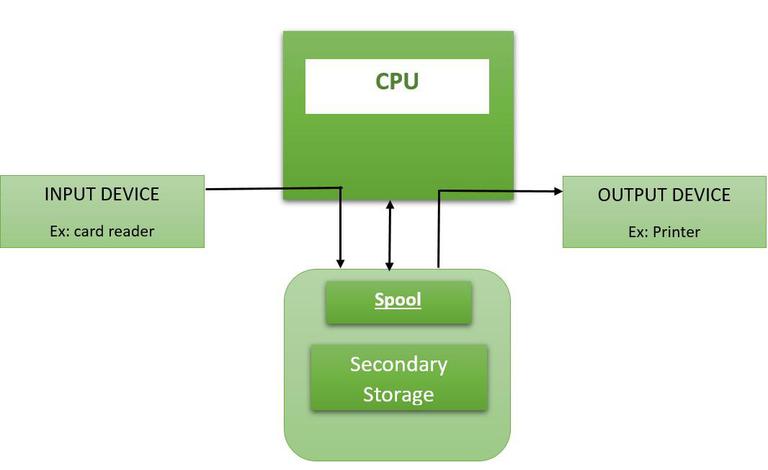
spooling
Advantages of Spooling
- **Management of Resources: Spooling keeps resources busy by handling tasks in a queue, so there is no idle time.
- **Improved Efficiency: It improves system performance by allowing multiple jobs to be processed at the same time.
- **Data Integrity: It ensures tasks are handled in order, helping reduce errors.
Disadvantages of Spooling
- **Disk Space Usage: In spooling we need to queue the data and for this disk space is required to store the queued data, and which can cause resource constraints in limited environments.
- **Delay in Processing: If the number of jobs increases, and the system may not able to handle these jobs and the load efficiently then the tasks might experience delays.
**Buffering
Buffering is a technique where data is temporarily stored in a memory area called a buffer during data transfer between devices or processes. It helps balance the speed difference between sender and receiver, ensuring smooth and efficient data transmission.
- Temporarily stores data in a buffer in main memory
- Helps match speed between sender and receiver
- Prevents data loss during transmission
- Improves efficiency of data transfer between devices or applications
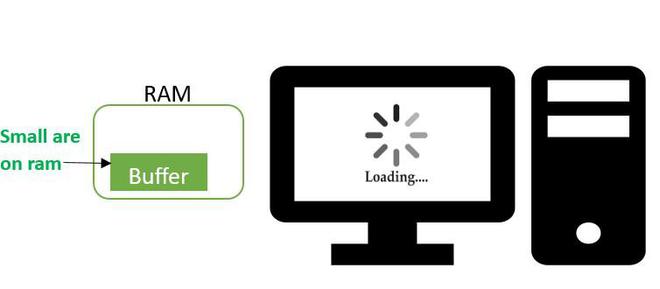
buffering
Advantages of Buffering
- **Matching the Speed: It accommodates speed differences between devices, also reduce the chances of bottlenecks by allowing smoother data transfer.
- **Minimized Latency: In buffering we don't need to wait for the source and destination to catch up for the data to be processed or transmitted, it reduces latency.
- **Better User Experience: In media streaming the data is preloaded, so that video is consistent while video is playing.
Disadvantage of Buffering
- **Memory Consumption: It requires extra buffer memory, which may be a limitation for low-resource systems.
- **Potential Data Loss: Data may be lost or damaged if the buffer overflows, especially in real-time systems.
Spooling vs Buffering
| **Spooling | **Buffering |
|---|---|
| Overlaps the input/output of one job with the execution of another job. | Overlaps the input/output of a job with the execution of the same job. |
| Stands for Simultaneous Peripheral Operation On-Line. | Has no full form. |
| More efficient since multiple jobs can be processed at the same time. | Less efficient compared to spooling. |
| Uses disk as a large buffer. | Uses a limited area of main memory (RAM). |
| Supports remote processing. | Does not support remote processing. |
| Implemented using spoolers to manage I/O requests and resources. | Implemented using software or hardware buffers like FIFO or circular buffers. |
| Can handle large amounts of data as storage is on disk. | Limited by the size of main memory. |
| Provides better recovery from errors since data is stored on disk. | Buffer overflow may cause data loss or corruption. |
| More complex due to additional management software. | Simpler and easier to implement. |
| **Example: Printing jobs are queued on disk and sent to the printer sequentially. | **Example: Video streaming uses a buffer to preload data in memory for smooth playback. |