User Level vs Kernel Level Threads (original) (raw)
Last Updated : 5 Feb, 2026
User-level threads are threads that are managed entirely by the user-level thread library without any direct involvement of the operating system kernel, whereas kernel-level threads are threads that are managed and scheduled directly by the operating system’s kernel.
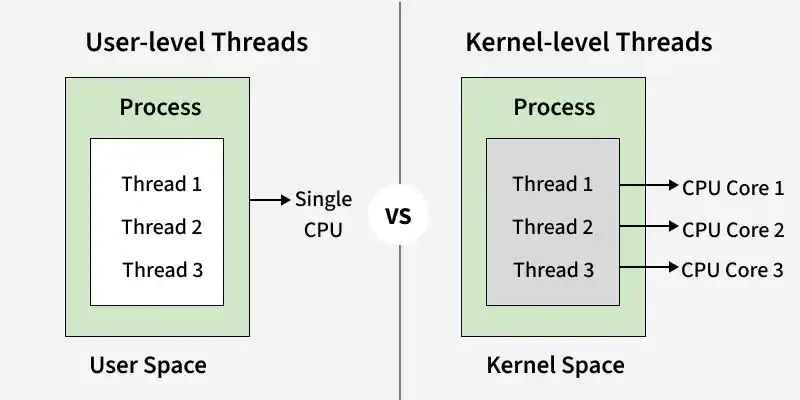
- **User-Level Threads: Threads are managed in user space and execute one at a time.
- **Kernel-Level Threads: Threads are managed by the kernel and can run in parallel on multiple CPUs.
User-Level Thread
The User-level Threads are implemented by the user-level software. These threads are created and managed by the thread library, which the operating system provides as an API for creating, managing, and synchronizing threads. it is faster than the kernel-level threads, it is basically represented by the program counter, stack, register, and PCB.
- User-level threads are typically employed in scenarios where fine control over threading is necessary, but the overhead of kernel threads is not desired.
- They are also useful in systems that lack native multithreading support, allowing developers to implement threading in a portable way.
- **Example: User threads library includes POSIX threads, Mach C-Threads
| **Advantages | **Disadvantages |
|---|---|
| Threads are quick and easy to create. | Multithreading may not fully use multiple processors. |
| They are highly portable across operating systems. | A blocking operation in one thread can halt the process. |
| No kernel mode privileges are needed for switching. | All threads share the same process, limiting isolation. |
| Context switching is fast and lightweight. | Debugging user-level threads is more difficult. |
Kernel-Level Thread
Kernel-level threads (KLTs) are created and managed directly by the operating system kernel. The kernel handles all operations like creation, scheduling, suspension, and termination, giving it full control. This ensures proper coordination and complete awareness of all threads within a process.
- The Kernel-level threads are directly handled by the OS directly whereas the thread’s management is done by the kernel.
- Each kernel-level thread has its own context, including information about the thread's status, such as its name, group, and priority.
- **Example: The example of Kernel-level threads are Java threads, POSIX thread on Linux, etc.
| **Advantages | **Disadvantages |
|---|---|
| Allows true parallel execution of threads. | Thread creation and management take more time. |
| Other threads continue running if one is blocked. | Requires switching to kernel mode, adding overhead. |
| Direct access to system resources and I/O operations. | More complex to implement than user-level threads. |
| Suitable for CPU-intensive and I/O-bound tasks. | Context switching is slower compared to user-level. |
User-Level Thread Vs Kernel-Level Thread
| User-Level Thread (ULT) | Kernel-Level Thread (KLT) |
|---|---|
| Implemented by user-level libraries | Implemented by the Operating System |
| Not recognized by the OS | Recognized by the OS |
| Fast context switching with less overhead | Slower context switching with more overhead |
| Blocking blocks the entire process | Only the blocked thread is affected |
| Limited use of multiprocessing | Fully utilizes multiprocessing |
| Fast and simple creation and management | Slower and more complex management |
| Threads share the same address space | Each thread has its own address space |
| More portable, works on any OS | OS-dependent and less portable |