Dining Philosopher Solution using Semaphores (original) (raw)
Last Updated : 8 Jan, 2026
The Dining Philosopher Problem is a classic synchronization problem introduced by Edsger Dijkstra in 1965. It illustrates the challenges of resource sharing in concurrent programming, such as deadlock, starvation, and mutual exclusion.
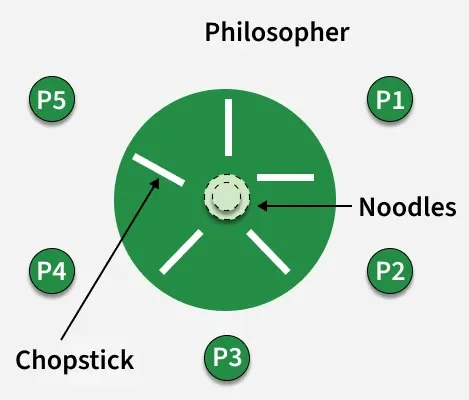
Problem Statement
- K philosophers sit around a circular table.
- Each philosopher alternates between thinking and eating.
- There is one chopstick between each philosopher (total K chopsticks).
- A philosopher must pick up two chopsticks (left and right) to eat.
- Only one philosopher can use a chopstick at a time.
**The challenge: Design a synchronization mechanism so that philosophers can eat without causing **deadlock (all waiting forever) or **starvation (some never get a chance to eat).
Issues in the Problem
- **Deadlock: If every philosopher picks up their left chopstick first, no one can pick up the right one circular wait.
- **Starvation: Some philosophers may never get a chance to eat if others keep eating.
- **Concurrency Control: Must ensure no two adjacent philosophers eat simultaneously.
**Semaphore Solution to Dining Philosopher
We use **semaphores to manage chopsticks and avoid deadlock.
Algorithm
- Each chopstick is represented as a binary semaphore (mutex).
- Philosopher must acquire both left and right semaphores before eating.
- After eating, the philosopher releases both semaphores.
**Pseudocode
semaphore chopstick[5] = {1,1,1,1,1};
Philosopher(i):
while(true) {
think();
wait(chopstick[i]); // pick left chopstick
wait(chopstick[(i+1)%5]); // pick right chopstickeat();
signal(chopstick[i]); // put left chopstick
signal(chopstick[(i+1)%5]); // put right chopstick}
Explanation:
- **semaphore chopstick[5] = {1,1,1,1,1}; Each chopstick is a binary semaphore initialized to 1 (available).
- **think(); Philosopher spends time thinking.
- **wait(chopstick[i]); Tries to pick the left chopstick. If it’s free, philosopher takes it; otherwise waits.
- **wait(chopstick[(i+1)%5]); Tries to pick the right chopstick (using modulo for circular table).
- **eat(); Philosopher eats once both chopsticks are acquired.
- **signal(chopstick[i]); and **signal(chopstick[(i+1)%5]); Puts down both chopsticks, making them available for neighbors.
**Code
C++ `
#include #include #include #include #include <unistd.h>
#define N 5 // Number of philosophers
std::counting_semaphore chopstick[N]; // One semaphore for each chopstick
void philosopher(int id) { while (true) { std::cout << "Philosopher " << id << " is thinking...\n"; std::this_thread::sleep_for(std::chrono::seconds(1));
    // Pick up left chopstick
    chopstick[id].acquire();

    // Pick up right chopstick
    chopstick[(id + 1) % N].acquire();

    std::cout << "Philosopher " << id << " is eating...\n";
    std::this_thread::sleep_for(std::chrono::seconds(2));

    // Put down left chopstick
    chopstick[id].release();

    // Put down right chopstick
    chopstick[(id + 1) % N].release();

    std::cout << "Philosopher " << id << " finished eating and put down chopsticks.\n";
}
}
int main() { std::vectorstd::thread threads(N);
// Initialize chopstick semaphores
for (int i = 0; i < N; i++) {
    chopstick[i] = std::counting_semaphore<N>(1);
}

// Create philosopher threads
for (int i = 0; i < N; i++) {
    threads[i] = std::thread(philosopher, i);
}

// Join threads (never ends in this example)
for (auto& th : threads) {
    if (th.joinable()) {
        th.join();
    }
}

return 0;
}
Java
import java.util.concurrent.Semaphore; import java.util.concurrent.TimeUnit;
public class DiningPhilosophers { private static final int N = 5; // Number of philosophers private static final Semaphore[] chopstick = new Semaphore[N];
public static void main(String[] args) {
    // Initialize chopstick semaphores
    for (int i = 0; i < N; i++) {
        chopstick[i] = new Semaphore(1);
    }

    // Create philosopher threads
    for (int i = 0; i < N; i++) {
        new Thread(new Philosopher(i)).start();
    }
}

static class Philosopher implements Runnable {
    private final int id;

    Philosopher(int id) {
        this.id = id;
    }

    @Override
    public void run() {
        while (true) {
            System.out.println("Philosopher " + id + " is thinking...");
            sleep(1);

            // Pick up left chopstick
            try { chopstick[id].acquire(); } catch (InterruptedException e) { e.printStackTrace(); }

            // Pick up right chopstick
            try { chopstick[(id + 1) % N].acquire(); } catch (InterruptedException e) { e.printStackTrace(); }

            System.out.println("Philosopher " + id + " is eating...");
            sleep(2);

            // Put down left chopstick
            chopstick[id].release();

            // Put down right chopstick
            chopstick[(id + 1) % N].release();

            System.out.println("Philosopher " + id + " finished eating and put down chopsticks.");
        }
    }

    private void sleep(int seconds) {
        try { TimeUnit.SECONDS.sleep(seconds); } catch (InterruptedException e) { e.printStackTrace(); }
    }
}
}
Python
import threading import time from threading import Semaphore
N = 5 # Number of philosophers chopstick = [Semaphore(1) for _ in range(N)]
def philosopher(id): while True: print(f'Philosopher {id} is thinking...') time.sleep(1)
    # Pick up left chopstick
    chopstick[id].acquire()

    # Pick up right chopstick
    chopstick[(id + 1) % N].acquire()

    print(f'Philosopher {id} is eating...')
    time.sleep(2)

    # Put down left chopstick
    chopstick[id].release()

    # Put down right chopstick
    chopstick[(id + 1) % N].release()

    print(f'Philosopher {id} finished eating and put down chopsticks.')
threads = []
Create philosopher threads
for i in range(N): thread = threading.Thread(target=philosopher, args=(i,)) threads.append(thread) thread.start()
Join threads (never ends in this example)
for thread in threads: thread.join()
`
Explanation
**1. Semaphores for chopsticks
sem_t chopstick[N];
Each chopstick is represented by a binary semaphore (1 = free, 0 = in use).
**2. Philosopher function
- A philosopher thinks first.
- Then tries to pick up left chopstick (sem_wait(chopstick[id])).
- Then pick up right chopstick (sem_wait(chopstick[(id+1)%N])).
- After acquiring both chopsticks eats.
- Finally, puts down both chopsticks (sem_post).
**3. Thread creation
- Each philosopher is represented as a thread.
- pthread_create() starts philosopher actions in parallel.
**4. Circular arrangement: Right chopstick is (id+1)%N ensures philosopher 4 gets chopsticks 4 and 0.
**Problem with this code
If all philosophers pick up their left chopstick at the same time, they will all wait for the right chopstick deadlock.
Deadlock Avoidance
One common fix is to allow only **N-1 philosophers to pick chopsticks at a time. This breaks the circular wait condition.
sem_t room; // new semaphore
sem_init(&room, 0, N-1); // allow only N-1 philosophers inside
// before picking chopsticks
sem_wait(&room);// after eating
sem_post(&room);
This ensures that at least one philosopher can always eat, preventing deadlock.