Functions of Operating System (original) (raw)
Last Updated : 16 Oct, 2025
An Operating System (OS) is software that acts as a bridge between the user and the computer hardware. It provides an environment where users can execute programs efficiently and conveniently.
- Manages and controls all computer resources.
- Provides services and resources to user programs.
- Coordinates and monitors program execution to prevent errors.
- Offers a user interface (virtual machine) and hides software complexity.
- Supports multiple execution modes for programs.
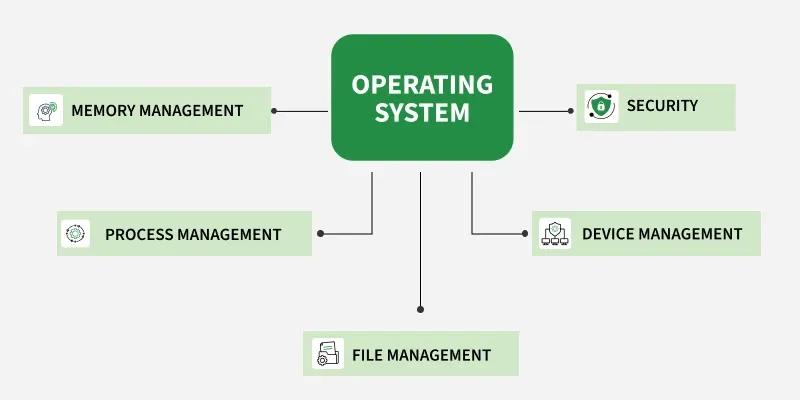
Function of OS
**Note: The OS controls all computer resources, coordinates program execution, hides system complexity, ensures security, and improves resource utilization.
Functions of an Operating System
1. Process Management
Process management in operating system is about managing processes. A Process is a running program. The life cycle of process is from the moment program start until it finishes.

Process State Diagram
Core Functions in Process Management:
- **Scheduling: Decides which process uses the CPU next (using algorithms like Round Robin or Priority Scheduling).
- **Synchronization: Ensures orderly execution using locks, semaphores, or monitors to prevent race conditions.
- **Deadlock Handling: Detects and prevents situations where processes wait forever for resources.
- **Inter-Process Communication (IPC): Allows processes to exchange data via shared memory or message passing.
Read more about Process Management in OS
2. Memory Management
Memory management in an operating system controls how data is stored and organized in main (primary) memory and secondary storage, ensuring programs get the memory they need and freeing it when no longer used.
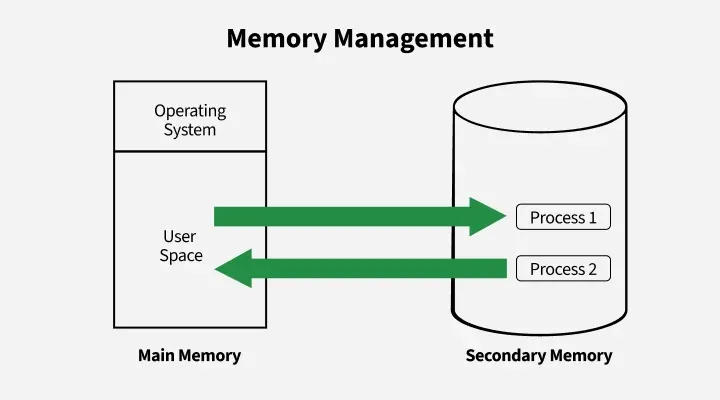
Memory Management
Key Activities in Memory Management:
- **Allocation & Deallocation: Assigns and frees memory as needed.
- **Protection: Prevents processes from interfering with each other’s memory..
- **Virtual Memory: Uses disk space as extra memory to run large programs.
- **Fragmentation Handling: Reduces wasted space through compaction.
- **Disk Management: Handles file storage, free space, disk scheduling, and backups.
Read more about Memory Management in OS
3. File System Management
File management in an operating system organizes and controls how data is stored, named, and accessed on storage devices, making it easy for users to find and use their files.
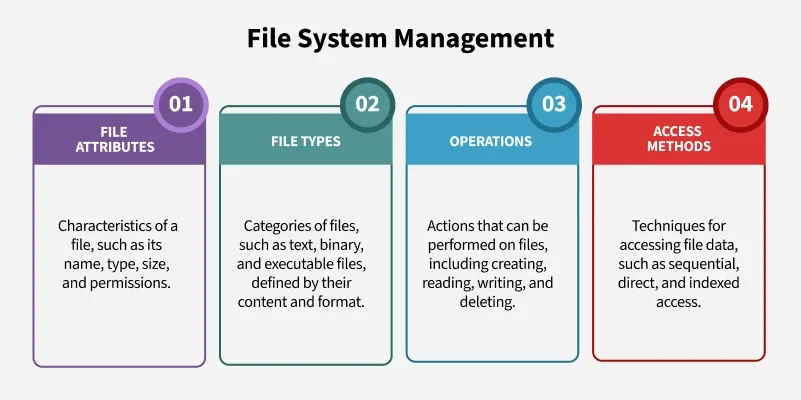
File System Management
File System Management includes managing of:
- **File Attributes: Name, type, size, and permissions.
- **File Types: Text, binary, and executable files.
- **Operations: Create, read, write, and delete files.
- **Access Methods: Sequential, direct, and indexed access for faster retrieval.
Read more about File System Management in OS
4. Device Management (I/O System)
Device management in an operating system controls how the computer communicates with hardware devices like printers or disks, using drivers and techniques to ensure smooth and efficient operation.

Device Management
Major components in Device Management:
- **Device Drivers: Interface between hardware and OS.
- **Buffering & Caching: Temporarily store data to match device speeds and improve performance.
- **Spooling: Spooling manages data waiting to be processed, particularly in devices like printers. The OS places print jobs in a spool (a temporary storage area), allowing the CPU to continue other tasks while the printer works through the queue.
Read more about Device Management in OS
5. Protection and Security
Protection and security mechanisms in an OS are designed to safeguard system resources from unauthorized access or misuse. These mechanisms control which processes or users can access specific resources (such as memory, files, and CPU time). It also ensures that only authorized users can perform specific actions.
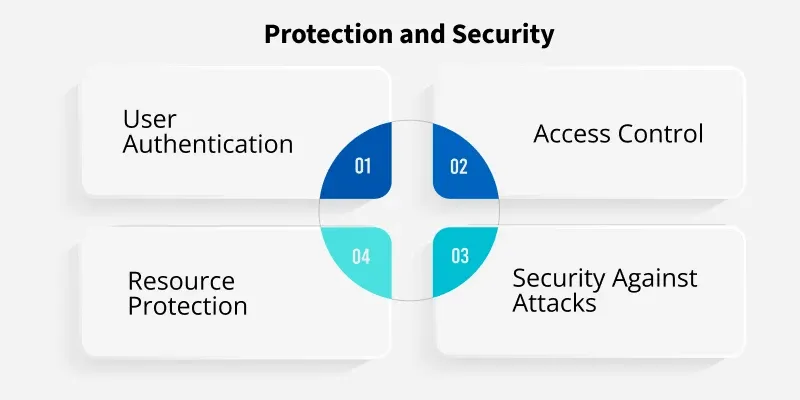
Protection & Security
The OS protects system resources and user data from unauthorized access and attacks.
- **Access Control: Limits user and process permissions.
- **Authentication: Verifies users through credentials (UIDs/SIDs).
- **Resource Protection: Prevents misuse of files, memory, or devices.
- **Security: Guards against malware, denial-of-service attacks, and data theft.
Read more about Security and Protection in OS
Additional Functions
Beyond core tasks like process and memory management, OS also focus on:
- **Performance Monitoring: Tracks system efficiency and identifies bottlenecks.
- **Job Accounting: Records resource usage for auditing and optimization.
- **Error Detection: Generates error logs, traces, and dumps to detect and fix issues.
**Note: These functions ensure smooth operation, efficient resource allocation and system reliability.