Interrupt In Operating System (original) (raw)
Last Updated : 11 Apr, 2026
An interrupt is a signal generated by hardware or software when an event needs immediate attention from the processor. It causes the CPU to temporarily stop the current execution and respond to a high-priority request. In I/O devices, interrupts are generated using the Interrupt Request Line (IRQ/IRL) and are handled by a software routine called the Interrupt Service Routine (ISR). After executing the ISR, the processor resumes the interrupted program from where it was paused.
- Interrupts allow the processor to respond quickly to external events
- IRQ/IRL is the hardware line used to generate interrupts
- ISR is the software routine executed to handle an interrupt
- The processor completes the current instruction before servicing the interrupt
- Interrupt latency is the delay between receiving the interrupt and starting ISR execution
Types
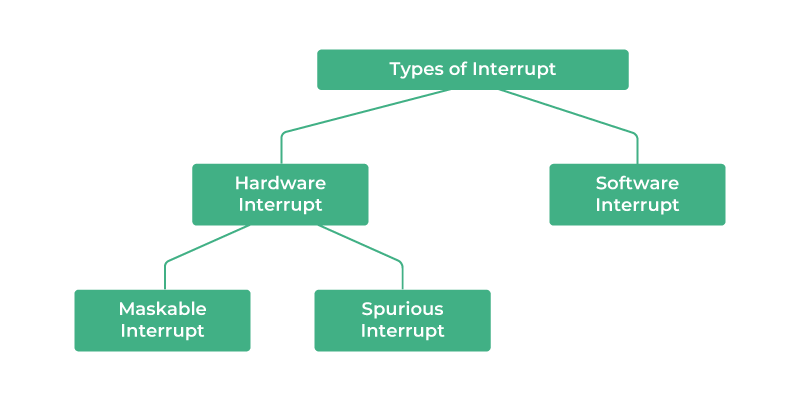
Event-related software or hardware can trigger the issuance of interrupt signals. These fall into one of two categories:
- Software Interrupts
- Hardware Interrupts
1. Software Interrupts
Interrupts that are generated by a program (software) rather than hardware. They are also known as traps or exceptions. These interrupts are used to request services from the operating system or to handle error conditions during program execution.
- They are typically triggered by special instructions (interrupt instructions) or by runtime errors such as division by zero.
- System calls like fork() are requests made by a program to the operating system. They internally use a software interrupt (trap) to switch from user mode to kernel mode.
- When a software interrupt occurs, the processor temporarily stops the current program and transfers control to a predefined interrupt handler, which performs the required task or handles the error, and then returns control back to the program.
2. Hardware Interrupts
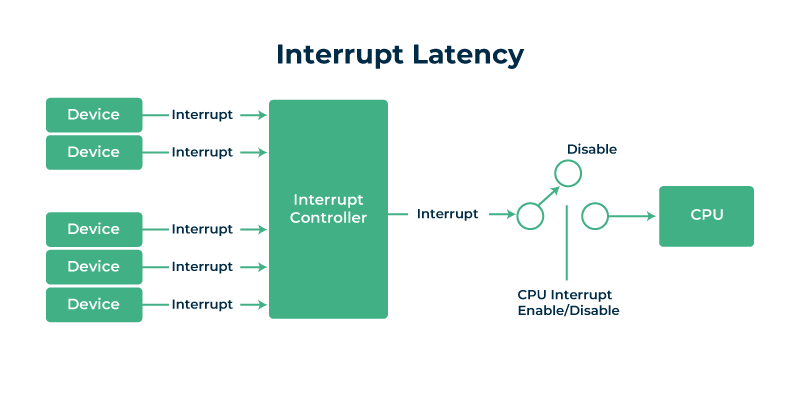
In a hardware interrupt, all the devices are connected to the Interrupt Request Line. Multiple devices generate interrupts through interrupt lines (IRQ), which are managed by an interrupt controller to identify and prioritize requests. To request an interrupt, a device closes its associated switch. When a device requests an interrupt, the value of INTR is the logical OR of the requests from individual devices.
Hardware interrupts are further divided into two types of interrupt:
- **Maskable Interrupt: Hardware interrupts can be selectively enabled and disabled thanks to an inbuilt interrupt mask register that is commonly found in processors. A bit in the mask register corresponds to each interrupt signal; on some systems, the interrupt is enabled when the bit is set and disabled when the bit is clear, but on other systems, the interrupt is deactivated when the bit is set.
- **Spurious Interrupt: A hardware interrupt for which there is no source is known as a spurious interrupt. This phenomenon might also be referred to as phantom or ghost interrupts. When a wired-OR interrupt circuit is connected to a level-sensitive processor input, spurious interruptions are typically an issue. When a system performs badly, it could be challenging to locate these interruptions.
Sequences of Events Involved in Handling an IRQ(Interrupt Request)
- Devices raise an IRQ.
- The processor temporarily suspends the current program to handle the interrupt.
- The device is informed that its request has been recognized and the device deactivates the request signal.
- The requested action is performed.
- An interrupt is enabled and the interrupted program is resumed.
Flowchart of Interrupt Handling Mechanism
The Image below depicts the flowchart of interrupt handling mechanism

Interrupt Handling Mechanism
- **Step 1: Any time that an interrupt is raised, it may either be an I/O interrupt or a system interrupt.
- **Step 2: The current state comprising registers and the program counter is then stored in order to conserve the state of the process.
- **Step 3: The current interrupt and its handler is identified through the interrupt vector table in the processor.
- **Step 4: This control now shifts to the interrupt handler, which is a function located in the kernel space.
- **Step 5: Specific tasks are performed by Interrupt Service Routine (ISR) which are essential to manage interrupt.
- **Step 6: The status from the previous session is retrieved so as to build on the process from that point.
- **Step 7: The control is then shifted back to the other process that was pending and the normal process continues.
Managing Multiple Devices
When more than one device raises an interrupt request signal, then additional information is needed to decide which device to be considered first. The following methods are used to decide which device to select: Polling, Vectored Interrupts, and Interrupt Nesting. These are explained below.
- **Polling: In polling, the first device encountered with the IRQ bit set is the device that is to be serviced first. Appropriate ISR is called to service the same. It is easy to implement but a lot of time is wasted by interrogating the IRQ bit of all devices.
- **Vectored Interrupts: In vectored interrupts, a device requesting an interrupt identifies itself directly by sending a special code to the processor over the bus. This enables the processor to identify the device that generated the interrupt. The special code can be the starting address of the ISR or where the ISR is located in memory and is called the interrupt vector.
- **Interrupt Nesting: In this method, the I/O device is organized in a priority structure. Therefore, an interrupt request from a higher-priority device is recognized whereas a request from a lower-priority device is not. The processor accepts interrupts only from devices/processes having priority.
Processors' priority is encoded in a few bits of PS (Process Status register). It can be changed by program instructions that are written into the PS. The processor is in supervised mode only while executing OS routines. It switches to user mode before executing application programs.
Interrupt Priority Schemes
Interrupt priority schemes are used in microprocessors and microcontrollers to manage multiple interrupt requests (IRQs). These schemes ensure that more urgent tasks are processed before less important ones, making them essential for real-time systems and efficient interrupt handling.
Types of Interrupt Priority Schemes
- Fixed Priority Scheme: In this scheme, each interrupt has a predetermined priority level. The interrupt with the highest priority is handled first. If two interrupts occur simultaneously, the one with the higher priority is serviced. Example: Interrupt A (priority 1) is serviced before Interrupt B (priority 2).
- Dynamic Priority Scheme: In a dynamic priority scheme, the priority of an interrupt can change based on system conditions. This helps prioritize real-time or critical tasks over others. Example: A system may increase the priority of a sensor interrupt based on its importance at a particular moment.
- Vectored Interrupt Scheme: Here, each interrupt has a specific memory address (vector). The processor jumps to this address to handle the interrupt, and the interrupt with the highest priority is processed first. Example: The system uses memory addresses to quickly handle the most urgent interrupts.
- Priority Masking: This scheme allows lower-priority interrupts to be temporarily disabled, ensuring that high-priority interrupts are handled immediately without delay. Example: If Interrupt A is more critical than Interrupt B, Interrupt B may be masked until Interrupt A is processed.
- Round-Robin Priority Scheme: In this scheme, interrupts are processed in a cyclic order, ensuring each interrupt gets handled fairly, especially when all interrupts have the same priority. Example: Interrupts A, B, and C are handled in a round-robin manner.
What is Interrupt Latency?
The amount of time between the generation of an interrupt and its handling. The number of created interrupts, the number of enabled interruptions, the number of interrupts that may be handled, and the time required to handle each interrupt all affect interrupt latency.
- When the device generating the interrupt needs a specific length of time to generate the interrupt, interrupt latency is required.
- Interrupt latency is the time delay between the occurrence of an interrupt and the start of execution of its Interrupt Service Routine (ISR).
- The interrupt latency is the amount of time the computer has to stop the program from operating.
Interrupt Latency
How CPU React when Interrupt Occurs?
- **Interrupt Detection: The CPU continuously monitors interrupt lines to detect interrupt requests.
- **Interrupt Acknowledgment: Upon detecting an interrupt request, the CPU acknowledges the interrupt using sending an acknowledgment sign to the interrupting device or software program.
- **Interrupt Handling: The CPU identifies the form of interrupt primarily based on its supply, together with a hardware interrupt from a device or a software interrupt from a training. It then seems the cope with the corresponding interrupt handler habitual within the interrupt vector desk.
- **Context Saving: Before moving manipulate to the interrupt handler ordinary, the CPU saves the present-day execution context, inclusive of the program counter (PC), processor state, and any applicable sign-in contents, onto the stack or in the devoted garage.
- **Transfer Control: The CPU transfers manipulation to the interrupt handler ordinary with the aid of placing this system counter (PC) to the address of the handler habitual retrieved from the interrupt vector desk.
- **Interrupt Servicing: The interrupt handler habitual executes to carrier the interrupt. It plays responsibilities to interrupt, such as reading facts from a device, processing enter/output operations, or coping with a software program request.
Triggering Methods
Every interrupt signal input is intended to be activated by a certain signal edge (level change) or a logic signal level. Level-sensitive inputs make constant requests for processor attention as long as they are treated with a specific logic level (high or low). Edge-sensitive inputs are responsive to signal edges; a service request will latch on to a specific (rising or falling) edge. When the interrupt handler runs, the CPU resets the latch.
- Level-Trigger: The interrupt signal must be held at its specific active logic level (high or low) to request a level-triggered interrupt. A level-triggered interrupt is triggered when a device drives the signal to the active level and maintains it there. When the CPU instructs it to do so, usually after the device has been serviced, it denies the signal.
- Edge-Trigger: An interrupt that is caused by a level change on the interrupt line-either a rising or lowering edge is known as an edge-triggered interrupt (low to high). A pulse is driven onto the line and released to its inactive state by a device that wishes to indicate an interrupt. It can be necessary to use specialized hardware to detect the pulse if polled I/O is unable to pick it up due to its short duration.
Benefits of Interrupt
- **Real-time Responsiveness: Interrupts permit a system to reply promptly to outside events or signals, permitting real-time processing.
- **Efficient Resource usage: Interrupt-driven structures are more efficient than system that depend on busy-waiting or polling strategies. Instead of continuously checking for the incidence of event, interrupts permit the processor to remain idle until an event occurs, conserving processing energy and lowering energy intake.
- **Multitasking and Concurrency: Interrupts allow multitasking with the aid of allowing a processor to address multiple tasks concurrently.
- **Improved system Throughput: By coping with occasions asynchronously, interrupts allow a device to overlap computation with I/O operations or other responsibilities, maximizing system throughput and universal overall performance.