Kernel I/O Subsystem in Operating System (original) (raw)
Last Updated : 19 Sep, 2025
Kernel I/O Subsystem is a key component of the operating system kernel responsible for managing communication between the CPU and I/O devices (e.g., printers, disks, keyboards, network interfaces). It translates high-level I/O requests from applications into low-level hardware commands, handling concurrency, synchronization, error handling, buffering, caching, spooling and protection mechanisms.
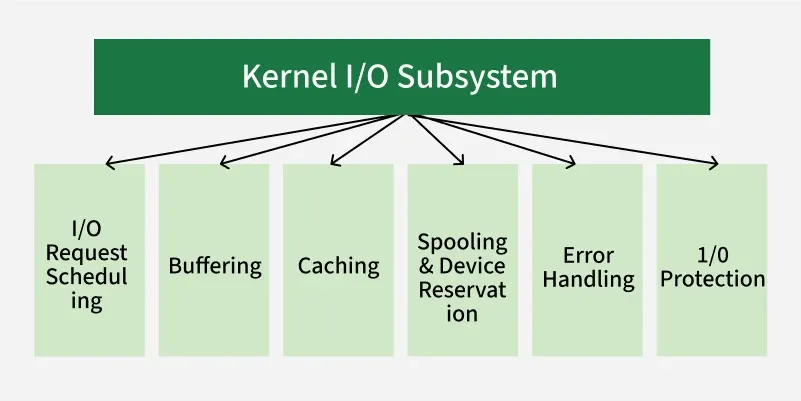
Kernel I/O Subsystem
**Note: It ensures that I/O requests are handled reliably, securely and efficiently, abstracting hardware complexity and enabling device-independent access.
Services Provided by the Kernel I/O Subsystem
1. I/O Scheduling
- Determines the optimal order of executing I/O requests.
- Improves system performance by Reducing average waiting time and turnaround time & Sharing device access fairly across multiple processes.
- Implemented via wait queues for each device.
- **Example: When multiple processes issue blocking I/O system calls, their requests are queued and reordered by the I/O scheduler for efficiency.
2. Buffering
A memory area temporarily stores data during transfers between devices or between a device and an application.
**Main reasons for buffering:
- To manage speed mismatch between producer and consumer.
- To adapt different data transfer sizes.
- To support copy semantics (e.g., copying application data into a buffer before writing to disk).
3. Caching
- A cache stores frequently accessed data in fast memory.
- **Example: Frequently used instructions are stored in CPU cache and main memory to avoid slow disk access.
- **Difference from buffering: Buffer holds data temporarily during transfer & Cache holds a copy of data to speed up future access.
4. Spooling and Device Reservation
- Spooling stores output (e.g., print jobs) in a separate disk file to prevent interleaved outputs.
- Jobs are queued (FIFO) and executed one by one.
- Prevents output mixing and allows concurrent job submission.
5. Error Handling
Provides robust strategies for handling transient or permanent I/O errors:
- **Error Detection Mechanisms: Detect I/O errors.
- **Error Reporting: Notify OS and applications of detected errors.
- **Error Recovery Mechanisms: Attempt to recover without system failure.
- **User Notification: Inform users or administrators via alerts or automated messages.
6. I/O Protection
- Prevents unauthorized or illegal I/O instructions.
- All I/O instructions are privileged.
- Only the Kernel can issue I/O instructions, protecting the system from malicious or erroneous user processes.
Functions and Services offered by the Kernel
The kernel provides many services related to I/O, some of these are:
- **Process management: Save context of the interrupted program, dispatch a process, manipulate scheduling lists.
- **Process communication: Send and receive inter-process messages.
- **Memory management: Set memory protection information, swap-in/ swap-out, handle page fault.
- **I/O management: Initiate I/O ,process I/O completion interrupt, recover from I/O errors.
- **File management: Open a file, read/ write data.
- **Security and protection: Add authentication information for a new user, maintain information for file protection.
- **Network management: Send/ receive data through a message.
Importance of Kernel I/O Subsystem
- Provides a unified and consistent interface for applications to access devices.
- Abstracts hardware complexity, enabling device independence.
- Manages concurrency and synchronization when multiple processes access the same device.
- Ensures data integrity and protects the system against unauthorized I/O access.