Multi Processing Operating System (original) (raw)
Last Updated : 21 Jan, 2026
A multiprocessing operating system uses two or more CPUs within a single computer system to execute processes concurrently. By distributing tasks across multiple processors, the OS improves throughput, CPU utilization, and system performance. All processors are typically connected to shared main memory, I/O devices, system buses, and clock signals.
The primary goal of a multiprocessing OS is to **increase execution speed and **reliability through **parallel processing. Common examples include UNIX, Linux, and Solaris.
Working of Multi-Processing Operating System
- The system consists of multiple CPUs connected to a shared main memory.
- The operating system divides the workload into smaller tasks or processes.
- These tasks are scheduled and distributed among available processors.
- Each processor executes its assigned task in parallel with others.
- After execution, results are combined (if required) to produce the final output.
- The OS manages CPU scheduling, memory access, and resource allocation, ensuring efficient utilization and synchronization.
This parallel execution model significantly improves system performance compared to single-processor systems.
The diagram below describes the working of multi-processing operating systems:

Working of Multiprocessing Operating System
Types of Multi-Processing Operating Systems
Multi-processing operating systems are classified into two types.
1. Symmetric Multiprocessing (SMP)
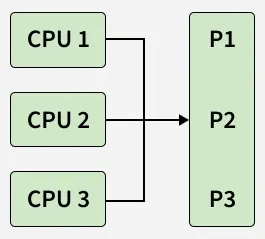
In a Symmetric Multiprocessing system, all processors are equal and execute the same instance of the operating system. Any processor can perform any task, including process scheduling and I/O handling.
- Processes are dynamically assigned to processors using CPU scheduling algorithms.
- All processors share the same physical memory and I/O subsystem.
- Also known as a Shared-Memory Multiprocessing System.
Advantages
- Failure of one processor does not affect the functioning of other processors.
- It divides all the workload equally to the available processors.
- Makes use of available resources efficiently.
Disadvantages
- Symmetrical multiprocessing OS are more complex.
- They are more costlier.
- Synchronization between multiple processors is difficult.
2. Asymmetric Multiprocessing (AMP)
In an Asymmetric Multiprocessing system, processors are not equal. One processor acts as the master, while the others act as slave processors.
- The master processor handles scheduling, memory management, and I/O operations.
- Slave processors execute tasks assigned by the master.
- The master maintains the ready queue and dispatches processes to slaves.
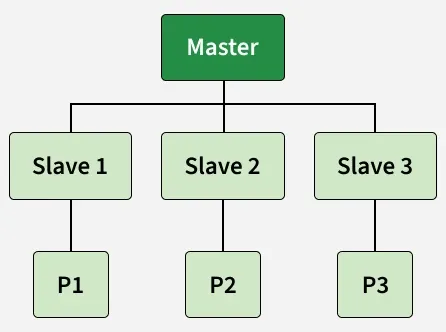
Asymmetrical Multiprocessing Operating System
Advantages
- Asymmetrical multiprocessing operating system are cost-effective.
- They are easy to design and manage.
- They are more scalable.
Disadvantages
- There can be uneven distribution of workload among the processors.
- The processors do not share same memory.
- Entire system goes down if one process fails.