Multi Threading Models in Process Management (original) (raw)
Last Updated : 25 Oct, 2025
Multithreading is a programming and execution model that allows multiple threads to exist within a single process, executing concurrently. Each thread represents a separate path of execution, enabling better responsiveness, resource utilization and parallelism, especially in modern multiprocessor systems.
**Note: Multithreading is widely used in applications like web servers, interactive applications and high-performance computing where concurrent execution is essential.
Threading Models
Operating systems support threads through different threading models, which determine how threads are created, managed and mapped to CPU execution:
1. User-Level Threads (ULT)
Managed by a user-level library, not the OS.
Advantages:
- **Greater flexibility and control: Programmers can customize scheduling.
- **Portability: Works across multiple operating systems.
- **Faster context switching: Switching between ULTs happens in user space.
Disadvantages:
- **Blocking system calls: If one thread blocks, the entire process is blocked.
- **Limited parallelism: Cannot utilize multiple CPUs effectively since the kernel is unaware of user threads.
2. Kernel-Level Threads (KLT)
Managed and scheduled directly by the operating system.
Advantages:
- **True parallelism: Can run on multiple CPUs simultaneously.
- **Better scalability: OS can efficiently schedule threads.
- **I/O efficiency: Other threads can continue if one thread blocks.
Disadvantages:
- **Less flexible and portable: Managed by the OS, harder to customize.
- **Higher overhead: Thread creation and context switching involve system calls.
3. Hybrid Threading Models
- Combines ULT and KLT advantages.
- **Examples: Solaris and some modern OS use a two-level model, where user threads are mapped to kernel threads.
Advantages:
- Flexibility, control and efficient parallelism.
- Reduces blocking issues and improves concurrency.
Disadvantages:
- More complex to implement.
- Requires more system resources.
Mapping Models of Threads
1. Many-to-Many Model:
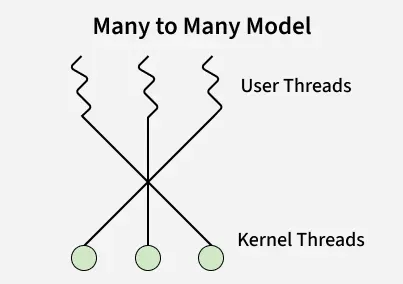
Many-to-Many Model
- Multiple user threads map to multiple kernel threads.
- If one thread blocks, others can continue.
- Provides high concurrency and is the most efficient model.
2. Many-to-One Model:
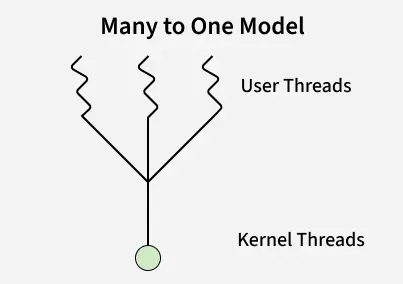
Many-to-One Model
- Multiple user threads map to a single kernel thread.
- Blocking in one thread blocks the entire process.
- Efficient user-level management but poor multiprocessing utilization.
3. One-to-One Model:
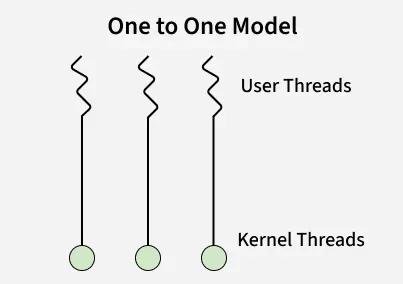
One-to-One Model
- Each user thread maps to a unique kernel thread.
- Multiple threads can run on multiple processors.
- Blocking in one thread does not affect others.
- Overhead is higher because each user thread requires a corresponding kernel thread.
Thread Libraries
Thread libraries provide APIs for creating and managing threads.
- **User-level library: Runs entirely in user space; fast and flexible.
- **Kernel-level library: Supported by the OS; better parallelism and fault tolerance.
Common thread libraries:
- **POSIX Pthreads: Can be implemented as ULT or KLT.
- **Windows Threads: Kernel-level library.
- **Java Threads: Typically built on kernel threads in modern JVMs.
Advantages of Multithreading
- **Minimized Context Switching Time: Switching threads is faster than switching processes.
- **Concurrency: Multiple instruction sequences execute within a single process.
- **Resource Efficiency: Threads share memory and resources of their parent process.
- **Scalability on Multiprocessors: Threads can run on multiple CPUs, improving throughput.
- **Responsiveness: Interactive applications remain responsive even when performing heavy tasks.
Disadvantages of Multithreading
- **Complexity: Threaded code can be harder to write and debug.
- **High Management Overhead: Managing multiple threads may be costly for simple tasks.
- **Risk of Deadlocks and Race Conditions: Improper synchronization may cause concurrency issues.
- **Debugging Difficulty: Errors in multithreaded programs are often subtle and hard to reproduce.