Multilevel Feedback Queue Scheduling (MLFQ) CPU Scheduling (original) (raw)
Last Updated : 5 Jan, 2026
Multilevel Feedback Queue Scheduling (MLFQ) CPU Scheduling is like Multilevel Queue(MLQ) Scheduling but in this process can move between the queues. And thus, much more efficient than multilevel queue scheduling.
**Characteristics of Multilevel Feedback Queue Scheduling:
- Processes can move between queues based on their CPU usage or I/O behavior.
- Processes are NOT permanently assigned to any queue.
- Priority changes dynamically depending on process performance.
Features of Multilevel Feedback Queue Scheduling (MLFQ) CPU Scheduling:
**Multiple Queues
- MLFQ has multiple priority queues, and processes can move between them.
- Higher-priority queues get CPU first.
- Movement depends on how the process behaves.
**Dynamic Priority
- A process’s priority changes based on CPU usage or I/O wait.
- CPU-heavy processes move down.
- I/O-bound or short processes move up.
**Time-Slicing
- Each queue has its own time slice.
- High-priority queues have shorter slices.
- Processes using their slice may get demoted.
**Feedback Mechanism
- Processes are promoted or demoted based on performance.
- Short or interactive processes rise to higher queues.
- CPU-bound processes move to lower queues.
Preemption
- Preemption is allowed in MLFQ scheduling, so higher-priority processes can interrupt lower-priority ones.
- This ensures urgent or interactive tasks get CPU quickly.
- Lower-priority processes resume later when the CPU is free.
Multilevel Feedback Queue Scheduling (MLFQ) dynamically adjusts the priority of processes based on their behavior. Understanding how MLFQ works and how to implement it effectively is essential for operating system studies. This complex scheduling mechanism is often examined in competitive exams.
Advantages and Disadvantages
| Advantages | Disadvantages |
|---|---|
| It is more flexible. | The selection of the best scheduler, it requires some other means to select the values. |
| It allows different processes to move between different queues. | It produces more CPU overheads. |
| It prevents starvation by moving a process that waits too long for the lower priority queue to the higher priority queue. | It is the most complex algorithm. |
| Provides fairness by gradually lowering CPU-bound processes while boosting I/O-bound ones. | Possibility of starvation for lower-priority processes if higher-priority queues stay full. |
| Reduces waiting time for processes that frequently block or need quick CPU access.. | Requires assumptions about process behavior, which may not always be accurate. |
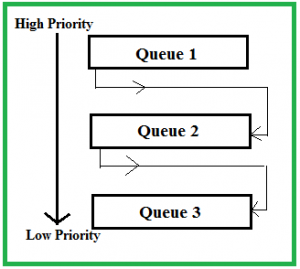
**Multilevel feedback queue scheduling, however, allows a process to move between queues. Multilevel Feedback Queue Scheduling ****(MLFQ)** keeps analyzing the behavior (time of execution) of processes and according to which it changes its priority.
Now let us suppose that queues 1 and 2 follow round robin with time quantum 4 and 8 respectively and queue 3 follow FCFS.
Implementation of MLFQ is given below -
- When a process starts executing the operating system can insert it into any of the above three queues depending upon its priority . For example, if it is some background process, then the operating system would not like it to be given to higher priority queues such as queues 1 and 2. It will directly assign it to a lower priority queue i.e. queue 3. Let's say our current process for consideration is of significant priority so it will be given queue 1 .
- In queue 1 process executes for 4 units and if it completes in these 4 units or it gives CPU for I/O operation in these 4 units then the priority of this process does not change and if it again comes in the ready queue then it again starts its execution in Queue 1.
- If a process in queue 1 does not complete in 4 units then its priority gets reduced and it is shifted to queue 2.
- Above points 2 and 3 are also true for queue 2 processes but the time quantum is 8 units. In a general case if a process does not complete in a time quantum then it is shifted to the lower priority queue.
- In the last queue, processes are scheduled in an FCFS manner.
- A process in a lower priority queue can only execute only when higher priority queues are empty.
- A process running in the lower priority queue is interrupted by a process arriving in the higher priority queue.
Well, the above implementation may differ for example the last queue can also follow Round-robin Scheduling.
**Problems in the above implementation: A process in the lower priority queue can suffer from starvation due to some short processes taking all the CPU time.
**Solution: A simple solution can be to boost the priority of all the processes after regular intervals and place them all in the highest priority queue.
**What is the need for such complex Scheduling?
- Firstly, it is more flexible than multilevel queue scheduling.
- To optimize turnaround time algorithms like SJF are needed which require the running time of processes to schedule them. But the running time of the process is not known in advance. MFQS runs a process for a time quantum and then it can change its priority(if it is a long process). Thus it learns from past behavior of the process and then predicts its future behavior. This way it tries to run a shorter process first thus optimizing turnaround time.
- MFQS also reduces the response time.
**Example: Consider a system that has a CPU-bound process, which requires a burst time of 40 seconds. The multilevel Feed Back Queue scheduling algorithm is used and the queue time quantum '2' seconds and in each level it is incremented by '5' seconds
- Q1 = 2
- Q2 = 7
- Q3 = 12
- Q4 = 17
- Q5 = 22
Then how many times the process will be interrupted and in which queue the process will terminate the execution?
**Solution:
- Process P needs 40 Seconds for total execution.
- At Queue 1 it is executed for 2 seconds and then interrupted and shifted to queue 2.
- At Queue 2 it is executed for 7 seconds and then interrupted and shifted to queue 3.
- At Queue 3 it is executed for 12 seconds and then interrupted and shifted to queue 4.
- At Queue 4 it is executed for 17 seconds and then interrupted and shifted to queue 5.
- At Queue 5 it executes for 22 seconds and then it completes.
- Hence the process is interrupted 4 times and completed on queue 5.