Multiprogramming in Operating System (original) (raw)
Last Updated : 29 Jul, 2025
As the name suggests, Multiprogramming means more than one program can be active at the same time. Before the operating system concept, only one program was to be loaded at a time and run. These systems were not efficient as the CPU was not used efficiently.
**Example: In a single-tasking system, the CPU is not used if the current program waits for some input/output to finish. The idea of multiprogramming is to assign CPUs to other processes while the current process might not be finished. This has the below advantages:
- The user gets the feeling that he/she can run multiple applications on a single CPU even if the CPU is running one process at a time.
- CPU is utilized better.
All modern operating systems like MS Windows, Linux, etc are multiprogramming operating systems.
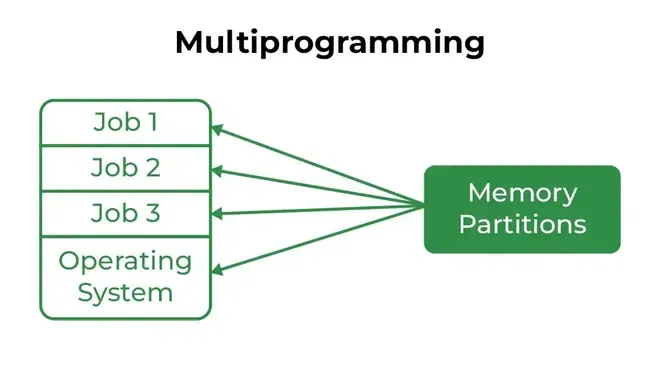
Multiprogramming OS
**Features of Multiprogramming
- Need Single CPU for implementation.
- Context switch between process.
- Switching happens when current process undergoes waiting state.
- CPU idle time is reduced.
- High resource utilization.
- High Performance.
**Disadvantages of Multiprogramming
- If it has a large number of jobs, then long-term jobs will have to require a long wait.
- Memory management is needed in the operating system because all types of tasks are stored in the main memory.
- Using multiprogramming up to a larger extent can cause a heat-up issue.
- High Degree of Multiprogramming will cause Thrashing.
- Prior knowledge of scheduling algorithms (An algorithm that decides which next process will get hold of the CPU) is required. These are of two types:
- **Preemptive Scheduling algorithm: In the preemptive scheduling algorithm if more than one process wants to enter into the critical section then it will be allowed and it can enter into the critical section without any interruption only if no other progress is in the critical section.
- **Non-Preemptive scheduling algorithm: If a process gets a critical section then it will not leave the critical section until or unless it works gets done.
**How do Multiprogramming Operating Systems Work?
In multiprogramming system, multiple programs are to be stored in memory and each program has to be given a specific portion of memory which is known as process. The operating system handles all these process and their states. Below are the steps occur when the process undergoes execution:
- The operating system selects a ready process by checking which one process should udergo execution.
- When the chosen process undergoes CPU execution, it might be possible that in between process need any input/output operation.
- At that time process goes out of main memory for I/O operation and temporarily stored in secondary storage.
- Then, CPU switches to next ready process.
- When the process which undergoes for I/O operation comes again after completing the work
- Then, CPU switches to this process.
- This switching is happening so fast and repeatedly that creates an illusion of simultaneous execution.
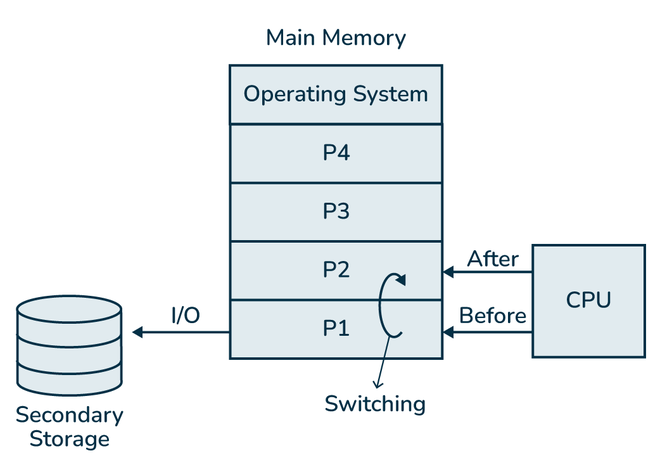
Working of Multi-Programming
Advantages of Multiprogramming
- Increase the resource utilization of a computer system.
- Support multiple simultaneously interactive users (terminals).
- Keeps multiple runnable jobs loaded in memory .
- Increase the throughput of the system.
- The waiting time for a program is reduced.
- Improve system's overall responsiveness.
- Improve the reliability and stability of the system.
- Make the system suitable for multitasking environments.
Difference Between Multiprogramming and Multi-tasking Operating Systems
| Multiprogramming | Multi-tasking |
|---|---|
| Involves loading multiple programs into the computer's memory and allowing them to share the CPU. The CPU switches between programs, especially when one is waiting for I/O operations to complete. | Refers to the ability of an operating system to execute multiple tasks (or processes) simultaneously by rapidly switching between them. |
| The main goal is to increase CPU utilization by reducing idle time. | The primary goal is to improve user responsiveness and allow for interactive computing |
| It does not involve direct user interaction. | Designed with user interaction, allowing users to run multiple applications (e.g., word processors, web browsers, etc.) simultaneously |
| Less complex than multitasking. It focuses on keeping the CPU busy by running one program at a time until it needs to wait for an I/O operation. | More complex one. It requires more sophisticated scheduling algorithms and resource management to handle multiple tasks, user inputs, and ensure a smooth experience. |
| There will be no effect of Parallelism. | It will give rise to concept of Parallelism |
| Used in environments where resource utilization is more critical, such as batch processing, and where tasks are long-running. | Used in interactive environments where multiple applications need to be run concurrently, particularly in desktop and mobile operating systems. |
Examples of Multiprogramming Operating Systems
Some examples of multiprogramming operating systems that have been widely used across different computing environments:
- IBM OS/360
- UNIX
- VMS (Virtual Memory System)
- Windows NT
- Linux
- macOS
- HP-UX