Priority Inversion in Operating Systems (original) (raw)
Last Updated : 15 Apr, 2026
Priority inversion is a scheduling problem where a low-priority task holds a resource (like a lock) that a high-priority task needs. This forces the high-priority task to wait for the low one.
Causes of Priority Inversion
- A low-priority task (L) acquires a shared resource that a high-priority task (H) will need later. When H requests that resource, it must wait for L to release it.
- While L holds that resource, a medium-priority task (M) which doesn’t require the resource becomes runnable and preempts L, because M has higher priority than L.
- As a result, the high-priority task (H) remains blocked, even though H outranks both L and M. Effectively, the priority order is inverted: M runs before H, despite H having the highest priority. This leads to unbounded priority inversion
Types of Priority Inversion
- Bounded Priority Inversion
- Unbounded Priority Inversion
**1. Bounded Priority Inversion: Bounded priority inversion occurs when a high-priority task is delayed by a lower-priority task holding a resource. The delay is predictable and limited to the time the lower-priority task holds the resource.
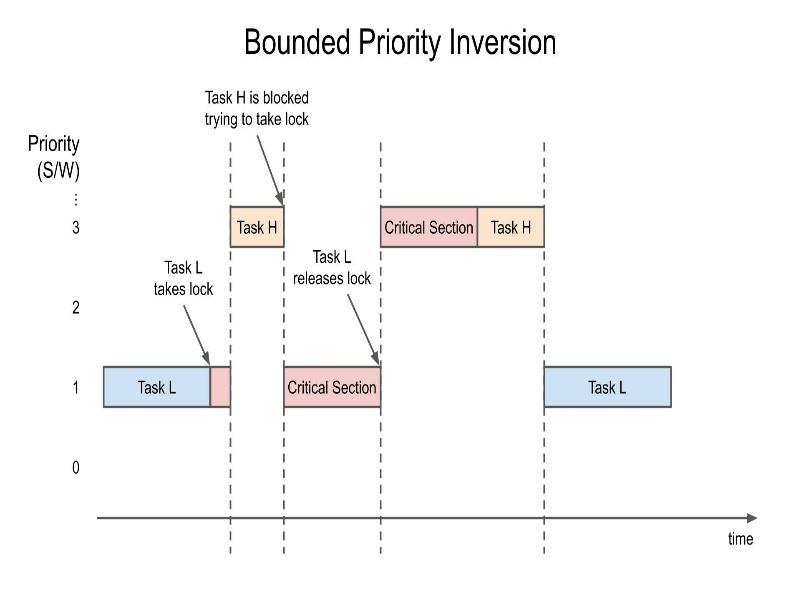
Bounded Priority Inversion
**Explanation: Consider three tasks with the following priorities
- L (Low priority): Task L holds a mutex to access a shared resource.
- M (Medium priority): Task M does not require the shared resource.
- H (High priority): Task H needs the shared resource held by L.
**Sequence of Events:
- L acquires the mutex and enters its critical section.
- H arrives and attempts to acquire the mutex but is blocked, waiting for L to release it.
- M becomes ready to run and preempts L.
- M executes until it completes its task.
- L resumes, finishes its critical section, and releases the mutex.
- H acquires the mutex and enters its critical section.
Outcome: H's execution is delayed by the time L holds the mutex and the time M runs. The total delay is predictable and equals the sum of L's critical section time and M's execution time.
**2. Unbounded Priority Inversion: Unbounded priority inversion occurs when a medium-priority task (M) preempts L while it holds the lock. This action delays L from releasing the resource, which in turn delays H. The delay H experiences becomes unpredictable and can potentially be indefinite, hence the term "unbounded."
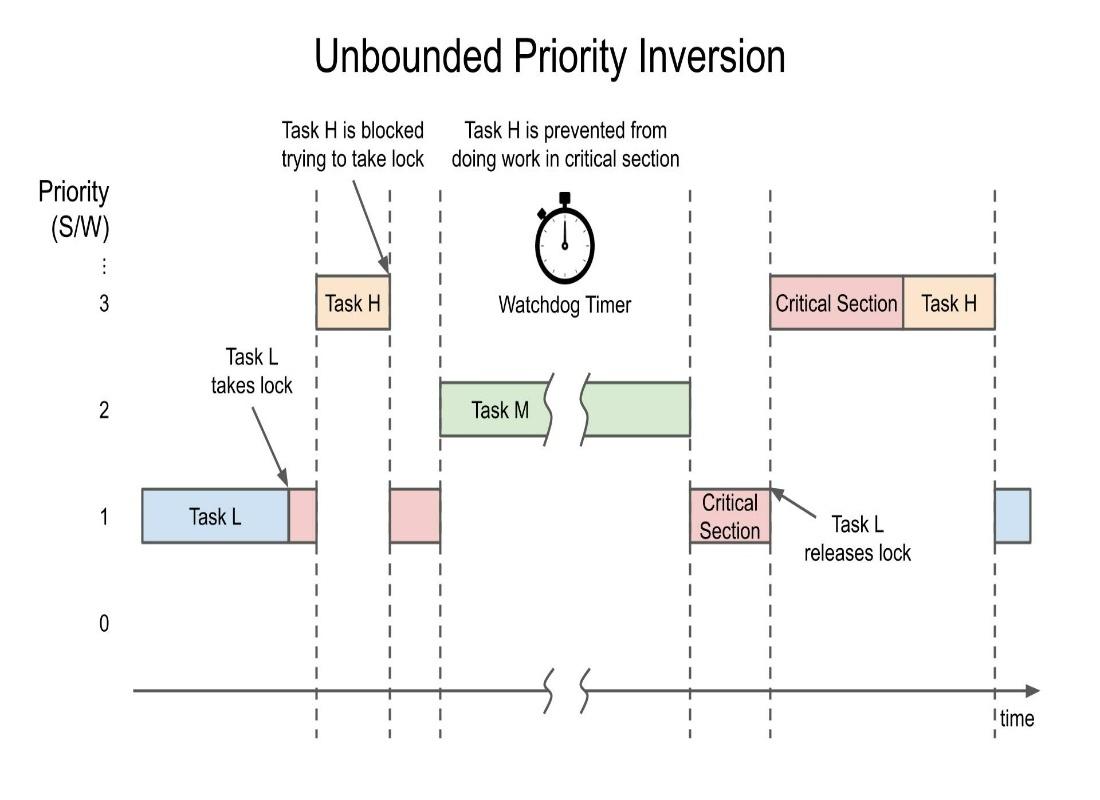
Unbounded Priority Inversion
**Explanation:
- Task L (Low Priority) starts and acquires a lock on a shared resource.
- Task H (High Priority) starts and needs the same lock. It gets blocked because Task L has it.
- This situation, where a high-priority task waits for a low-priority one, is called Priority Inversion.
- Task M (Medium Priority) now starts. Its priority is higher than Task L's.
- The scheduler lets Task M preempt Task L, so Task M begins running.
- This is the critical problem: Task M runs, preventing Task L from finishing its work.
- Because Task L can't run, it cannot release the lock.
- This means Task H remains blocked indefinitely, even though it's the most important task.
- The high-priority task is stuck waiting for a medium-priority task to finish, which is a serious flaw. This can cause a system failure or trigger a watchdog timer.
Solutions to Priority Inversion
Priority inversion can lead to significant delays and system inefficiencies. To resolve or prevent this issue, the following solutions are commonly used:
- **Priority Inheritance: Temporarily elevates the priority of the low-priority task holding the resource to match that of the highest-priority waiting task, ensuring timely resource release .
- **Priority Ceiling Protocol: Assigns a maximum priority to each resource, preventing tasks with lower priorities from acquiring resources needed by higher-priority tasks .
- **Avoiding Blocking: Utilizes non-blocking algorithms or designs systems to minimize shared resource usage, thereby reducing the chances of priority inversion .