Program for SSTF Disk Scheduling Algorithm (original) (raw)
Last Updated : 9 May, 2026
Given an array of disk track numbers and initial head position, our task is to find the total number of seek operations done to access all the requested tracks if Shortest Seek Time First (SSTF) is a disk scheduling algorithm is used.
The basic idea is the tracks that are closer to the current disk head position should be serviced first in order to minimize the seek operations is basically known as Shortest Seek Time First (SSTF).
Algorithm
**Step 1: Let the Request array represents an array storing indexes of tracks that have been requested. 'head' is the position of the disk head.
**Step 2: Find the positive distance of all tracks in the request array from the head.
**Step 3: Find a track from the requested array which has not been accessed/serviced yet and has a minimum distance from the head.
**Step 4: Increment the total seek count with this distance.
**Step 5: Currently serviced track position now becomes the new head position.
**Step 6: Go to step 2 until all tracks in the request array have not been serviced.
**Example:
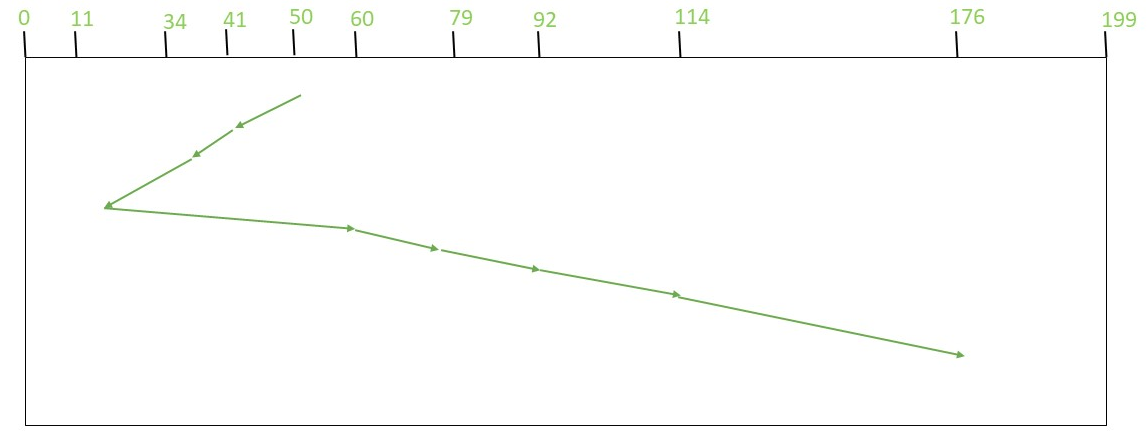
Request sequence = {176, 79, 34, 60, 92, 11, 41, 114}
Initial head position = 50
The following chart shows the sequence in which requested tracks are serviced using SSTF.
Therefore, the total seek count is calculated as:
SSTF (Shortest Seek Time First)
= (50-41)+(41-34)+(34-11)+(60-11)+(79-60)+(92-79)+(114-92)+(176-114) = 204 which can also be directly calculated as: (50-11) + (176-11)
Implementation
The implementation of SSTF is given below. Note that we have made a node class having 2 members. ‘distance’ is used to store the distance between the head and the track position. ‘accessed’ is a boolean variable that tells whether the track has been accessed/serviced before by the disk head or not.
C++ `
// C++ program for implementation of // SSTF disk scheduling #include <bits/stdc++.h> using namespace std;
// Calculates difference of each
// track number with the head position
void calculatedifference(int request[], int head,
int diff[][2], int n)
{
for(int i = 0; i < n; i++)
{
diff[i][0] = abs(head - request[i]);
}
}
// Find unaccessed track which is // at minimum distance from head int findMIN(int diff[][2], int n) { int index = -1; int minimum = 1e9;
for(int i = 0; i < n; i++)
{
    if (!diff[i][1] && minimum > diff[i][0])
    {
        minimum = diff[i][0];
        index = i;
    }
}
return index;
}
void shortestSeekTimeFirst(int request[], int head, int n) { if (n == 0) { return; }
// Create array of objects of class node
int diff[n][2] = { { 0, 0 } };

// Count total number of seek operation
int seekcount = 0;

// Stores sequence in which disk access is done
int seeksequence[n + 1] = {0};

for(int i = 0; i < n; i++)
{
    seeksequence[i] = head;
    calculatedifference(request, head, diff, n);
    int index = findMIN(diff, n);
    diff[index][1] = 1;

    // Increase the total count
    seekcount += diff[index][0];

    // Accessed track is now new head
    head = request[index];
}
seeksequence[n] = head;

cout << "Total number of seek operations = "
     << seekcount << endl;
cout << "Seek sequence is : " << "\n";

// Print the sequence
for(int i = 0; i <= n; i++)
{
    cout << seeksequence[i] << "\n";
}
}
// Driver code int main() { int n = 8; int proc[n] = { 176, 79, 34, 60, 92, 11, 41, 114 };
shortestSeekTimeFirst(proc, 50, n);

return 0;
}
// This code is contributed by manish19je0495
Java
// Java program for implementation of // SSTF disk scheduling class node {
// represent difference between
// head position and track number
int distance = 0;

// true if track has been accessed
boolean accessed = false;
}
public class SSTF {
// Calculates difference of each
// track number with the head position
public static void calculateDifference(int queue[],
                                    int head, node diff[])

{
    for (int i = 0; i < diff.length; i++)
        diff[i].distance = Math.abs(queue[i] - head);
}

// find unaccessed track
// which is at minimum distance from head
public static int findMin(node diff[])
{
    int index = -1, minimum = Integer.MAX_VALUE;

    for (int i = 0; i < diff.length; i++) {
        if (!diff[i].accessed && minimum > diff[i].distance) {

            minimum = diff[i].distance;
            index = i;
        }
    }
    return index;
}

public static void shortestSeekTimeFirst(int request[],
                                                 int head)

{
    if (request.length == 0)
        return;

    // create array of objects of class node
    node diff[] = new node[request.length];

    // initialize array
    for (int i = 0; i < diff.length; i++)

        diff[i] = new node();

    // count total number of seek operation
    int seek_count = 0;

    // stores sequence in which disk access is done
    int[] seek_sequence = new int[request.length + 1];

    for (int i = 0; i < request.length; i++) {

        seek_sequence[i] = head;
        calculateDifference(request, head, diff);

        int index = findMin(diff);

        diff[index].accessed = true;

        // increase the total count
        seek_count += diff[index].distance;

        // accessed track is now new head
        head = request[index];
    }

    // for last accessed track
    seek_sequence[seek_sequence.length - 1] = head;

    System.out.println("Total number of seek operations = "
                                                 + seek_count);

    System.out.println("Seek Sequence is");

    // print the sequence
    for (int i = 0; i < seek_sequence.length; i++)
        System.out.println(seek_sequence[i]);
}

public static void main(String[] args)
{
    // request array
    int arr[] = { 176, 79, 34, 60, 92, 11, 41, 114 };
    shortestSeekTimeFirst(arr, 50);
}
}
Python
Python3 program for implementation of
SSTF disk scheduling
Calculates difference of each
track number with the head position
def calculateDifference(queue, head, diff): for i in range(len(diff)): diff[i][0] = abs(queue[i] - head)
find unaccessed track which is
at minimum distance from head
def findMin(diff):
index = -1
minimum = 999999999

for i in range(len(diff)):
    if (not diff[i][1] and
            minimum > diff[i][0]):
        minimum = diff[i][0]
        index = i
return index
def shortestSeekTimeFirst(request, head):
if (len(request) == 0):
return
    l = len(request)
    diff = [0] * l

    # initialize array
    for i in range(l):
        diff[i] = [0, 0]

    # count total number of seek operation
    seek_count = 0

    # stores sequence in which disk
    # access is done
    seek_sequence = [0] * (l + 1)

    for i in range(l):
        seek_sequence[i] = head
        calculateDifference(request, head, diff)
        index = findMin(diff)

        diff[index][1] = True

        # increase the total count
        seek_count += diff[index][0]

        # accessed track is now new head
        head = request[index]

    # for last accessed track
    seek_sequence[len(seek_sequence) - 1] = head

    print("Total number of seek operations =",
                                   seek_count)

    print("Seek Sequence is")

    # print the sequence
    for i in range(l + 1):
        print(seek_sequence[i])
Driver code
if name =="main":
# request array
proc = [176, 79, 34, 60,
        92, 11, 41, 114]
shortestSeekTimeFirst(proc, 50)
This code is contributed by
Shubham Singh(SHUBHAMSINGH10)
C#
// C# program for implementation of // SSTF disk scheduling using System;
public class node {
// represent difference between
// head position and track number
public int distance = 0;

// true if track has been accessed
public Boolean accessed = false;
}
public class SSTF {
// Calculates difference of each
// track number with the head position
public static void calculateDifference(int []queue,
                                    int head, node []diff)

{
    for (int i = 0; i < diff.Length; i++)
        diff[i].distance = Math.Abs(queue[i] - head);
}

// find unaccessed track
// which is at minimum distance from head
public static int findMin(node []diff)
{
    int index = -1, minimum = int.MaxValue;

    for (int i = 0; i < diff.Length; i++)
    {
        if (!diff[i].accessed && minimum > diff[i].distance)
        {

            minimum = diff[i].distance;
            index = i;
        }
    }
    return index;
}

public static void shortestSeekTimeFirst(int []request,
                                                int head)
{
    if (request.Length == 0)
        return;

    // create array of objects of class node
    node []diff = new node[request.Length];

    // initialize array
    for (int i = 0; i < diff.Length; i++)

        diff[i] = new node();

    // count total number of seek operation
    int seek_count = 0;

    // stores sequence in which disk access is done
    int[] seek_sequence = new int[request.Length + 1];

    for (int i = 0; i < request.Length; i++)
    {

        seek_sequence[i] = head;
        calculateDifference(request, head, diff);

        int index = findMin(diff);

        diff[index].accessed = true;

        // increase the total count
        seek_count += diff[index].distance;

        // accessed track is now new head
        head = request[index];
    }

    // for last accessed track
    seek_sequence[seek_sequence.Length - 1] = head;

    Console.WriteLine("Total number of seek operations = "
                                                + seek_count);

    Console.WriteLine("Seek Sequence is");

    // print the sequence
    for (int i = 0; i < seek_sequence.Length; i++)
        Console.WriteLine(seek_sequence[i]);
}

// Driver code
public static void Main(String[] args)
{
    // request array
    int []arr = { 176, 79, 34, 60, 92, 11, 41, 114 };
    shortestSeekTimeFirst(arr, 50);
}
}
// This code contributed by Rajput-Ji
JavaScript
// Javascript Program for implementation of // SSTF disk scheduling function calculatedifference(request, head, diff, n) { for (let i = 0; i < n; i++) { diff[i][0] = Math.abs(head - request[i]); } }
// Find unaccessed track which is // at minimum distance from head function findMIN(diff, n) { let index = -1; let minimum = 1e9;
for (let i = 0; i < n; i++) {
    if (!diff[i][1] && minimum > diff[i][0]) {
        minimum = diff[i][0];
        index = i;
    }
}
return index;
}
function shortestSeekTimeFirst(request, head, n) { if (n == 0) { return; }
// Create array of objects of class node
let diff = new Array(n);
for (let i = 0; i < n; i++) {
    diff[i] = new Array(2);
}

// Count total number of seek operation
let seekcount = 0;

// Stores sequence in which disk access is done
let seeksequence = new Array(n + 1);
seeksequence[0] = head;

for (let i = 0; i < n; i++) {
    calculatedifference(request, head, diff, n);
    let index = findMIN(diff, n);
    diff[index][1] = 1;

    // Increase the total count
    seekcount += diff[index][0];

    // Accessed track is now new head
    head = request[index];
    seeksequence[i + 1] = head;
}

console.log("Total number of seek operations = " + seekcount);
console.log("Seek sequence is : ");

// Print the sequence
for (let i = 0; i <= n; i++) {
    console.log(seeksequence[i]);
}
}
// Driver code let n = 8; let proc = [176, 79, 34, 60, 92, 11, 41, 114];
shortestSeekTimeFirst(proc, 50, n);
// This code is contributed by ishankhandelwals.
`
**Output
Total number of seek operations = 204 Seek Sequence: 50, 41, 34, 11, 60, 79, 92, 114, 176
**Time Complexity: O(N^2)
**Auxiliary Space: O(N)
Advantages of Shortest Seek Time First (SSTF)
- Better performance than the FCFS scheduling algorithm.
- It provides better throughput.
- This algorithm is used in Batch Processing systems where throughput is more important.
- It has a less average response and waiting time.
Disadvantages of Shortest Seek Time First (SSTF)
- Starvation is possible for some requests as it favors easy-to-reach requests and ignores the far-away processes.
- There is a lack of predictability because of the high variance of response time.
- Switching direction slows things down.