Second Chance (or Clock) Page Replacement Policy (original) (raw)
Last Updated : 15 Apr, 2026
The Second Chance Page Replacement Algorithm is an improvement over FIFO that avoids removing frequently used pages by using a reference bit. When a page is accessed, its reference bit is set to 1, and during replacement, pages with bit 0 are replaced while pages with bit 1 are given a second chance, making memory management more efficient.
- Uses a reference bit to track page usage
- Replaces pages with reference bit 0
- Gives a second chance to pages with bit 1 by resetting it
- More efficient and scalable than FIFO, and sometimes better than LRU in modern systems
Algorithm
The algorithm works by associating a reference bit with each page in memory:
- Reference Bit = 1, The page has been recently used.
- Reference Bit = 0, The page has not been recently used.
Steps:
1. Pages are maintained in a queue (like FIFO).
2. When a page fault occurs, the algorithm checks the page at the front of the queue.
3. If the reference bit = 0, the page is replaced.
4. If the reference bit = 1:
- The reference bit is reset to 0.
- The page is moved to the back of the queue (given a second chance).
- The search continues until a page with reference bit = 0 is found.
Thus, frequently accessed pages are less likely to be replaced.
Example
Let's say the reference string is **0 4 1 4 2 4 3 4 2 4 0 4 1 4 2 4 3 4 and we have **3 frames. Let's see how the algorithm proceeds by tracking the second chance bit and the pointer.
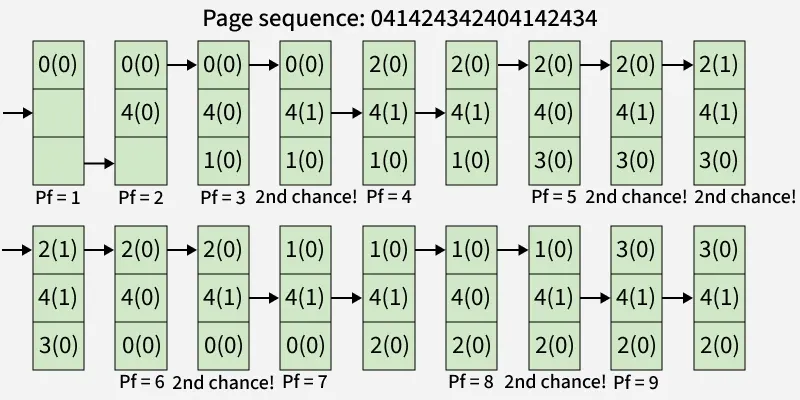
Page Replacement
- Initially, all frames are empty so after the first 3 passes they will be filled with {0, 4, 1} and the second chance array will be {0, 0, 0} as none has been referenced yet. Also, the pointer will cycle back to 0.
- **Pass-4: Frame={0, 4, 1}, second_chance = {0, 1, 0} [4 will get a second chance], pointer = 0 (No page needed to be updated so the candidate is still page in frame 0), pf = 3 (No increase in page fault number).
- **Pass-5: Frame={2, 4, 1}, second_chance= {0, 1, 0} [0 replaced; it's second chance bit was 0, so it didn't get a second chance], pointer=1 (updated), pf=4
- **Pass-6: Frame={2, 4, 1}, second_chance={0, 1, 0}, pointer=1, pf=4 (No change)
- **Pass-7: Frame={2, 4, 3}, second_chance= {0, 0, 0} [4 survived but it's second chance bit became 0], pointer=0 (as element at index 2 was finally replaced), pf=5
- **Pass-8: Frame={2, 4, 3}, second_chance= {0, 1, 0} [4 referenced again], pointer=0, pf=5
- **Pass-9: Frame={2, 4, 3}, second_chance= {1, 1, 0} [2 referenced again], pointer=0, pf=5
- **Pass-10: Frame={2, 4, 3}, second_chance= {1, 1, 0}, pointer=0, pf=5 (no change)
- **Pass-11: Frame={2, 4, 0}, second_chance= {0, 0, 0}, pointer=0, pf=6 (2 and 4 got second chances)
- **Pass-12: Frame={2, 4, 0}, second_chance= {0, 1, 0}, pointer=0, pf=6 (4 will again get a second chance)
- **Pass-13: Frame={1, 4, 0}, second_chance= {0, 1, 0}, pointer=1, pf=7 (pointer updated, pf updated)
- **Page-14: Frame={1, 4, 0}, second_chance= {0, 1, 0}, pointer=1, pf=7 (No change)
- **Page-15: Frame={1, 4, 2}, second_chance= {0, 0, 0}, pointer=0, pf=8 (4 survived again due to 2nd chance!)
- **Page-16: Frame={1, 4, 2}, second_chance= {0, 1, 0}, pointer=0, pf=8 (2nd chance updated)
- **Page-17: Frame={3, 4, 2}, second_chance= {0, 1, 0}, pointer=1, pf=9 (pointer, pf updated)
- **Page-18: Frame={3, 4, 2}, second_chance= {0, 1, 0}, pointer=1, pf=9 (No change)
Code Implementation:
C++ `
#include #include #include using namespace std;
// If page found, updates the second chance bit to true static bool findAndUpdate(int x,int arr[], bool second_chance[],int frames){ int i; for(i = 0; i < frames; i++){ if(arr[i] == x){ // Mark that the page deserves a second chance second_chance[i] = true; // Return 'true', that is there was a hit // and so there's no need to replace any page return true; } } // Return 'false' so that a page for replacement is selected // as he reuested page doesn't exist in memory return false; }
// Updates the page in memory and returns the pointer static int replaceAndUpdate(int x,int arr[], bool second_chance[],int frames,int pointer){ while(true){ // We found the page to replace if(!second_chance[pointer]){ // Replace with new page arr[pointer] = x; // Return updated pointer return (pointer + 1) % frames; } // Mark it 'false' as it got one chance // and will be replaced next time unless accessed again second_chance[pointer] = false; //Pointer is updated in round robin manner pointer = (pointer + 1) % frames; } } static void printHitsAndFaults(string reference_string, int frames){ int pointer, i, l=0, x, pf; //initially we consider frame 0 is to be replaced pointer = 0;
//number of page faults
pf = 0;

// Create a array to hold page numbers
int arr[frames];

// No pages initially in frame,
// which is indicated by -1
memset(arr, -1, sizeof(arr));

// Create second chance array.
// Can also be a byte array for optimizing memory
bool second_chance[frames];
// Split the string into tokens,
// that is page numbers, based on space
string str[100];
string word = "";
for (auto x : reference_string){
    if (x == ' '){
        str[l]=word;
        word = "";
        l++;
    }
    else{
        word = word + x;
    }
}
str[l] = word;
l++;
// l=the length of array
for(i = 0; i < l; i++){
    x = stoi(str[i]);
    // Finds if there exists a need to replace
    // any page at all
    if(!findAndUpdate(x,arr,second_chance,frames)){
        // Selects and updates a victim page
        pointer = replaceAndUpdate(x,arr,
                second_chance,frames,pointer);

        // Update page faults
        pf++;
    }
}
cout << "Total page faults were " << pf << "\n";
} // Driver code int main(){ string reference_string = ""; int frames = 0; // Test 1: reference_string = "0 4 1 4 2 4 3 4 2 4 0 4 1 4 2 4 3 4"; frames = 3; // Output is 9 printHitsAndFaults(reference_string,frames); // Test 2: reference_string = "2 5 10 1 2 2 6 9 1 2 10 2 6 1 2 1 6 9 5 1"; frames = 4; // Output is 11 printHitsAndFaults(reference_string,frames); return 0; }
C
#include <stdio.h> #include <string.h> #include <stdlib.h>
// If page found, updates the second chance bit to true static int findAndUpdate(int x, int arr[], int second_chance[], int frames) { int i; for (i = 0; i < frames; i++) { if (arr[i] == x) { // Mark that the page deserves a second chance second_chance[i] = 1; // Return 'true', that is there was a hit // and so there's no need to replace any page return 1; } } // Return 'false' so that a page for replacement is selected // as the requested page doesn't exist in memory return 0; }
// Updates the page in memory and returns the pointer static int replaceAndUpdate(int x, int arr[], int second_chance[], int frames, int pointer) { while (1) { // We found the page to replace if (!second_chance[pointer]) { // Replace with new page arr[pointer] = x; // Return updated pointer return (pointer + 1) % frames; } // Mark it 'false' as it got one chance // and will be replaced next time unless accessed again second_chance[pointer] = 0; // Pointer is updated in round robin manner pointer = (pointer + 1) % frames; } }
static void printHitsAndFaults(char* reference_string, int frames) { int pointer = 0, i, l = 0, x, pf = 0; // Create a array to hold page numbers int arr[frames]; // No pages initially in frame, which is indicated by -1 memset(arr, -1, sizeof(arr)); // Create second chance array int second_chance[frames]; // Split the string into tokens, that is page numbers, based on space char* token = strtok(reference_string, " "); while (token != NULL) { str[l++] = atoi(token); token = strtok(NULL, " "); } for (i = 0; i < l; i++) { x = str[i]; // Finds if there exists a need to replace any page at all if (!findAndUpdate(x, arr, second_chance, frames)) { // Selects and updates a victim page pointer = replaceAndUpdate(x, arr, second_chance, frames, pointer); // Update page faults pf++; } } printf("Total page faults were %d\n", pf); }
int main() { char reference_string[] = "0 4 1 4 2 4 3 4 2 4 0 4 1 4 2 4 3 4"; int frames = 3; // Output is 9 printHitsAndFaults(reference_string, frames);
strcpy(reference_string, "2 5 10 1 2 2 6 9 1 2 10 2 6 1 2 1 6 9 5 1");
frames = 4;
// Output is 11
printHitsAndFaults(reference_string, frames);
return 0;
}
Java
import java.util.Arrays;
public class SecondChance{ static boolean findAndUpdate(int x, int[] arr, boolean[] secondChance, int frames){ for (int i = 0; i < frames; i++) { if (arr[i] == x) { secondChance[i] = true; return true; } } return false; }
static int replaceAndUpdate(int x, int[] arr, boolean[] secondChance, int frames, int pointer){
    while (true) {
        if (!secondChance[pointer]) {
            arr[pointer] = x;
            return (pointer + 1) % frames;
        }
        secondChance[pointer] = false;
        pointer = (pointer + 1) % frames;
    }
}

static void printHitsAndFaults(String referenceString, int frames) {
    int pointer = 0, i, l, x, pf = 0;
    int[] arr = new int[frames];
    Arrays.fill(arr, -1);
    boolean[] secondChance = new boolean[frames];
    String[] str = referenceString.split(" ");
    l = str.length;
    for (i = 0; i < l; i++) {
        x = Integer.parseInt(str[i]);
        if (!findAndUpdate(x, arr, secondChance, frames)) {
            pointer = replaceAndUpdate(x, arr, secondChance, frames, pointer);
            pf++;
        }
    }
    System.out.println("Total page faults were " + pf);
}

public static void main(String[] args) {
    String referenceString = "0 4 1 4 2 4 3 4 2 4 0 4 1 4 2 4 3 4";
    int frames = 3;
    printHitsAndFaults(referenceString, frames);

    referenceString = "2 5 10 1 2 2 6 9 1 2 10 2 6 1 2 1 6 9 5 1";
    frames = 4;
    printHitsAndFaults(referenceString, frames);
}
}
Python
def find_and_update(x, arr, second_chance, frames): for i in range(frames): if arr[i] == x: second_chance[i] = True return True return False
def replace_and_update(x, arr, second_chance, frames, pointer): while True: if not second_chance[pointer]: arr[pointer] = x return (pointer + 1) % frames second_chance[pointer] = False pointer = (pointer + 1) % frames
def print_hits_and_faults(reference_string, frames): pointer = 0 pf = 0 arr = [-1] * frames second_chance = [False] * frames str_list = reference_string.split() l = len(str_list) for i in range(l): x = int(str_list[i]) if not find_and_update(x, arr, second_chance, frames): pointer = replace_and_update(x, arr, second_chance, frames, pointer) pf += 1 print(f'Total page faults were {pf}')
Driver code
reference_string = '0 4 1 4 2 4 3 4 2 4 0 4 1 4 2 4 3 4' frames = 3 print_hits_and_faults(reference_string, frames)
reference_string = '2 5 10 1 2 2 6 9 1 2 10 2 6 1 2 1 6 9 5 1' frames = 4 print_hits_and_faults(reference_string, frames)
` JavaScript ``
function findAndUpdate(x, arr, secondChance, frames) { for (let i = 0; i < frames; i++) { if (arr[i] === x) { secondChance[i] = true; return true; } } return false; }
function replaceAndUpdate(x, arr, secondChance, frames, pointer) { while (true) { if (!secondChance[pointer]) { arr[pointer] = x; return (pointer + 1) % frames; } secondChance[pointer] = false; pointer = (pointer + 1) % frames; } }
function printHitsAndFaults(referenceString, frames) {
let pointer = 0, i, l, x, pf = 0;
let arr = new Array(frames).fill(-1);
let secondChance = new Array(frames).fill(false);
let str = referenceString.split(' ');
l = str.length;
for (i = 0; i < l; i++) {
x = parseInt(str[i]);
if (!findAndUpdate(x, arr, secondChance, frames)) {
pointer = replaceAndUpdate(x, arr, secondChance, frames, pointer);
pf++;
}
}
console.log(Total page faults were ${pf});
}
// Driver code let referenceString = '0 4 1 4 2 4 3 4 2 4 0 4 1 4 2 4 3 4'; let frames = 3; printHitsAndFaults(referenceString, frames);
referenceString = '2 5 10 1 2 2 6 9 1 2 10 2 6 1 2 1 6 9 5 1'; frames = 4; printHitsAndFaults(referenceString, frames);
``
**Output:
Total page faults were 9
Total page faults were 11