Understanding Terminal, Console, Shell and Kernel (original) (raw)
Last Updated : 7 May, 2026
The terminal, console, shell and kernel are fundamental components of an operating system that help users interact with a computer. Together, they connect user commands to system hardware through layers of software and interfaces.
- **Terminal: A text-based interface where users type commands and receive output from the system.
- **Console: The physical or virtual device that provides access for input and output operations.
- **Shell: A command-line interpreter that translates user commands into actions performed by the operating system.
- **Kernel: The core part of the operating system that manages hardware resources like memory, CPU and devices.
Terminal
The Linux terminal is a command-line interface that lets users interact with the system using text commands. It is used for file management, running programs, system administration and automation, offering precise control and flexibility.
- Executes commands and manages processes
- Supports scripting for automation
- Aids in system monitoring and troubleshooting
- Provides access to system settings and administration

The terminal is just an interface that accepts user input and displays output. It does not understand commands itself, so it relies on another program - usually the shell - to interpret and execute them

Key Functions
- Takes user input in the form of commands
- Displays output and system responses
- Helps in automation and scripting
- Provides deep control over system resources
Console
The console is the primary interface that allows users to directly interact with the operating system through input and output devices. It can be a physical screen/keyboard or a virtual interface.
- Acts as a low-level communication interface with the OS
- Can work without a graphical environment
- Used during system boot and recovery scenarios
- Supports multiple virtual terminals
In Windows, the Command Prompt opens a console window, which works similarly to the Linux terminal. However, the console is the underlying system interface, while the command prompt is the program running inside it.

Shell
The shell is a command-line interpreter that acts as a bridge between the user and the kernel. When you press Enter after typing a command, the terminal sends it to the shell for processing.
The shell performs the following functions
- Interprets user commands
- Checks command syntax and correctness
- Converts valid commands into a format understood by the kernel
- Forwards those commands to the kernel
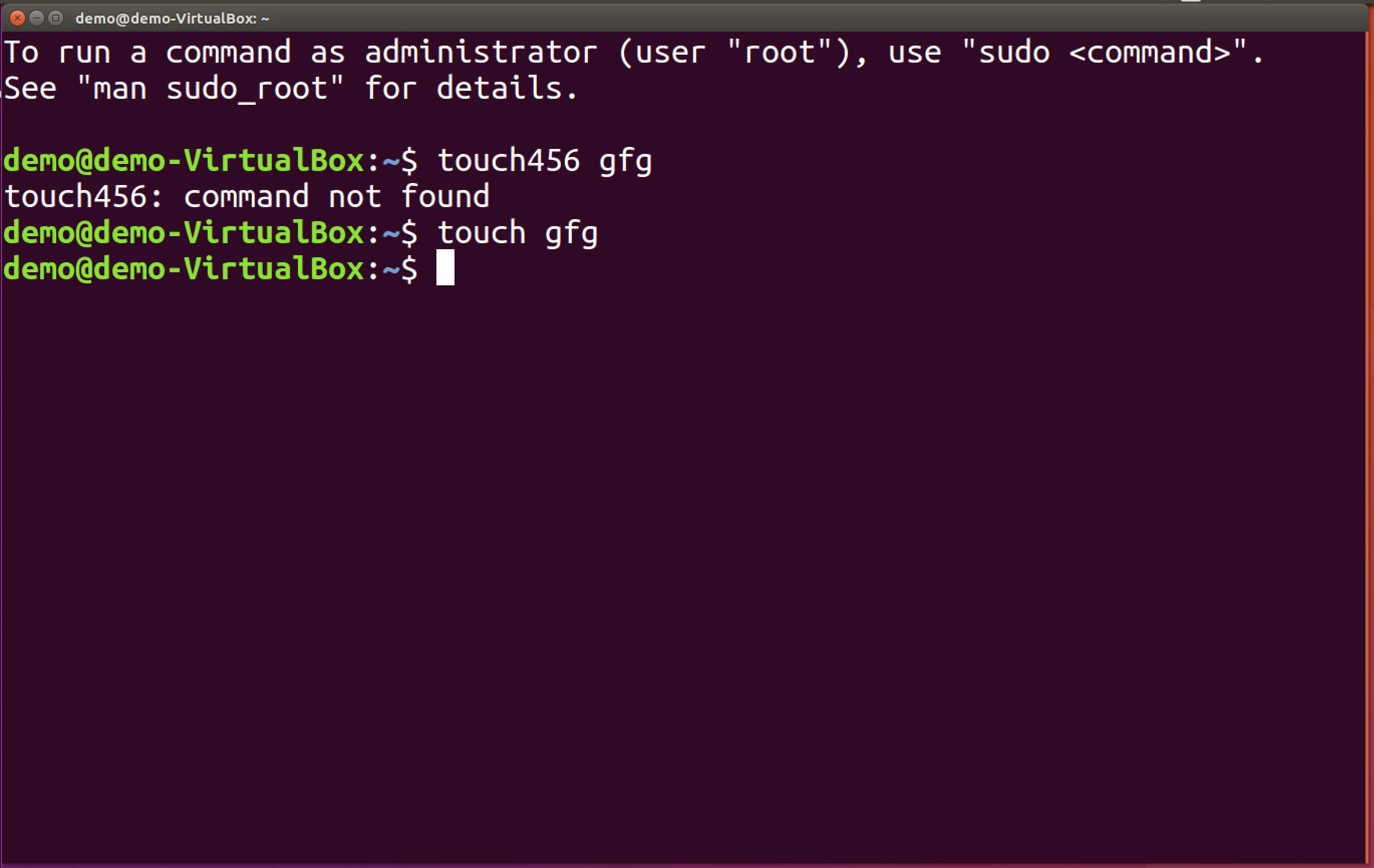
- Displays errors if the command is incorrect
- Displays a new prompt for the next command
Examples of shell programs include
- **Bash: The most widely used Linux shell, known for scripting, automation and default availability on most systems.
- **Zsh: An advanced shell with powerful customization, better autocomplete and plugin support.
- **Ksh: A Unix shell optimized for scripting with enhanced programming features.
- **Tcsh: An improved version of the C Shell with command-line editing and history features.
- **Fish Shell: A user-friendly shell with syntax highlighting, auto suggestions and easy configuration.
**Note: Default shell varies according to your Linux distribution (commonly Bash; some use Zsh).

Kernel
The kernel is the core component of the operating system responsible for managing system resources and hardware communication. It executes the commands passed by the shell and interacts directly with hardware components.
Core Components of Kernel Interaction
- **OS Libraries: Provide functions such as read() and write() that applications use to request kernel services.
- **Device Drivers: Allow communication with hardware like keyboard, disk and display
Kernel Responsibilities
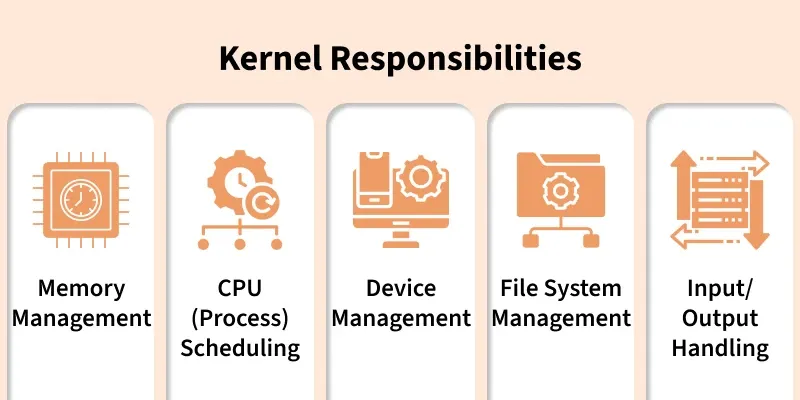
The kernel handles most of the core system operations and manages hardware and system resources; some of its major responsibilities are listed below.
Kernel Responsibilities
1. Memory Management
- Allocates and deallocates system memory(RAM)
- Ensures efficient use of RAM and prevents memory conflicts
2. CPU (Process) Scheduling
- Manages process execution and task switching
- Allocates CPU time between running processes
3. Device Management
- Controls communication with hardware devices
- Manages device drivers and hardware interrupts
4. File System Management
- Organizes and manages data storage on disks
- Handles file access permissions and security
5. Input/Output Handling
- Manages communication between software and hardware
- Handles data transfer between input and output devices
Interaction Flow Between Terminal, Shell and Kernel
The communication between these components follows a layered execution model. Each layer has a specific responsibility in processing user commands.
Execution Flow
- The user enters a command in the Terminal.
- The terminal forwards the input to the Shell.
- The shell validates the syntax and prepares system calls.
- The request is passed to the Kernel.
- The kernel communicates with hardware using device drivers.
- The result is returned back through the shell to the terminal for display.
This structured flow ensures
- Clear separation of responsibilities
- Secure access to hardware
- Stable resource management
- Controlled execution of user commands