Python | Pandas Series.kurtosis() (original) (raw)
Last Updated : 11 Feb, 2019
Pandas series is a One-dimensional ndarray with axis labels. The labels need not be unique but must be a hashable type. The object supports both integer- and label-based indexing and provides a host of methods for performing operations involving the index. Pandas **Series.kurtosis()** function returns an unbiased kurtosis over requested axis using Fisher’s definition of kurtosis (kurtosis of normal == 0.0). The final result is normalized by N-1.
Syntax: Series.kurtosis(axis=None, skipna=None, level=None, numeric_only=None, **kwargs)Parameter : axis : Axis for the function to be applied on.skipna : Exclude NA/null values when computing the result.level : If the axis is a MultiIndex (hierarchical), count along a particular level, collapsing into a scalar.numeric_only : Include only float, int, boolean columns.**kwargs : Additional keyword arguments to be passed to the function.Returns : kurt : scalar or Series (if level specified)
Example #1: Use Series.kurtosis() function to find the kurtosis of the underlying data in the given series object.
Python3 `
importing pandas as pd
import pandas as pd
Creating the Series
sr = pd.Series([10, 25, 3, 25, 24, 6])
Create the Index
index_ = ['Coca Cola', 'Sprite', 'Coke', 'Fanta', 'Dew', 'ThumbsUp']
set the index
sr.index = index_
Print the series
print(sr)
`
Output : 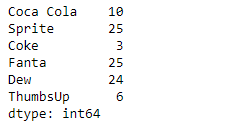 Now we will use
 Series.kurtosis() function to find the kurtosis of the underlying data in the given series object.
Python3 `
return the kurtosis
result = sr.kurtosis()
Print the result
print(result)
`
Output :  As we can see in the output, the
 Series.kurtosis() function has returned the kurtosis of the given series object.Example #2 : Use Series.kurtosis() function to find the kurtosis of the underlying data in the given series object. The given series object contains some missing values.
Python3 `
importing pandas as pd
import pandas as pd
Creating the Series
sr = pd.Series([19.5, 16.8, None, 22.78, 16.8, 20.124, None, 64, 89])
Print the series
print(sr)
`
Output : 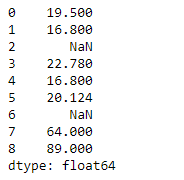 Now we will use
 Series.kurtosis() function to find the kurtosis of the underlying data in the given series object.
Python3 `
return the kurtosis
skip the missing values
result = sr.kurtosis(skipna = True)
Print the result
print(result)
`
Output :  As we can see in the output, the
 Series.kurtosis() function has returned the kurtosis of the given series object.