Angle between Two Vectors Formula (original) (raw)
Last Updated : 12 Jun, 2026
Vectors are quantities that have both magnitude and direction. When two vectors originate from a common point, they form an angle that describes their relative orientation in space.
- Angle between two vectors is the angle formed at the intersection of their tails.
- Angles can be acute, right, or obtuse, depending on the direction of the vectors.
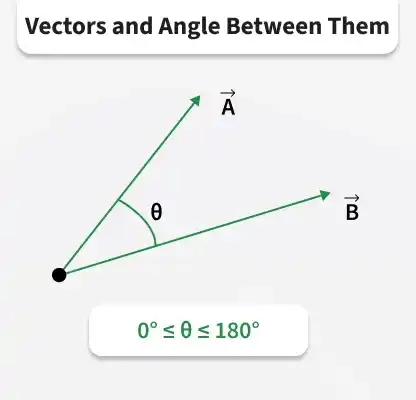
The angle between two vectors is found using two formulas:
**1. Using Dot Product:
The dot product of two vectors is equal to the product of their magnitudes and the cosine of the angle between them.
For vectors A and B, the dot product is given by,
A . B= |A| |B| cosθ
Rearranging the formula ,
\cos\theta=\frac{\vec{A}.\vec{B}}{|A|.|B|} or \theta=cos^{-1}(\frac{\vec{A}.\vec{B}}{|A|.|B|})
This formula is widely used to find the angle between two vectors because it directly relates the dot product to the cosine of the angle.
2. Using Cross Product
The magnitude of the cross product of two vectors is equal to the product of their magnitudes and the sine of the angle between them.
For vectors A and B,
|A × B| = |A||B| sin θ
Rearranging the formula,
sin θ = \frac{|A × B|}{(|A||B|)} or θ = sin⁻¹(\frac{|A × B|}{|A||B|})
This method is useful when the cross product of the vectors is known or can be calculated easily.
Angle Between Two Vectors in Cartesian Form
Let \vec{A}=A_x\hat{i}+A_y\hat{j}+A_z\hat{k} and \vec{B}=B_x\hat{i}+B_y\hat{j}+B_z\hat{k} be two vectors in Cartesian form.
The dot product of the vectors is \vec{A}\cdot\vec{B}=A_xB_x+A_yB_y+A_zB_z
The magnitudes of the vectors are |\vec{A}|=\sqrt{A_x^2+A_y^2+A_z^2} and |\vec{B}|=\sqrt{B_x^2+B_y^2+B_z^2}
Substituting these values into the angle formula, \cos\theta=\frac{A_xB_x+A_yB_y+A_zB_z}{\sqrt{A_x^2+A_y^2+A_z^2}\sqrt{B_x^2+B_y^2+B_z^2}}
Therefore, \theta=\cos^{-1}\left(\frac{A_xB_x+A_yB_y+A_zB_z}{\sqrt{A_x^2+A_y^2+A_z^2}\sqrt{B_x^2+B_y^2+B_z^2}}\right)
This formula can be used to find the angle between any two non-zero vectors expressed in Cartesian coordinates.
**Special Cases
**1. Parallel Vectors: Two vectors are parallel when they point in the same direction i.e., θ = 0°, therefore, A.B = |A| |B| cos 0 ⇒ |A| |B| . The dot product attains its maximum positive value for parallel vectors.
**2. Opposite Vectors: Two vectors are opposite when they have the same magnitude but point in opposite directions i.e.,θ = 180° therefore, A.B = |A| |B| cos 180 ⇒ -|A| |B| . The dot product attains its maximum negative value for opposite vectors.
**3. Perpendicular Vectors: Two vectors are perpendicular when they intersect at a right angle i.e.,θ = 90° therfore, A.B = |A| |B| cos 90 ⇒ 0. Hence, if the dot product of two non-zero vectors is zero, the vectors are orthogonal (perpendicular).
Sample Problems
**Problem 1: Find the angle between vectors (If they form an equilateral triangle)
- a and b vectors
- b and c vectors
- a and c vectors
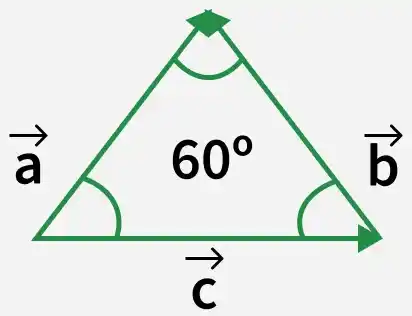
Equilateral Triangle formed by a, b, c vector
- a and b vectors
For vector a and b, head of both the vectors coincide with each other, hence angle between a and b vector is same as the angle between two sides of equilateral triangle = 60°.
- b and c vectors:
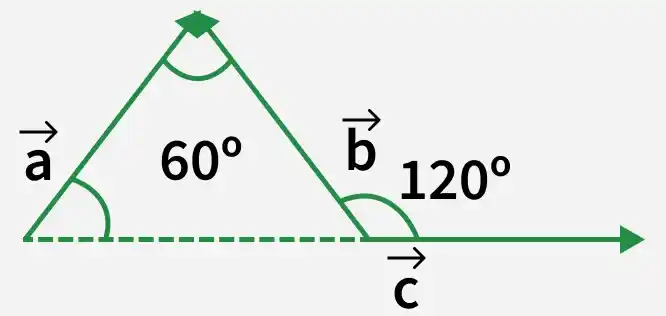
From the above figure, we see that head or tail of the b and c vector does not coincide with each other.
So, by using the property- A vector remains unchanged if it is transmitted parallel to itself.
Vector c is shifted parallel to itself
Now we see the tail of vectors b and c are coincide with each other, therefore is the same as the exterior angle make with an equilateral triangle = 120°.
- a and c vectors
The tail of a and c coincide
For vectors a and c, the tail of both the vectors coincide with each other, hence the angle between the a and c vector is the same as the angle between two sides of the equilateral triangle = 60°.
**Problem 2: Find angle between the vectors A = i + j + k and vector B = -2i - 2j - 2k.
From the formula,
A = Axi + Ayj + Azk
B= Bxi + Byj + Bzk
cosθ= \frac{(Ax.Bx+Ay.By+Az.Bz)}{(\sqrt{Ax^2+Ay^2+Az^2}×\sqrt{Bx^2+By^2+Bz^2})}
Here in the Given question, A= i + j + k and B= -2i -2j -2k
Substituting the values in the formula
cosθ = \frac{(1.(-2)+1.(-2)+1.(-2))}{(\sqrt{1^2+1^2+1^2}×\sqrt{(-2)^2+(-2)^2+(-2)^2})}
cosθ = \frac{(-2-2-2)}{(\sqrt{1+1+1}×\sqrt{4+4+4})}
cosθ = \frac{-6}{(\sqrt{3}×\sqrt{12})}
cosθ = \frac{-6}{(\sqrt{36})}
cosθ = -6/6 = -1
θ = 180°
**Problem 3: Find angle between vector A = 3i + 4j and B = 2i + j
A = Axi + Ayj + Azk
B = Bxi + Byj + Bzk
cosθ = \frac{(Ax.Bx+Ay.By+Az.Bz)}{(\sqrt{Ax^2+Ay^2+Az^2}×\sqrt{Bx^2+By^2+Bz^2})}
Here Given, A= 3i + 4j + 0k and B= 2i + j + 0k
Substituting the values in the formula,
cosθ = \frac{(3.2+4.1+0.0)}{(\sqrt{3^2+4^2+0^2}×\sqrt{2^2+1^2+0^2})}
cosθ = \frac{(6+4+0)}{(\sqrt{9+16+0}×\sqrt{4+1+0})}
cosθ = \frac{(10)}{(\sqrt{25}×\sqrt{5})}
cosθ = \frac{(10)}{(\sqrt{125})}
θ = cos-1 (\frac{(10)}{5.(\sqrt{5})})
θ = cos-1 (\frac{2}{(\sqrt{5})})
**Problem 4: Find the angle between vector A = i + j and Vector B = j + k.
From the formula,
A = Axi + Ayj + Azk
B = Bxi + Byj + Bzk
cosθ = \frac{(Ax.Bx+Ay.By+Az.Bz)}{(\sqrt{Ax^2+Ay^2+Az^2}×\sqrt{Bx^2+By^2+Bz^2})}
Here , A = i + j and B = j + k
cosθ = \frac{(1.0+1.1+0.1)}{(\sqrt{1^2+1^2+0^2}×\sqrt{0^2+1^2+1^2})}
cosθ = \frac{(1)}{(\sqrt{1+1+0}×\sqrt{0+1+1})}
cosθ =\frac{1}{(\sqrt{2}×\sqrt{2})}
θ = cos-1 (1/2) = 60°
Practice Problems
- Find the angle between vectors 2\hat{i}+\hat{j}\ \text{and}\ \hat{i}+2\hat{j}
- Determine whether vectors 3\hat{i}-2\hat{j}\ \text{and}\ 2\hat{i}+3\hat{j} are perpendicular.
- Find the angle between vectors (1,0,1) and (2,1,0).
- Find the angle between vectors 2\hat{i}+3\hat{j}+\hat{k}\ \text{and}\ \hat{i}-\hat{j}+2\hat{k}
- Show that vectors (1, 1, 1) and (−1, −1, −1) are oppositely directed.