Applications of Alpha Decay in Everyday Life (original) (raw)
Last Updated : 23 Jul, 2025
Alpha decay is when an atom spits out an alpha particle, consisting of 2 protons and 2 neutrons, reducing its mass. Here, we will explain alpha decay, a type of radioactive decay where atoms emit alpha particles. Here, we will cover its applications, real-life examples, and significance in various fields.
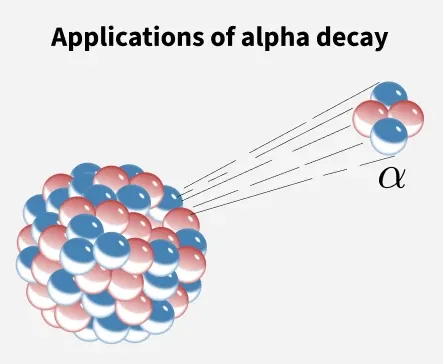
Applications of Alpha -decay
Table of Content
What is Alpha Decay?
Alpha decay is a form of radioactive decay where unstable atomic nuclei release energy by emitting an alpha particle. This process results in a daughter nucleus with a mass number decreased by four and an atomic number lowered by two compared to the original nucleus.
An alpha particle is identical to a helium-4 nucleus, composed of two protons and two neutrons, carrying a ****+2e** charge and a mass of **4 atomic mass units (u).
Alpha decay takes place in high-atomic-mass and instable isotopes like uranium and radium. It is an essential process in nuclear physics and while it plays a major role in the mechanism of radioactive decay, in this case it means the breakup of atoms.
**The alpha decay of uranium is represented by the following equation:
**238 92 U → **234 90 Th + **4 2 He
**History of Alpha Decay
Alpha decay was first discovered in the early 20th century when scientists like **Ernest Rutherford were studying radioactive materials.
**Rutherford, along with others such as **Paul Villard, observed that certain unstable elements, like uranium, released particles made up of two protons and two neutrons, which were later named alpha particles. Over time, researchers understood that when a radioactive nucleus undergoes alpha decay, it transforms into a new element with a lower atomic number and mass.
- Discovered in the early 1900s by scientists like Ernest Rutherford and Paul Villard.
- Found that unstable elements like uranium emit particles made of 2 protons and 2 neutrons (alpha particles).
- Alpha decay causes the original element to change into a new one with a lower atomic number and mass.
- Important in understanding nuclear reactions and radioactivity.
Applications of Alpha Decay
**Here are some of the most important real-life applications of alpha decay.
**Radiometric Dating
- In material radiometric dating materials with both uranium and thorium, alpha decay is very important.
- It consists of the journey from the nucleus of unstable atoms to the alpha particle, which is composed of two protons and two neutrons.
- The parent isotopes such as uranium and thorium usually experience alpha decay, which in turn, causes them to be transformed into daughter isotopes.
- With time, the concentration of parents' isotopes decreases versus that of the daughter isotopes because it disintegrates by alpha decay.
- Scientists can calculate by a sample measurement of this ratio, using the principle of radioactive decay.
- Radiocarbon dating as well as alpha decay is a method which is used to calculate the age of rocks and minerals as well as of archaeological artifacts.
**Smoke Detectors
- Smoke detectors that operate by way of ionization are powered by alpha particles from the radio isotope of americium: americium-241.
- The americium-241's alpha emission produces ionizing radiation powerful enough to make the air molecules in the detector chamber charged.
- This charging creates a small electric current between two electrodes within the detector, which contributes to detection of the radiation by the way of creating an electromagnetic field.
- When smoke passes through the chamber, it makes the flow of charged particles to be disturbed by having this current to be reduced.
- The reduction in current is the message that the alarm system has received, and it is a warning that there is a smoke in the area.
**Medical Treatments
- TAT (Targeted Alpha Therapy) is a new cancer treatment.
- It will use some alpha particle materials which are radioactive.
- These are molecules that are connected to their material, and that adhere to cancer cells.
- This signifies that the radiation is usually concentrated in the tumor.
- It is a goal to damage and kill the cancer cells only but not the healthy ones which are located nearby.
- As alpha particles are powerful and can damage cancer cells but they also put healthy tissues and cells at risk.
- It is possible that this approach could work well for some cancers.
**Nuclear Energy
- Alpha decay is not directly utilized in nuclear reactors but is significant in the decay chains of certain radioactive isotopes like uranium and thorium.
- These isotopes serve as fuel in nuclear reactors.
- Understanding alpha decay is crucial for effectively managing nuclear fuel and waste.
- Alpha decay involves the emission of an alpha particle, which consists of two protons and two neutrons, from the nucleus of a radioactive atom.
- This process reduces the atomic number of the parent nucleus by 2 and the mass number by 4.
- The daughter nucleus formed after alpha decay is usually a different element with a lower atomic number.
- Managing the decay products and waste generated from alpha decay is essential for nuclear reactor operations and safety.
**Industrial Thickness Gauges
- Alpha radiation is used in industries to measure the thickness of materials.
- Engineers use alpha particles to detect how much a material weakens as the particles pass through it.
- This weakening helps engineers figure out the thickness of the material.
- The method works well with different types of materials and thicknesses.
- It's used in manufacturing, construction, and quality control.
- Safety precautions are important because alpha radiation can ionize substances.
**Space Exploration
- Space probes and satellites use devices called radioisotope thermoelectric generators (RTGs).
- RTGs work by harnessing the heat produced from the decay of radioactive isotopes like plutonium-238.
- The heat generated is converted into electricity by the RTGs.
- This electricity acts as a durable power supply for spacecraft, supporting their instruments and systems.
- RTGs are crucial for deep space missions, as they offer reliable power even in areas where solar power isn't feasible.
- They enable spacecraft to carry out extended missions beyond the range of solar energy.
**Material Analysis
- Alpha spectroscopy is a method that is used to analyze materials.
- It concerns the energy spectrum of the alpha particle emitted from the radioactive substances.
- This distinguishes and determines the quantity of a given material in a given sample.
- It is good for identifying what radioactive substances are made of and determining the quantity of individual elements that exist in each of them.
- In alpha spectroscopy, the alpha particles have to be detected by detectors that are able to precisely measure their energy.
- It is used in many fields as such monitoring the environment, medical treatments whose process involves radioactivity and investigating nuclear accidents.
- It helps us know how these things behave and what they are made of which is through the emission of alpha-radiation materials.
Conclusion
In conclusion, alpha decay, with its emission of alpha particles, underpins various practical applications ranging from radiometric dating to cancer therapy, illustrating its significance in diverse fields of science and technology.
**Also, check