Atmospheric Refraction (original) (raw)
Last Updated : 1 May, 2026
Atmospheric refraction is the phenomenon in which light rays bend while passing through the Earth’s atmosphere due to variations in the density of air layers. Since the atmosphere is made up of layers with different temperatures and densities, the refractive index of air changes continuously with height.
Effects of Atmospheric Refraction-
**1. Twinkling of Stars
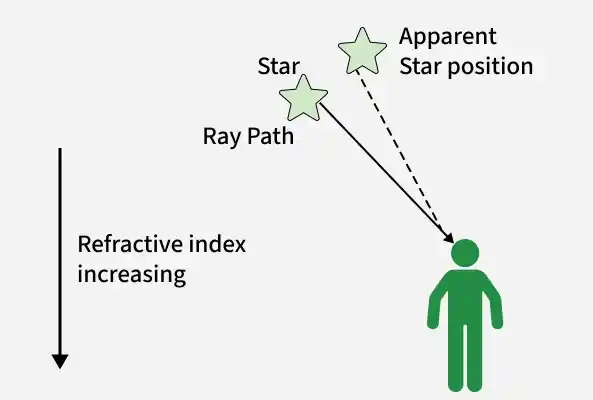
- Stars appear to twinkle due to continuous refraction of light
- Their light passes through layers of varying density
- The apparent position and brightness keep changing
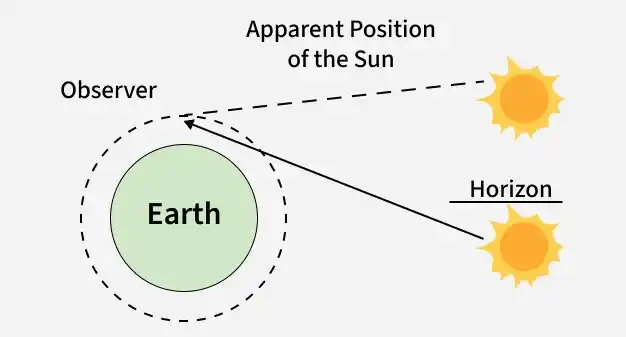
**2. Advanced Sunrise and Delayed Sunset
- The Sun appears earlier before actual sunrise
- It remains visible even after it has set
- This happens because light bends toward the observer
**3. Apparent Flattening of the Sun
- At sunrise and sunset, the Sun appears flattened
- Due to different bending of light from the top and bottom of the Sun.
Cause of Atmospheric Refraction
- The Earth’s atmosphere is not uniform
- The density of air decreases with altitude
- The refractive index of air varies accordingly
- Light travels through layers of gradually changing refractive index, causing continuous bending
Sample Problems
**Question 1: By how much time the atmosphere refraction causes a delay in the sunset and early sunrise?
**Solution: The sun appears 2 minutes before the actual sunrise and sunset 2 minutes later than the actual sunset.
**Question 2: Explain why the object seems moving if we look at the object through the hot air over the fire?
**Solution: This is because of the refraction of light, as the hot air above the fire behave as rarer medium and the colder air further above the hot air behaves as an optically denser medium, hence refraction takes place and the object seems shaky or moving.
**Problem 3: Write at least three applications of atmospheric refraction?
**Solution: Following are the application of atmospheric refraction:
- Advance sunrise and delay sunset
- The apparent position of stars
- Formation of rainbow
**Problem 4: We know that when light moves from one medium to another causes refraction. Now our atmosphere covers with air only so how does light refract in one medium? Explain in brief.
**Solution: Well the atmosphere's layer is not the same, as at different height it has different temperature due to which some layer become optically rarer medium and some become optically denser and this causes atmospheric refraction.