Bohr's Model of an Atom (original) (raw)
Last Updated : 8 May, 2026
Bohr's model is an atomic model proposed by Danish physicist Niels Bohr in 1913. In an atom, the electrons revolve around the nucleus in definite energy levels called orbits/shells. This model provides a basic understanding of the concept of the atom and its constituents. According to this model, the electron revolving near the nucleus has less energy, whereas the electron revolving away from the nucleus has higher energy.
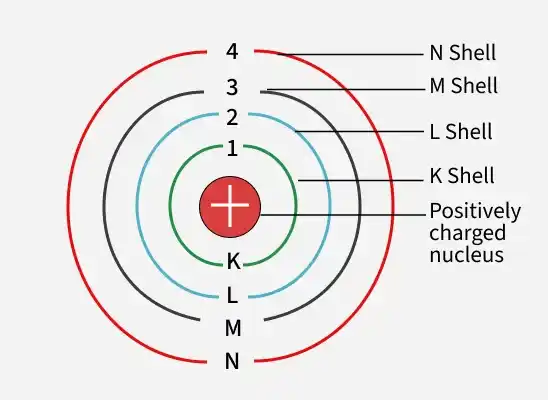
- This model proposes that the maximum number of electrons that can be accommodated in any particular orbit is 2n2, where n is the number of orbits, and the maximum number of electrons that can be accommodated in the outermost shell of an atom is 8.
- Also, the orbit that is closest to the nucleus has the minimum energy, and the orbit farthest from the nucleus has the maximum energy.
- Electrons are excited to higher energy levels by absorbing energy and return to lower energy levels by radiating.
**Postulates of Bohr's Model
To describe how electrons move in fixed paths around the nucleus, Bohr suggested certain important statements known as postulates of the Bohr model, which explain the arrangement and energy of electrons in an atom.
- In an atom, electrons revolve around the nucleus in some fixed circular orbits called shells.
- These shells are also called stationary orbits.
- Electrons while revolving in these orbits do not lose any energy. Also, each shell has a fixed energy associated with it.
- In these fixed orbits, the angular momentum of the electron is an integral multiple of "h/2π," where "h" is Planck's constant.
Therefore the angular momentum "L" of the revolving electron is,
L = \frac{nh}{2\pi}
where,
n is integer 1,2,3..... known as a principal quantum number
h is Planck's constant
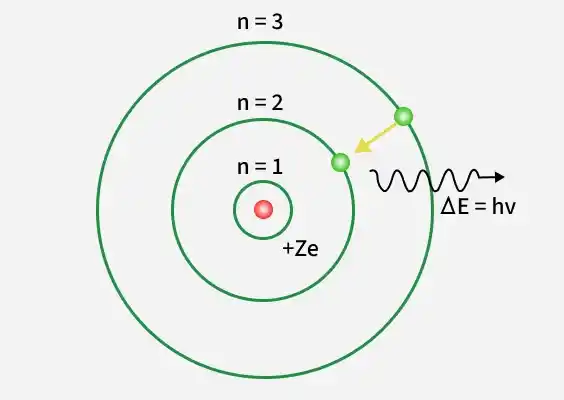
- The energy of an electron revolving in a stationary orbit remains constant. Energy is emitted from an atom only when an electron jumps from the orbit of higher energy to the orbit having low energy.
- When an electron jumps from one energy level to another energy level, it radiates energy. For example, if an electron jumps from orbit with energy Ei to orbit with energy Ef it releases a photon of energy hv which is calculated as,
hv = Ei- Ef
Limitations of Bohr's Model of Atom
The Bohr model successfully explained the structure and spectrum of the hydrogen atom. However, it could not explain many observations related to more complex atoms, such as the spectra of multi-electron atoms and the fine structure of spectral lines.
**1. Does Not Follow Heisenberg’s Uncertainty Principle
Bohr's model states that electrons revolve in fixed circular orbits with definite radius and velocity. However, according to Werner Heisenberg’s Uncertainty Principle, it is impossible to determine both the exact position and exact momentum of an electron at the same time. Thus, the idea of fixed electron orbits is inconsistent with the Heisenberg Uncertainty Principle.
**2. Cannot Explain the Zeeman Effect
Bohr's model fails to explain the splitting of spectral lines when an atom is placed in a magnetic field. This phenomenon is known as the Zeeman effect.
**3. Cannot Explain the Stark Effect
It also cannot explain the splitting of spectral lines in the presence of an electric field. This phenomenon is called the Stark effect.
**4. Not Applicable to Multi-Electron Atoms
Bohr's model works well only for hydrogen or hydrogen-like atoms (single-electron systems). It does not explain the electronic spectra of larger atoms having more than one electron.
**5. Cannot Explain Intensity of Spectral Lines
The model explains the position of spectral lines but does not explain why some spectral lines are brighter (more intense) than others.
**6. Ignores Wave Nature of Electrons
Later, Louis de Broglie showed that electrons have a wave nature. Bohr's model treats electrons only as particles and does not consider their wave behavior.
Applications of Bohr's Model of an Atom
Its applications are important in understanding atomic structure, spectral lines, and the behavior of electrons in atoms, especially in simple systems like hydrogen.
- Bohr's model is very helpful in explaining the behavior of electrons inside an atom in electron species such as hydrogen, which has only 1 electron, or hydrogen-like species such as Li2+, Be3+, etc.
- This model explains the stability of an atom, which previous models failed to do.
Distribution of Electrons in Orbits or Shells
In an atom, electrons are arranged around the nucleus in different energy levels called orbits or shells. According to the Bohr model, the distribution of electrons in these shells helps us understand the structure of atoms and the chemical properties of elements.
**K Shell (1st Orbit)
- Here, n = 1
- Using the formula: 2n^2 = 2(1)^2 = 2
- Maximum electrons in K shell = 2
**L Shell (2nd Orbit)
- Here, n = 2
- Using the formula: 2n^2 = 2(2)^2 = 8
- Maximum electrons in L shell = 8
**M Shell (3rd Orbit)
- Here, n = 3
- Using the formula: 2n^2 = 2(3)^2 = 18
- Maximum electrons in M shell = 18
**N Shell (4th Orbit)
- Here, n = 4
- Using formula: 2n^2 = 2(4)^2 = 32
- Maximum electrons in N shell = 32
Solved Examples
**Example 1: If the velocity of an electron's first orbit in Bohr's atomic model of a hydrogen atom is 2.19 × 10 6 m/s. Find the velocity of electrons in the second orbit.
**Solution:
Velocity of an electron in orbit n is given by vn = v1/n
Given,
v1 = 2.19 × 10⁶ m/s
n = 2So, v2 = 2.19 × 10⁶ /2
= 1.095 × 10⁶ m/s.
**Example 2: Find the distance between the 2 nd **and 3 rd orbits of Bohr's Hydrogen atom.
**Solution:
Radius of 3rd orbit r3 = 0.529 × n2 × 10-10 / z
= 0.529 × 9 × 10-10
Radius of 2nd orbit r2 = 0.529 × 4 × 10-10
r3 - r2 = 0.529 × (5 × 10 -10)m
= 2.645 Å
**Example 3: Find the distance between the 2 nd **and 1 st orbits of Bohr's atom.
**Solution:
Radius of 2nd orbit r2 = 0.529 × n2 × 10-10 / z
= 0.529 × 4 × 10-10
Radius of 1st orbit r1 = 0.529 × 1 × 10-10
r2 - r1 = 0.529 × ( 3 × 10⁻¹⁰) m
= 1.587 Å