Combination of Cells in Series and Parallel (original) (raw)
Last Updated : 25 May, 2026
A combination of Cells is the arrangement of two or more cells (batteries) connected together in an electrical circuit to obtain the desired voltage and current required for the proper operation of devices. Since a single cell may not always provide sufficient energy, cells are combined in different ways to enhance the overall performance of the circuit.
This arrangement is classified into two types:
1. Series Combination
When cells are connected in series, the same current flows through each cell. The total emf depends on how the cells are connected, while internal resistances always add. Consider two cells with emfs ε1,ε2, and internal resistances r1, r2, and current I.

Potential difference across first cell: V_1 = \varepsilon_1 - I r_1
Potential difference across second cell: V_2 = \varepsilon_2 - I r_2
Total potential difference:
V = V_1 + V_2
V = (\varepsilon_1 - I r_1) + (\varepsilon_2 - I r_2)
V = (\varepsilon_1 + \varepsilon_2) - I (r_1 + r_2)
Hence, \varepsilon_{eq} = \varepsilon_1 + \varepsilon_2
r_{eq} = r_1 + r_2
If one cell is reversed:
So,
\varepsilon_{eq} = \varepsilon_1 - \varepsilon_2
r_{eq} = r_1 + r_2
For n identical cells:
\varepsilon_{eq} = n\varepsilon
r_{eq} = nr
If m cells are reversed:
\varepsilon_{eq} = (n - 2m)\varepsilon
r_{eq} = nr
2. Parallel Combination
When two or more cells are connected such that all positive terminals are joined together and all negative terminals are joined together, it is called a parallel combination of cells. It increases current capacity while voltage remains almost the same.
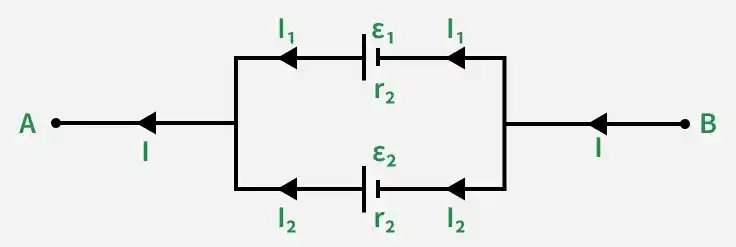
Total current in circuit: I = I_1 + I_2
Potential difference using first cell: V = \varepsilon_1 - I_1 r_1
Potential difference using second cell: V = \varepsilon_2 - I_2 r_2
Current through each cell:
- I_1 = \frac{\varepsilon_1 - V}{r_1}
- I_2 = \frac{\varepsilon_2 - V}{r_2}
Total current expression:
I = \frac{\varepsilon_1}{r_1} + \frac{\varepsilon_2}{r_2} - V\left(\frac{1}{r_1} + \frac{1}{r_2}\right)
Equivalent resistance (parallel):
\frac{1}{r_{eq}} = \frac{1}{r_1} + \frac{1}{r_2}
Simplified equivalent resistance:
r_{eq} = \frac{r_1 r_2}{r_1 + r_2}
Relation for equivalent emf:
\frac{\varepsilon_{eq}}{r_{eq}} = \frac{\varepsilon_1}{r_1} + \frac{\varepsilon_2}{r_2}
Equivalent emf formula
\varepsilon_{eq} = \frac{\varepsilon_1 r_2 + \varepsilon_2 r_1}{r_1 + r_2}
Equivalent resistance for n cells:
\frac{1}{r_{eq}} = \frac{1}{r_1} + \frac{1}{r_2} + \cdots + \frac{1}{r_n}
Equivalent emf for n cells:
\frac{\varepsilon_{eq}}{r_{eq}} = \frac{\varepsilon_1}{r_1} + \frac{\varepsilon_2}{r_2} + \cdots + \frac{\varepsilon_n}{r_n}
For identical cells:
r_{eq} = \frac{r}{n}
\varepsilon_{eq} = \varepsilon
Solved Problems
**Question 1: Batteries of 10V and 5 V are connected in series such that their emf's point in the same direction. Find the equivalent EMF for the system.
**Solution: The formula for equivalent series emf is given by,
Eeq = E1 + E2 + ...
Given: E1 = 10, E2 = 5
Substituting these values in the equation,
E = E1 + E2
⇒ E = 10 + 5
⇒ E = 15 V
**Question 2: Batteries of 10V and 5 V are connected in series such that their emf's point in the same direction. The internal resistances of the batteries are 2 and 10 ohms respectively. Find the equivalent resistance for the system.
**Solution: Equivalent resistance is also given by a similar equation,
req = r1 + r2
Given: r1 = 2, r2 = 10
substituting these values in the equation,
r = r1 + r2
⇒ r = 2 + 10
⇒ r = 12 ohms
**Question 3: Three batteries of internal resistances 2, 2, and 4 ohms are connected in parallel. Find the equivalent resistance for the system.
**Solution: The formula for equivalent resistance is given by,
\frac{1}{R} = \frac{1}{R_1} + \frac{1}{R_2} + \frac{1}{R_3} + ....
Given: R1 = 2, R2 = 2 and R3 = 4
Substituting these values in the equation,
⇒ \frac{1}{R} = \frac{1}{R_1} + \frac{1}{R_2} + \frac{1}{R_3}
Substitute
\frac{1}{R} = \frac{1}{2} + \frac{1}{2} + \frac{1}{4}
⇒ \frac{1}{2}+\frac{1}{2} = 1
\frac{1}{R} = 1 + \frac{1}{4} = \frac{5}{4}
⇒ R = \frac{4}{5}\,\Omega
**Question 4: Three batteries of internal resistances 5, 5 ohm, and 10, 10 V are connected in parallel. Find the equivalent resistance and emf for the system.
**Solution: Given
r₁ = 5 Ω, r₂ = 5 Ω, r₃ = 10 Ω
E₁ = 10 V, E₂ = 10 V, E₃ = 10 VEquivalent Resistance:
\frac{1}{R} = \frac{1}{5} + \frac{1}{5} + \frac{1}{10}
\frac{1}{R} = \frac{2}{5} + \frac{1}{10}
= \frac{4 + 1}{10} = \frac{5}{10} = \frac{1}{2}
R = 2\,\Omega
Equivalent EMF:
\frac{E_{eq}}{r_{eq}} = \frac{E_1}{r_1} + \frac{E_2}{r_2} + \frac{E_3}{r_3}
\frac{E_{eq}}{2} = \frac{10}{5} + \frac{10}{5} + \frac{10}{10}
\frac{E_{eq}}{2} = 2 + 2 + 1 = 5
E_{eq} = 10\,V
Unsolved Problems
**Question 1: Two batteries of 12 V and 8 V with internal resistances 3 Ω and 2 Ω are connected in series such that their EMFs point in the same direction. Find the equivalent EMF and equivalent internal resistance of the system.
**Question 2: Three resistors of 4 Ω, 6 Ω, and 12 Ω are connected in series. Find the equivalent resistance of the combination.
**Question 3: Two batteries of EMFs 9 V and 6 V with internal resistances 1 Ω and 3 Ω are connected in parallel. Find the equivalent EMF and equivalent resistance of the system.
**Question 4: Four resistors of 2 Ω, 4 Ω, 6 Ω, and 12 Ω are connected in parallel. Calculate the equivalent resistance of the combination.
**Question 5: Three batteries of EMFs 5 V, 10 V, and 15 V with internal resistances 2 Ω, 3 Ω, and 5 Ω are connected in series but in opposite directions (the second battery is reversed). Find the equivalent EMF and equivalent resistance of the system.