Conduction (original) (raw)
Last Updated : 30 May, 2026
Conduction is the mode of heat transfer in which thermal energy flows from a region of higher temperature to a region of lower temperature within a body or between bodies in direct contact, without any bulk movement of the medium. It occurs due to the transfer of energy through collisions and vibrations of neighboring particles and is most effective in solids where particles are closely packed.
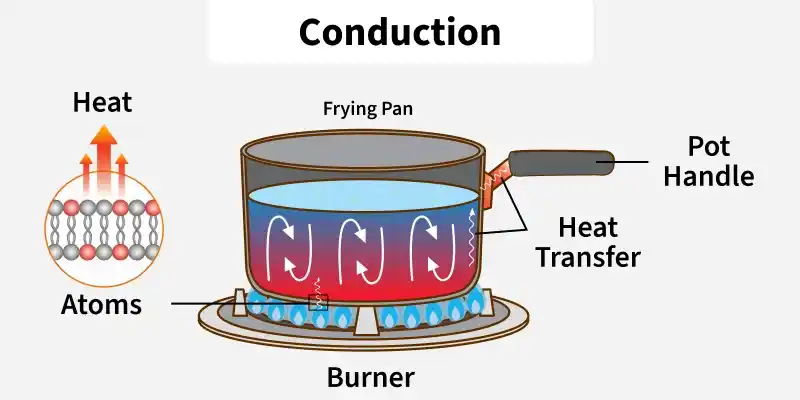
**Examples
- **Heating of water in a vessel: When water is heated in a vessel, the molecules near the bottom gain heat energy first and transfer it to neighboring molecules. This process continues, helping heat spread through the water.
- **Holding an ice cube: When we hold an ice cube, heat flows from our hand (higher temperature) to the ice (lower temperature). As a result, our hands feel cold due to heat loss by conduction.
- **Ironing of clothes: When clothes are ironed, heat is transferred from the hot iron to the fabric through conduction, which helps in removing wrinkles.
Types of Conduction
There are mainly two types of conduction of heat, namely,
1. Steady-State Conduction
Steady-state conduction refers to the condition in which the temperature at every point of a material remains constant with time, even though heat continues to flow through it. In this case, the rate of heat transfer remains constant. This occurs when the heat entering a system is equal to the heat leaving it, so there is no change in temperature with time.
2. Transient (Non-Steady-State) Conduction
Transient conduction occurs when the temperature of a material changes with time. It takes place when a system is not in thermal equilibrium, such as when heating or cooling starts. In this case, the temperature varies at different points within the material and also changes with time until steady-state is reached.
Fourier's Law
Fourier’s Law states that the rate of heat transfer through a material is directly proportional to the area of cross-section and the temperature gradient, and it occurs in the direction opposite to the temperature gradient.
It is mathematically represented as:
q \propto -A \frac{dT}{dx}
q = -kA \frac{dT}{dx}
where,
- q = rate of heat transfer (heat per unit time)
- A = cross-sectional area
- dT/dx = temperature gradient
- k = thermal conductivity of the material
Heat flows from higher to lower temperature; the negative sign indicates the opposite direction of the temperature gradient, and the rate depends on the material property (thermal conductivity (k)).
Thermal Conductivity
Thermal conductivity (k) is a property of a material that indicates how efficiently it can conduct heat. It is defined as the amount of heat conducted per second through a unit area of a material of unit thickness when the temperature difference between its faces is 1 K.
SI unit: W m⁻¹ K⁻¹
Factors Affecting Heat Conduction
- Cross-sectional Area (A): The rate of heat transfer is directly proportional to the cross-sectional area. A larger area allows more heat to flow through the material.
- Length (L): The rate of heat transfer is inversely proportional to the length (or thickness) of the material. A shorter length allows heat to transfer more quickly.
- Temperature Difference (ΔT): The rate of heat transfer is directly proportional to the temperature difference between the two ends. A greater temperature difference results in faster heat flow.
- Nature of Material (k): The rate of heat conduction depends on the thermal conductivity of the material. Materials with higher thermal conductivity transfer heat more efficiently.
Conduction (Thermal) Resistance
Conduction resistance, also known as thermal resistance, is the opposition offered by a material to the flow of heat through it. A material with high thermal resistance resists heat flow and behaves as an insulator, while a material with low thermal resistance allows heat to pass easily and behaves as a conductor.
Mathematically, thermal resistance is given by:
R = \frac{L}{kA}
where
- R = thermal resistance
- L = length (or thickness) of the material
- A = cross-sectional area
- k = thermal conductivity of the material
Classification of Material Based on Conductivity
Based on the conductivity of the substance, there are two types of substances:
Conductors: These are the substances that allow the heat energy to flow through them easily. They are called good conductors of heat or simply conductors. These substances offer low resistance to thermal conductivity. Some examples of conductors are copper, aluminum, iron, graphite, etc.
Insulators: These are the substances that do not allow the heat energy to flow through them easily. They are called bad conductors of heat or simply insulators. These substances offer high resistance to thermal conductivity. Some examples of insulators are- plastic, mica, air, wood, fabrics, etc.
Conduction, Convection and Radiation
Transfer of heat takes place via conduction, convection, and radiation. Difference between them is listed in the table given below:
| Parameter | Conduction | Convection | Radiation |
|---|---|---|---|
| Medium | Medium is required. | Medium is required. | Medium is not required; it can occur in vacuum. |
| Method of Heat Transfer | Transfer of heat takes place by direct physical contact. | Transfer of heat takes place my motion of particles. | Transfer of heat takes place by electromagnetic radiation. |
| Reason | Occurs due to difference in temperature between two substances. | Occurs due to difference in density between two substances. | Occurs at all bodies that have temperature above absolute zero (0K). |
| Process | It is slow process. | It is a faster process than conduction. | It is fastest process of all three modes. |
| Path of Heat Transfer | Path of transfer of heat is irregular. | Path of transfer of heat is irregular. | Path of the transfer of heat is linear. |