Conductors and Insulators (original) (raw)
Last Updated : 27 May, 2026
A metal rod rubbed with wool while held in the hand does not show signs of charging because the charge flows through the body to the ground. However, if the metal rod has a wooden or plastic handle and is rubbed without touching the metal part, it becomes charged. In another experiment, when a copper wire connects a negatively charged plastic rod to a neutral pith ball, the pith ball acquires a negative charge. But when a nylon thread or rubber band is used instead of copper wire, no charge is transferred.
Conductors
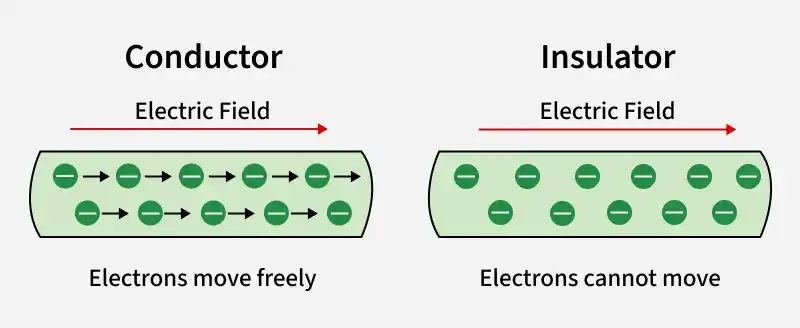
Materials that allow electric charges to move freely are called **conductors, such as metals, the human body, and the earth. Earthing is an important safety measure in electrical systems. A metal plate buried in the ground is connected to appliances through an earth wire. If a fault occurs or a live wire touches the metallic body of an appliance, the charge flows safely to the earth, preventing damage and protecting people from electric shock.
**Applications
Conductors are quite handy in a variety of situations. They're useful in a variety of situations. As an example,
- Mercury is a frequent component of thermometers used to measure body temperature.
- Aluminum is used in the manufacture of food-storage foils. It's also used to make fry pans that can hold heat for a long time.
- Iron is a typical heat-conducting material used in car engine production.
- The iron plate is made of steel to quickly absorb heat.
- Conductors are used in automobile radiators to transfer heat away from the engine.
**Examples
- Silver is the best conductor of electricity, but it is rarely used because it is expensive.
- Copper, brass, steel, gold, and aluminium are good conductors and are commonly used as wires in electric circuits and systems.
- Mercury is a good conductor in liquid form and is used in various scientific instruments.
- Gases are generally poor conductors of electricity because their atoms are far apart, making it difficult for electrons to flow.
Insulators
Most non-metals such as glass, porcelain, plastic, nylon, and wood resist the flow of electricity and are called **insulators. In these materials, electrons cannot move freely, so if a charge is placed on their surface it remains at the same spot and does not spread. Insulators can be charged by methods such as **rubbing (friction) or **induction.
In contrast, when a charge is given to a conductor it spreads quickly over the entire surface. However, in an insulator the charge stays fixed. This is why a nylon or plastic comb becomes charged when rubbed with dry hair, while a metal comb does not, because the charge on metal flows through our body to the ground since both the human body and the earth are conductors.
**Applications
- **Thermal Insulators: Prevent heat transfer from one place to another. They are used in thermoplastic bottles and for fireproofing walls and ceilings.
- **Sound Insulators: Absorb sound and help control noise levels, so they are used in buildings and conference halls.
- **Electrical Insulators: Prevent the flow of electric current and are used in circuit boards, high-voltage systems, and as coatings for electric wires and cables.
**Examples
- Glass has very high resistivity, so it acts as a good insulator.
- Plastic is also a good insulator and is used to make many everyday items.
- Rubber is an excellent insulator and is commonly used in tyres, fire-resistant clothing, and shoes.
**Conductors vs Insulators
| Conductor | Insulators |
|---|---|
| A conductor is a material that permits current to flow freely through it. | Insulators prevent current from flowing through them. |
| Electric charge exists on the surface of conductors. | Electric charges are absent in the insulator. |
| Conductors don’t store energy when kept in a magnetic field. | Insulators store energy when kept in a magnetic field. |
| The thermal conductivity ( heat allowance) of a conductor is very high. | The thermal conductivity of an insulator is very low. |
| The resistance of a conductor is very low. | The resistance of the insulator is very high. |
Sample Questions
**Question 1: Find the charge on a body that has 5 × 10¹² excess electrons.
**Solution: Charge on one electron
e = 1.6 \times 10^{-19} \, C
Number of electrons
n = 5 \times 10^{12}
\text{Q = ne}
Substitute the values
Q = (5 \times 10^{12})(1.6 \times 10^{-19})
Q = 8 \times 10^{-7} \, C
Since electrons carry negative charge
Q = -8 \times 10^{-7} \, C
**Question 2: How many electrons must be removed from a neutral body to produce a charge of 3.2 × 10 -9 C.
**Solution: Charge of one electron
e = 1.6 \times 10^{-19} \, C
Total charge
Q = 3.2 \times 10^{-9} \, C
n = \frac{Q}{e}
Substitute the values
n = \frac{3.2 \times 10^{-9}}{1.6 \times 10^{-19}}
n = 2 \times 10^{10}
Thus 2 \times 10^{10} electrons must be removed.
**Question 3: Two charges of 2 C and 3 C are placed 2 m apart. Find the electrostatic force between them.
**Solution: Coulomb's Law
F = k \frac{q_1 q_2}{r^2}
Where
k = 9 \times 10^9 \, Nm^2/C^2
q_1 = 2\,C
q_2 = 3\,C
r = 2\,m
Substitute the values
F = 9 \times 10^9 \times \frac{(2)(3)}{(2)^2}
F = 9 \times 10^9 \times \frac{6}{4}
F = 1.35 \times 10^{10} \, N
Unsolved Problems
**Question 1: A body gains 5 × 10¹² electrons. Calculate the total charge on the body. (Charge of one electron = 1.6 × 10⁻¹⁹ C)
**Question 2: Two point charges of 2 C and 5 C are placed 4 m apart in vacuum. Calculate the electrostatic force between them.
_(k = 9 × 10⁹ N m²/C²)
**Question 3: How many electrons must be removed from a body to produce a charge of 6.4 × 10⁻⁹ C? (Charge of one electron = 1.6 × 10⁻¹⁹ C)
**Question 4: Two charges 3 C and 7 C are placed 5 m apart. Find the force between them using Coulomb’s law.