Critical Velocity Formula (original) (raw)
Last Updated : 30 May, 2026
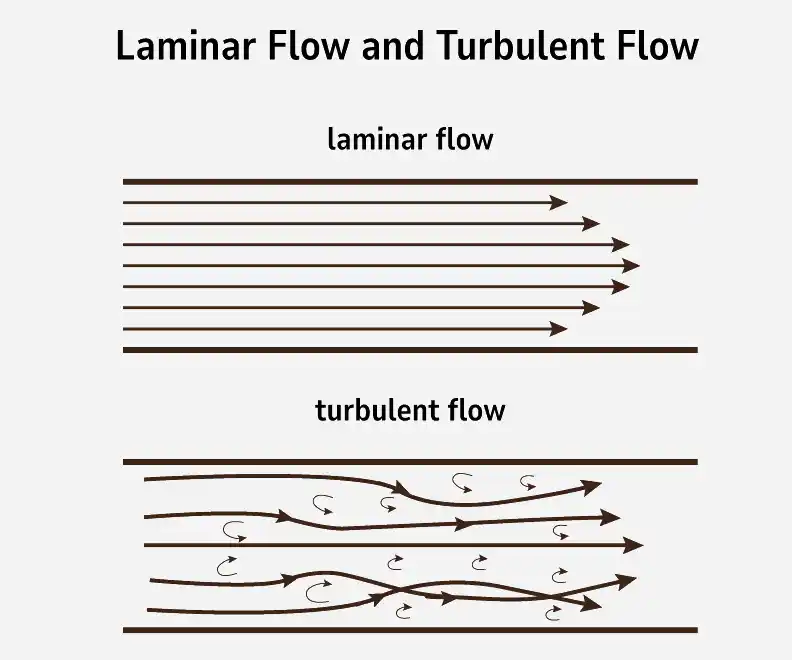
Critical velocity is the maximum velocity of a fluid at which the flow remains smooth and streamlined (laminar). Beyond this velocity, the flow becomes turbulent and irregular.
The concept of critical velocity is important in fluid mechanics because it helps determine the conditions under which the nature of fluid flow changes.
Formula
v_c = \frac{Re \cdot \eta}{\rho \, r}
Where:
- vc is the critical velocity
- Re is the Reynolds number (ratio of inertial force to viscous force)
- η is the coefficient of viscosity of the fluid
- ρ is the density of the fluid
- r is the radius of the tube
Critical velocity is directly proportional to viscosity and inversely proportional to the density of the fluid and the radius of the tube. This means fluids with higher viscosity can maintain smooth (laminar) flow at higher speeds, while higher density or larger tube radius make the flow more likely to become turbulent. It is important in applications like pipeline design and blood flow in arteries, where maintaining smooth flow is necessary.
Sample Problems
**Problem 1. Calculate the critical velocity of a fluid flowing through a tube of radius 2 m. The density and coefficient of viscosity of the fluid are 1.5 kg/m 3 and 2 kg/ms respectively. The value of Reynolds number is 1500.
**Solution:
We have,
Re = 1500
η = 2
ρ = 1.5
r = 2
Using the formula we get,
Vc = Reη / ρr
= (1500) (2)/ (1.5) (2)
= 3000/3
= 1000 m/s
**Problem 2. Calculate the critical velocity of a fluid flowing through a tube of radius 3 m. The density and coefficient of viscosity of the fluid are 2 kg/m 3 and 1.5 kg/ms respectively. The value of Reynolds number is 2000.
**Solution:
We have,
Re = 2000
η = 1.5
ρ = 2
r = 3
Using the formula we get,
Vc = Reη / ρr
= (2000) (1.5)/ (2) (3)
= 3000/6
= 500 m/s
**Problem 3. Calculate the Reynolds number of a fluid flowing through a tube of radius 1 m. The density and coefficient of viscosity of the fluid are 3 kg/m 3 and 4 kg/ms respectively. The value of critical velocity is 300 m/s.
**Solution:
We have,
Vc = 300
η = 4
ρ = 3
r = 1
Using the formula we get,
Vc = Reη / ρr
=> 300 = Re (4) / (3) (1)
=> Re = 900/4
=> Re = 225
**Problem 4. Calculate the Reynolds number of a fluid flowing through a tube of radius 3 m. The density and coefficient of viscosity of the fluid are 5 kg/m 3 and 2 kg/ms respectively. The value of critical velocity is 400 m/s.
**Solution:
We have,
Vc = 400
η = 2
ρ = 5
r = 3
Using the formula we get,
Vc = Reη / ρr
=> 400 = Re (2) / (5) (3)
=> Re = 6000/2
=> Re = 3000
**Problem 5. Calculate the viscosity coefficient of a fluid flowing through a tube of radius 4 m. The density and Reynolds number of the fluid are 5 kg/m 3 and 2800 respectively. The value of critical velocity is 200 m/s.
**Solution:
We have,
Vc = 200
Re = 2800
ρ = 5
r = 4
Using the formula we get,
Vc = Reη / ρr
=> 200 = (2800) η / (5) (4)
=> η = 4000/2800
=> η = 1.42 kg/ms
Unsolved Problems
**Question 1: Calculate the critical velocity of a fluid flowing through a tube of radius 2.5 m. The density of the fluid is 1.2 kg/m 3 , coefficient of viscosity is 1.8 kg/ms, and Reynolds number is 1800.
**Question 2: A fluid flows through a pipe of radius 4 m. If the Reynolds number is 2000, density is 2.5 kg/m 3 , and critical velocity is 600 m/s, find the coefficient of viscosity.
**Question 3:
Find the Reynolds number of a fluid flowing in a pipe of radius 3 m, where the critical velocity is 450 m/s, density is 3.5 kg/m 3 ****, and coefficient of viscosity is 2.1 kg/ms.**
**Question 4: A fluid has density 4 kg/m 3 ****, viscosity 3 kg/ms, and Reynolds number 2500. If its critical velocity is 500 m/s, find the radius of the tube.**
**Question 5: Two fluids flow through identical tubes of radius 2 m. Fluid A has density 2 kg/m 3 and viscosity 1 kg/ms, while Fluid B has density 3 kg/m 3 and viscosity 2 kg/ms. If both have the same Reynolds number, compare their critical velocities.