Difference Between Kinematic and Dynamic Viscosity (original) (raw)
Last Updated : 25 May, 2026
Viscosity is a measure of a fluid’s resistance to deformation or flow. It represents the internal friction between layers of a fluid moving relative to each other.
Liquids with higher viscosity, such as syrup, flow more slowly than low-viscosity liquids like water. When a fluid flows through a tube, it moves faster at the center and slower near the walls due to friction. To maintain steady flow, a pressure difference is required to overcome this internal friction, which depends on the viscosity of the fluid.
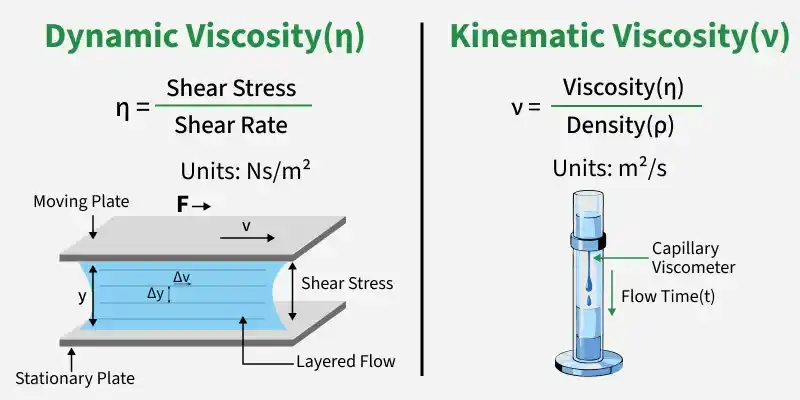
1. Kinematic Viscosity
Kinematic viscosity measures a fluid’s resistance to flow under the influence of gravity. It is denoted by ( \nu ) and is defined as the ratio of dynamic viscosity to density. It represents both viscous and inertial effects in fluid flow. Kinematic viscosity is also called momentum diffusivity. It is commonly measured using a viscometer at a constant temperature. The SI unit of kinematic viscosity is ( m2/sec ).
**ν = μ/ρ
where,
- ν = kinematic viscosity
- μ = dynamic viscosity
- ρ = density
2. Dynamic Viscosity
Dynamic viscosity is the resistance that occurs when one layer of fluid moves over another. It represents the viscous force within a fluid and is denoted by the symbol ( η ). Higher viscosity means the fluid is thicker and flows more slowly. Viscosity is affected by temperature—generally decreasing with increasing temperature in liquids and increasing with temperature in gases. Dynamic viscosity is also called absolute viscosity and its SI unit is Ns/m² (or Pa·s).
**η = τ/γ
**where,
- η = Dynamic Viscosity
- τ = Shearing stress
- γ= Shear rate
**Kinematic vs Dynamic Viscosity
| **Kinematic Viscosity | **Dynamic Viscosity |
|---|---|
| Inertia and viscous force are both represented by kinematic viscosity. | The viscous force of the fluid is represented by dynamic viscosity. |
| Its symbol is ν. | Its symbol is η. |
| It is the dynamic viscosity to density ratio. | It is the shear stress to shear strain ratio. |
| Kinematic viscosity density is dependent on density. | Dynamic viscosity density is independent. |
| Kinematic viscosity is a fundamental property. | Dynamic viscosity is a derived property. |
| The unit is m2/s. | The unit is Ns/m2. |
| It is also called the diffusivity of momentum. | It is also called absolute viscosity. |
Solved Problems
**Problem 1: A fluid with an absolute viscosity of 0.98 Ns/m and2 and a kinematic viscosity of 3 m2/s. How can you calculate a fluid's density?
**Solution: Given,
ν = 3 m2/s
μ = 0.098 Ns/m2
Using the Kinematic Viscosity Formula,
ν= μ/ρ
Substituting values in the equation,
ρ = ν/μ
= 3/0.98
= 3.0612 kg/m3
So, the density of fluid is 3.0612 kg/m3.
**Problem 2: Calculate the density of a fluid with a kinematic viscosity of 2 m²/s2/s and absolute viscosity of 0.89 Ns/m2.
**Solution: Given,
ν = 2 m2/s
μ = 0.89 Ns/m2
Using Kinematic Formula,
ν = μ/ρ
Substituting values in the equation,
ρ = ν/μ
= 2/0.89
= 0.445 kg/m3
So, the density of a fluid is 0.445 kg/m3.
**Problem 3: With a shear rate of 0.35 s⁻¹-1 and dynamic viscosity of 0.018 Pa s, what pressure is necessary to move a plane of fluid?
**Solution: Given,
Shear rate γ = 0.35 s-1
dynamic viscosity η = 0.018 Pa s
Using the Dynamic Viscosity Formula,
η = τ /γ
Substituting values in the given equation,
τ = η×γ
= (0.018 ×0.35)
= 0.0063 Pa
So, the pressure required is 0.0063 Pa
**Problem 4: With a shear rate of 0.35 s⁻¹-1 and dynamic viscosity of 0.018 Pa s, what pressure is necessary to move a plane of fluid?
- Water: 1 Pa s
- Air: 0.018 Pa s
- Mercury: 1.526 Pa s
**Solution: Given,
Shearing stress τ = 0.76 N/m2
Shearing rate γ = 0.5 s-1
Using Dynamic Viscosity Formula,
η = τ /γ
= 0.76/0.5
= 1.52 Pa s
Therefore, the fluid corresponds to 1.52 Pa s.